
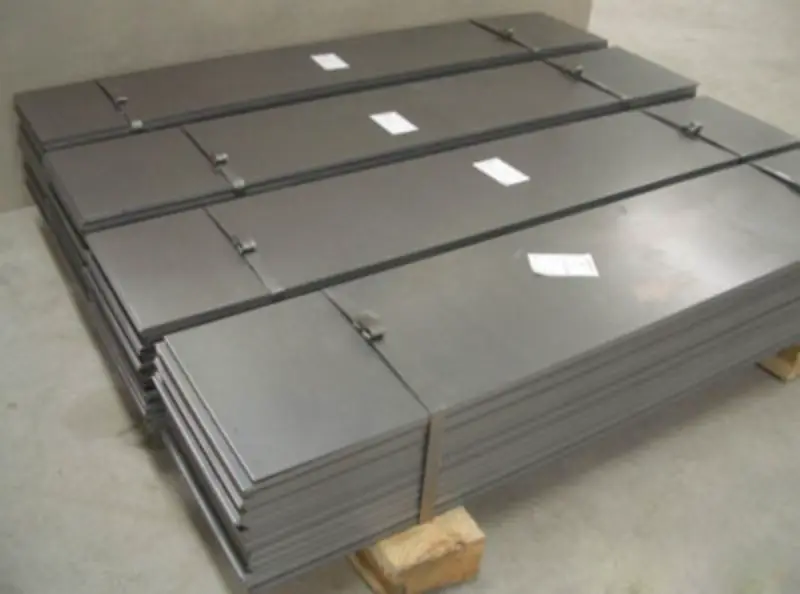
BV Grade A Shipbuilding Steel Plate
BV Grade A Shipbuilding Steel Plate: Properties, Equivalents & Applications
Comprehensive data on BV Grade A shipbuilding steel: chemical composition, mechanical and physical properties, equivalent grades, and typical applications.
Welding, cutting, cold/hot forming, bending, machining
- Phone : +8618037372205
- Email : [email protected]
- WhatsApp: Contact via Whtsapp
- WeChat: +8618037372205
BV Grade A Shipbuilding Steel Plate Introduction
BV Grade A is an ordinary strength hull structural steel specified by Bureau Veritas (BV) for marine and offshore applications. It is designed for use in welded ship hulls and other marine structures. The steel offers a minimum yield strength of 235 MPa and good toughness at 0°C, with excellent weldability and formability. It is produced as plates, sheets, profiles, and bars, typically delivered in normalized, controlled rolled, or TMCP condition.
- Good strength and ductility
- Reliable impact properties at 0°C
- Widely accepted by all major classification societies
- Suitable for cold forming and welding
BV Grade A Shipbuilding Steel Plate Chemical Composition
The chemical composition of BV Grade A steel is controlled to ensure adequate strength, toughness, and weldability. Carbon is limited to maintain good weldability, while manganese provides strength. Phosphorus and sulfur are kept low to avoid brittleness. Grain refining elements such as aluminium may be added. The values below are based on BV Rules and IACS UR W11.
| Element | Standard Value (wt%) | Remarks |
|---|---|---|
| C | ≤0.21 | Carbon content |
| Mn | ≥2.5×C (typically 0.80–1.20) | Manganese content |
| Si | 0.10–0.50 | Silicon content |
| P | ≤0.035 | Phosphorus content |
| S | ≤0.035 | Sulfur content |
| Al (acid soluble) | ≥0.015 (if grain refined) | Optional, for fine grain practice |
BV Grade A Shipbuilding Steel Plate Thermal and Electrical Physical Properties
The typical physical properties provided below are based on carbon‑manganese steel with a similar composition to BV Grade A. Actual values may vary slightly depending on exact chemistry and processing. These data are intended for design guidance and are not specified by the BV standard.
| Property | Typical Value | Unit | Condition |
|---|---|---|---|
| Density (ρ) | 7.85 | g/cm³ | Room temperature |
| Elastic Modulus (E) | 205 | GPa | Room temperature |
| Shear Modulus (G) | 79 | GPa | Estimated from E and ν |
| Poisson's Ratio (ν) | 0.30 | — | |
| Thermal Expansion Coefficient (α) | 12.1 | 10⁻⁶/K | 20–100 °C |
| Thermal Conductivity (λ) | 50 | W/(m·K) | Room temperature |
| Specific Heat Capacity (c) | 460 | J/(kg·K) | Room temperature |
| Electrical Resistivity (ρₑ) | 0.16 | μΩ·m | Room temperature |
BV Grade A Shipbuilding Steel Plate Mechanical Properties
Mechanical properties are determined on standard test specimens. The values depend on product thickness and test direction. The requirements below are for longitudinal specimens from plates ≤50 mm (except where noted). BV Grade A meets the IACS UR W13 requirements for ordinary strength hull steel. Bending tests must be free from cracks.
| Property | Specified Value | Unit | Test Condition |
|---|---|---|---|
| Yield Strength (ReH) | ≥235 | MPa | Thickness ≤100 mm |
| Tensile Strength (Rm) | 400–520 | MPa | Thickness ≤100 mm |
| Elongation (A) | ≥22 (long.) | % | Gauge length 5.65√S₀; thickness ≤50 mm |
| Bending Test | 180°, no cracks | — | Mandrel diameter: 2t (t≤20 mm), 3t (t>20 mm) |
| Charpy V‑notch Impact Energy (KV₂) | ≥27 (long.) | J | Test temperature 0 °C |
BV Grade A Shipbuilding Steel Plate Fully Equivalent Grades from Other Classification Societies
| Country/Region | Standard/Society | Grade | Remark |
|---|---|---|---|
| International | IACS UR W11 / W13 | Ordinary Strength Grade A | Common requirements for all IACS members |
| USA | ABS Rules | ABS Grade A | American Bureau of Shipping |
| Norway / Germany | DNV GL Rules (now DNV) | DNV Grade A | DNV classification |
| UK | LR Rules | LR Grade A | Lloyd's Register |
| Japan | NK Rules | NK Grade A | ClassNK |
| Italy | RINA Rules | RINA Grade A | Registro Italiano Navale |
| South Korea | KR Rules | KR Grade A | Korean Register |
| China | CCS Rules | CCS Grade A | China Classification Society |
BV Grade A Shipbuilding Steel Plate Application Introduction
BV Grade A steel is widely used in the shipbuilding industry for the construction of hulls and marine equipment. Its balanced properties make it suitable for large, welded fabrications that require reliable strength and toughness at ambient and low temperatures. Key application areas and products are listed below.
Product Applications: Bulk carriers, Oil tankers, Container ships, Fishing vessels, Inland waterway barges, Workboats and tugs
Processed into products: Shell plates (side and bottom), Deck plates, Bulkhead plating, Longitudinal stiffeners, Transverse web frames, Hatch coamings and girders, Rudder horns and stern frames (subject to thickness limits), Foundations for deck machinery
Application industries: Shipbuilding, Offshore engineering, Barge and floating structure construction, Marine repair and conversion
BV Grade A Shipbuilding Steel Plate Similar / Alternative Materials
| Country/Region | Standard | Grade | Remark |
|---|---|---|---|
| USA | ASTM A131/A131M | Grade A | Ordinary strength shipbuilding steel; similar chemical and mechanical requirements |
| EU | EN 10025-2 | S235JR | Structural steel with comparable strength; impact properties at 20 °C (may need additional testing for marine use) |
| Japan | JIS G3106 | SM400A | Welded structural steel; min. yield 245 MPa; impact not specified (evaluate for marine conditions) |
| International | ISO 630-2 | S235B | Structural steel, impact tested at +20 °C; similar strength level |
Notes:
BV Grade A exhibits good weldability with common processes such as SMAW, SAW, and GMAW. Preheating may be required for thick sections or when welding under low ambient temperatures. The steel is supplied with full classification society stamping and certification, ensuring traceability and compliance with BV Rules. Supplementary ultrasonic testing and other inspections can be ordered as per BV requirements.
- Share



