
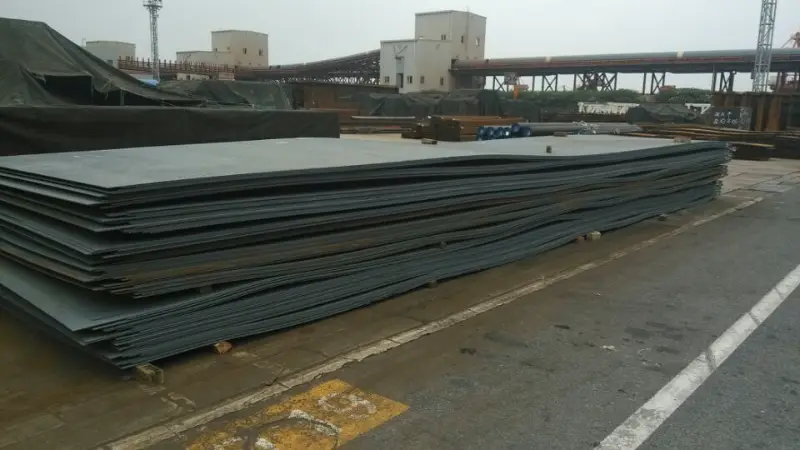
BV Grade B Shipbuilding Steel Plate
BV Grade B Shipbuilding Steel Plate: Properties, Equivalents and Applications
Detailed material data for BV Grade B shipbuilding steel plate including chemical composition, mechanical and physical properties, international equivalents and application guidance, all conforming to Bureau Veritas rules and IACS UR W11.
Hot rolling, normalizing, welding, cutting, forming, cold bending
- Phone : +8618037372205
- Email : [email protected]
- WhatsApp: Contact via Whtsapp
- WeChat: +8618037372205
BV Grade B Shipbuilding Steel Plate Introduction
BV Grade B is a normal strength hull structural steel plate certified by Bureau Veritas (BV), one of the leading classification societies. It complies with the BV Rules for the Classification of Steel Ships and the IACS Unified Requirement W11. Designed for primary hull structures of seagoing vessels, it offers a minimum yield strength of 235 MPa, good weldability and reliable notch toughness at 0°C. The grade is produced via fully killed fine-grain practice and delivered in normalized or as-rolled condition depending on thickness. It is widely used in ship frames, decks, bulkheads and offshore structures, providing an optimum balance of strength, ductility and cost-effectiveness.
BV Grade B Shipbuilding Steel Plate Chemical Composition
The ladle analysis limits for BV Grade B conform to IACS UR W11 and BV Rules. The steel is fully killed and fine-grain treated. Carbon equivalent (CEV) is commonly controlled to ensure weldability. Grain-refining elements such as Al, Nb, V, or Ti may be added individually or in combination. Any intentional addition of boron is not permitted.
| Element | Nominal Value (max. unless specified) | Remarks |
|---|---|---|
| C (Carbon) | 0.21% | Ladle analysis |
| Mn (Manganese) | ≥ 2.5 × C, min. 0.60% | Besides carbon, usual range 0.60–1.50% |
| Si (Silicon) | ≤ 0.50% | Deoxidation element |
| P (Phosphorus) | ≤ 0.035% | Low phosphorus for improved toughness |
| S (Sulfur) | ≤ 0.035% | Low sulfur for better formability and welding |
| Al (Aluminum, acid soluble) | ≥ 0.015% | Grain refinement (if Al is used as the refining element) |
| Nb (Niobium) | 0.02–0.05% (if added) | Optional grain refiner |
| V (Vanadium) | 0.05–0.10% (if added) | Optional grain refiner |
| Ti (Titanium) | ≤ 0.02% (if added) | Optional grain refiner |
| Cr (Chromium) | ≤ 0.20% | Residual element |
| Ni (Nickel) | ≤ 0.40% | Residual element |
| Mo (Molybdenum) | ≤ 0.08% | Residual element |
| Cu (Copper) | ≤ 0.35% | Residual element |
BV Grade B Shipbuilding Steel Plate Physical Properties
Physical constants given below are typical for low-carbon structural steel and apply approximately to BV Grade B. They are not mandatory requirements but serve as engineering references for design calculations. Thermal expansion is linear between 20°C and 100°C. Thermal conductivity decreases slightly with temperature. Electrical resistivity is measured at room temperature. Density assumes standard composition.
| Property | Typical Value (approx.) | Unit | Condition / Temperature |
|---|---|---|---|
| Density (ρ) | 7850 | kg/m³ | Room temperature |
| Elastic Modulus (E) | 205 | GPa | Room temperature |
| Shear Modulus (G) | 80 | GPa | Calculated from E and ν |
| Poisson's Ratio (ν) | 0.30 | — | Room temperature |
| Thermal Expansion Coefficient (α) | 11.9 | ×10⁻⁶/K | 20 – 100°C |
| Thermal Conductivity (λ) | 51.9 | W/(m·K) | At 20°C |
| Specific Heat Capacity (cₚ) | 486 | J/(kg·K) | At 20°C |
| Electrical Resistivity (ρₑ) | 0.15 | µΩ·m | At 20°C |
BV Grade B Shipbuilding Steel Plate Mechanical Properties
Mechanical properties are determined on test specimens taken in the transverse direction for plates or in the longitudinal direction for flats and sections, as per BV Rules. Yield strength (ReH) and tensile strength (Rm) are guaranteed for thicknesses ≤100 mm. Elongation is measured on a gauge length of 5.65√S₀. Impact energy (KV) is the standard Charpy V-notch test at 0°C, minimum 27 J longitudinal. The bend test mandates a mandrel diameter of 3t for thicknesses ≤50 mm (180° bend).
| Property | Specification Value | Unit | Test Conditions |
|---|---|---|---|
| Yield Strength (ReH) | ≥ 235 | MPa | Transverse, t ≤ 100 mm |
| Tensile Strength (Rm) | 400 – 520 | MPa | Transverse, t ≤ 100 mm |
| Elongation (A) on 5.65√S₀ | ≥ 22 | % | Transverse, t ≤ 50 mm |
| Elongation (A) on 5.65√S₀ | ≥ 22 (depends on thickness reduction factor) | % | t > 50 mm to 100 mm (reduced by 0.5% per 12.5 mm increment) |
| Charpy V-notch Impact (KV) — Longitudinal | ≥ 27 | J | 0°C, average of 3 specimens |
| Charpy V-notch Impact (KV) — Transverse | ≥ 20 (if specified) | J | 0°C, average of 3 specimens |
| Bend Test (180°) | No cracks | — | Mandrel diameter = 3 × thickness (t ≤ 50 mm) |
| Bend Test (180°) | No cracks | — | Mandrel diameter = 4 × thickness (t > 50 mm to 100 mm) |
BV Grade B Shipbuilding Steel Plate Fully Equivalent Material Standards and Replacement Grades
| Country / Region | Standard / Classification Society | Grade | Remarks |
|---|---|---|---|
| International | IACS UR W11 | Grade B | Direct equivalent recognized by all IACS members |
| USA | ABS (American Bureau of Shipping) | Grade B | Identical requirements |
| UK | LR (Lloyd's Register) | Grade B | Identical requirements |
| Norway / Germany | DNV (Det Norske Veritas) | B | Identical requirements |
| China | CCS (China Classification Society) | B | Identical requirements |
| Japan | NK (ClassNK) | B | Identical requirements |
| South Korea | KR (Korean Register) | B | Identical requirements |
| Italy | RINA (Registro Italiano Navale) | B | Identical requirements |
| Russia | RS (Russian Maritime Register of Shipping) | B | Identical requirements |
| Croatia | CRS (Croatian Register of Shipping) | B | Identical requirements |
BV Grade B Shipbuilding Steel Plate Application Introduction
BV Grade B steel plate is a primary material for ship and offshore structural engineering. Its good weldability, reliable low-temperature toughness, and moderate strength make it suitable for a broad range of structural components. Typical design and fabrication follow BV classification rules and IACS recommendations. The steel can be cut, bent, and welded using common marine fabrication practices. It is generally used in environments with ambient temperatures not below 0°C unless additional low-temperature testing is agreed. The following are key application areas:
Product Applications: Seagoing cargo ships (bulk carriers, container ships, tankers), Ro-Ro vessels and ferries, Offshore platform topsides and jacket structures, Hull reinforcements and shell plating, Ship hatch covers and coamings, Structural pipes and hollow sections for marine use
Processed into products: Main deck plating, Bottom shell and side shell plates, Transverse and longitudinal bulkheads, Frames, floors and girders, Keels and stem/stern frames (when approved for thickness), Brackets and stiffeners, Web frames and stringers, Collision bulkhead plating
Application industries: Shipbuilding and repair yards, Offshore oil & gas platform fabrication, Marine engineering and dredging equipment, Barge and inland waterway vessel construction, Structural steelwork for port/crane applications where BV certification is required
BV Grade B Shipbuilding Steel Plate Similar or Closely Related Materials for Comparison
| Country / Region | Standard | Grade | Analysis / Remarks |
|---|---|---|---|
| International | ASTM A131 / A131M | Grade B | Similar chemistry and mechanical properties, also used in marine construction; often dual-certified |
| Europe | EN 10025-2 | S235JRG2 (former Fe 360 B) | Similar yield strength but not a direct shipbuilding grade; impact test temperature differs and CEV may be higher |
| China | GB 712 | B | Similar normal strength hull structural steel, equivalent usage but verify CCS approval |
| Russia | GOST 5521 | B (Ст3сп) | Comparable strength, but may have variations in impact testing and deoxidation practice |
Notes:
Special requirements: Higher low-temperature impact testing (e.g., -20°C) or through-thickness (Z-direction) properties can be agreed upon. Ultrasonic testing per BV rules may be specified. Weldability is assured by CEV typically ≤0.38 (ladle analysis), but the exact value is subject to the product analysis. For plates intended for cold forming, the steel shall be free from internal defects. If copper-bearing steel is supplied for enhanced corrosion resistance, an additional marking 'Cu' is applied.
- Share



