
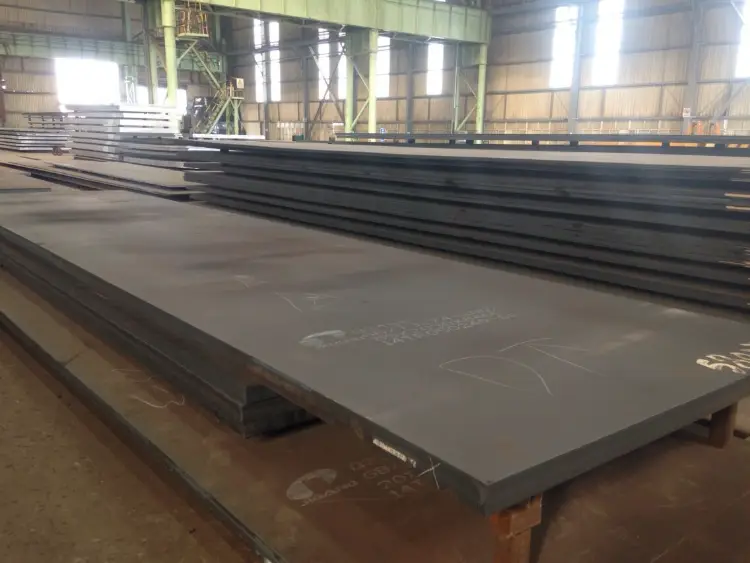
BV Grade D Shipbuilding Steel Plate
BV Grade D Shipbuilding Steel Plate: Properties, Equivalents & Applications
Comprehensive technical data for BV Grade D normal strength hull structural steel plate, including chemical composition, mechanical and physical properties, international equivalents and similar alternatives.
Hot rolling, normalizing, TMCP, cutting, welding, bending
- Phone : +8618037372205
- Email : [email protected]
- WhatsApp: Contact via Whtsapp
- WeChat: +8618037372205
BV Grade D Shipbuilding Steel Plate Introduction
BV Grade D is a normal strength shipbuilding steel plate certified by Bureau Veritas (BV) for marine applications. It complies with the BV Rules for the Classification of Steel Ships and the IACS UR W11 unified requirements. This grade is designed for primary hull structures requiring guaranteed impact toughness at -20°C. As a low-carbon, manganese-silicon killed steel, it offers excellent weldability, good cold-forming characteristics and reliable performance in the as-rolled, normalized or thermomechanically controlled processed condition. Key attributes include:
- Minimum yield strength of 235 MPa
- Tensile strength in the range 400–520 MPa
- Longitudinal Charpy V-notch energy of at least 27 J at -20°C
- Fine-grain practice through aluminum or other grain refiners
It is widely used in hull plates, decks, bulkheads and stiffeners for ships, barges and offshore structures.
BV Grade D Shipbuilding Steel Plate Chemical Composition
The chemical composition of BV Grade D steel is specified according to BV Rules and IACS UR W11. This grade is a fully killed, fine-grain steel. Aluminum is usually added as a grain refiner; alternative grain-refining elements such as niobium, vanadium or titanium may be used singly or in combination, subject to agreement. Residual elements are normally not limited except when specified for special services. All values are maximum unless a range is stated.
| Element | Standard Value | Remarks |
|---|---|---|
| Carbon (C) | ≤0.21 | Ladle analysis |
| Manganese (Mn) | ≥0.60 | Ladle analysis; also see note below |
| Silicon (Si) | ≤0.35 | Ladle analysis |
| Phosphorus (P) | ≤0.035 | Ladle analysis |
| Sulfur (S) | ≤0.035 | Ladle analysis |
| Aluminum (acid soluble) | ≥0.015 | When used as grain-refining element; total Al ≥0.020 is also acceptable |
BV Grade D Shipbuilding Steel Plate Physical Properties
The following physical properties are typical for low-carbon manganese structural steel and are not part of the BV Grade D specification. They are provided for design and engineering reference. Actual values may differ slightly depending on the exact chemical composition and processing route. All values are measured at room temperature unless stated otherwise.
| Property | Typical Value | Unit | Test Conditions |
|---|---|---|---|
| Density (ρ) | 7.85 | g/cm³ | Room temperature |
| Elastic modulus (E) | 210 | GPa | Room temperature |
| Shear modulus (G) | 80 | GPa | Typical value |
| Poisson's ratio (ν) | 0.3 | — | Typical value |
| Thermal expansion coefficient (α) | 11.7 | 10−6/K | 20–100°C |
| Thermal conductivity (λ) | 51.9 | W/(m·K) | Room temperature |
| Specific heat capacity | 486 | J/(kg·K) | Room temperature |
| Electrical resistivity (ρe) | 0.17 | μΩ·m | Room temperature |
BV Grade D Shipbuilding Steel Plate Mechanical Properties
Mechanical testing is performed in accordance with BV Rules and IACS UR W11. Tensile specimens are taken transverse or longitudinal, typically longitudinal for grade D. Impact tests are carried out on longitudinal Charpy V-notch specimens at -20°C. Elongation values are referred to a gauge length of 5.65√So. Bend test pieces are subjected to 180° bending without cracking. Values may vary depending on product thickness.
| Property | Required Value | Unit | Test Conditions |
|---|---|---|---|
| Yield strength (ReH) | ≥235 | MPa | Transverse or longitudinal, all thicknesses |
| Tensile strength (Rm) | 400–520 | MPa | Transverse or longitudinal, all thicknesses |
| Elongation (A5) | ≥22 | % | Thickness ≤50 mm |
| Elongation (A5) | ≥20 | % | Thickness 50 < t ≤70 mm |
| Elongation (A5) | ≥19 | % | Thickness 70 < t ≤100 mm |
| Bend test (180°) | d=2a | — | Thickness ≤25 mm |
| Bend test (180°) | d=3a | — | Thickness 25 < t ≤35 mm |
| Impact energy (KV2) | ≥27 | J | Longitudinal, -20°C, standard 10×10 mm specimen |
BV Grade D Shipbuilding Steel Plate Exact International Equivalents to BV Grade D
| Country / Region | Standard / Rule | Grade | Remarks |
|---|---|---|---|
| International | IACS UR W11 | D | Unified requirement for normal strength hull structural steel |
| United States | ASTM A131 / ABS Rules | Grade D | American Bureau of Shipping |
| China | CCS Rules | CCS D | China Classification Society |
| Norway / Germany | DNV Rules | DNV D | Det Norske Veritas (now DNV GL) |
| United Kingdom | LR Rules | LR D | Lloyd's Register |
| Japan | NK Rules | NK D | ClassNK (Nippon Kaiji Kyokai) |
| Italy | RINA Rules | RINA D | Registro Italiano Navale |
| South Korea | KR Rules | KR D | Korean Register |
| Russia | RS Rules | RS D | Russian Maritime Register of Shipping |
BV Grade D Shipbuilding Steel Plate Application Introduction
BV Grade D is primarily used in the construction of ship hulls and marine structures that require guaranteed notch toughness at low temperatures. Typical applications include
- Unstiffened and stiffened panels for the shell envelope
- Longitudinal and transverse structural members
- Deck plating and bulkheads for cargo ships, tankers and bulk carriers
- Offshore platform topsides and jacket structures
It can be processed by flame cutting, plasma cutting, bending, rolling and welding with standard marine electrodes. The steel is compatible with all common welding methods (SMAW, SAW, GMAW, FCAW) and can be joined without preheat when thickness is moderate, though low-hydrogen procedures are recommended for thicker sections.
Product Applications: Merchant ships, Naval auxiliary vessels, Offshore platforms and modules, Floating production storage and offloading (FPSO) units, Hulls and deckhouses for workboats
Processed into products: Hull shell plates, Deck plates, Bulkhead plates, Longitudinal stiffeners, Frames and beams, Bracket plates, Rudder horn plates, Bow flare plates
Application industries: Shipbuilding (cargo vessels, tankers, bulk carriers, container ships), Offshore engineering (platforms, FPSO modules, subsea structures), Barge and pontoon construction, Harbour and port equipment
BV Grade D Shipbuilding Steel Plate Similar / Alternative Steel Grades
| Country / Region | Standard / Rule | Grade | Remarks |
|---|---|---|---|
| International | IACS UR W11 / BV Rules | BV Grade B | Same strength; impact at 0°C instead of -20°C; suitable for less demanding regions |
| International | IACS UR W11 / BV Rules | BV Grade A | Same strength; impact at +20°C; for structural use above waterline |
| International | IACS UR W11 / BV Rules | BV Grade E | Same strength; impact at -40°C; for highest toughness requirements |
| International | ASTM A131 | ASTM A131 Grade D | Equivalent strength and toughness; US-based standard for shipbuilding |
| Europe | EN 10025-2 | S235JR / S235J0 / S235J2 | Comparable yield strength; different toughness grades; check thickness and certification for marine use |
Notes:
Thickness-dependent delivery conditions: for thicknesses ≤25 mm, the steel is usually supplied in the as-rolled condition; for greater thicknesses, normalizing or thermomechanical controlled processing (TMCP) may be required to meet the toughness requirements. Fine-grain practice is mandatory. All products are supplied with a Bureau Veritas inspection certificate (3.1 or 3.2 as required). Weldability is excellent with nearly all common processes, but low-hydrogen consumables are recommended for thicker sections to avoid hydrogen-induced cracking.
- Share



