
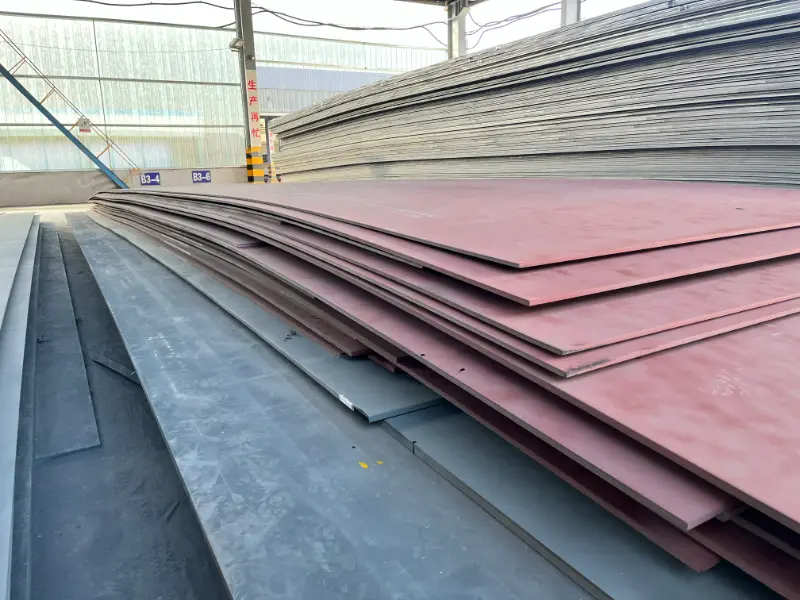
BV Grade E Shipbuilding Steel Plate
BV Grade E Shipbuilding Steel Plate: Chemical, Mechanical & Thermal Properties and Equivalent Grades
Comprehensive material data for BV Grade E shipbuilding steel plate: chemical composition, mechanical properties, thermal and electrical physical properties, international equivalents and applications.
Hot rolling, controlled rolling, normalizing, welding, cold forming
- Phone : +8618037372205
- Email : [email protected]
- WhatsApp: Contact via Whtsapp
- WeChat: +8618037372205
BV Grade E Shipbuilding Steel Plate Introduction
BV Grade E is a general strength shipbuilding structural steel plate defined by Bureau Veritas (BV) Rules for Materials. It is designed for welded ship hulls and marine structures requiring guaranteed impact toughness at low temperatures. The steel is delivered in normalized or thermo-mechanically rolled condition and offers a minimum yield strength of 235 MPa combined with excellent weldability and formability. Typical applications include hull plates, decks, bulkheads and offshore components operating in cold waters. Its -40°C impact energy requirement of at least 27 J makes it suitable for arctic-class vessels.
BV Grade E Shipbuilding Steel Plate Chemical Composition
Typical chemical requirements for BV Grade E according to BV Rules, Part 2, Section 1. The steel is fully killed and fine-grained, normally with aluminum as the grain-refining element. The carbon equivalent is controlled to ensure good weldability.
- Low carbon content for weldability
- Manganese is kept at 0.70–1.20% to maintain strength
- Sulfur and phosphorus are strictly limited for toughness and homogeneity
| Element | Standard Value (weight %) | Remarks |
|---|---|---|
| C | 0.18 max | Ladle analysis |
| Mn | 0.70 – 1.20 | Min. 2.5×C |
| Si | 0.10 – 0.50 | |
| P | 0.035 max | |
| S | 0.035 max | |
| Al (acid soluble) | ≥ 0.015 | For fine grain treatment |
| N | ≤ 0.012 | If not combined with Al |
| Other elements | Not specified | Trace levels as per BV Rules |
BV Grade E Shipbuilding Steel Plate Thermal and Electrical Physical Properties
Typical physical properties for general strength carbon-manganese shipbuilding steel (density, elastic moduli, thermal expansion, etc.). These values are not part of the BV specification but represent commonly accepted reference data for this steel grade at room temperature unless otherwise noted.
- Density is standard for carbon steel.
- Thermal conductivity decreases with temperature elevation.
- Electrical resistivity varies with alloy content.
| Property | Standard Value (Typical) | Unit | Test Condition |
|---|---|---|---|
| Density (ρ) | 7.85 | g/cm³ | 20 °C |
| Elastic modulus (E) | 210 | GPa | 20 °C |
| Shear modulus (G) | ~80 | GPa | Estimated |
| Poisson's ratio (ν) | 0.3 | — | 20 °C |
| Thermal expansion coefficient (α) | 11.7×10⁻⁶ | K⁻¹ | 20–100 °C |
| Thermal conductivity (λ) | ~50 | W/(m·K) | 20 °C |
| Specific heat capacity (cp) | ~460 | J/(kg·K) | 20 °C |
| Electrical resistivity (ρe) | ~0.16 | µΩ·m | 20 °C |
BV Grade E Shipbuilding Steel Plate Mechanical Properties
Minimum mechanical properties for BV Grade E plates in normalized or thermo-mechanical rolled condition, at ambient temperature (20°C), as per BV Rules.
- Yield strength is guaranteed for thicknesses up to typically 100 mm.
- Charpy V-notch impact energy is measured at −40 °C in longitudinal direction.
- Bend test with 180° bend on 3×thickness former without cracking.
| Property | Standard Requirement | Unit | Test Condition |
|---|---|---|---|
| Yield strength (ReH) | ≥ 235 | MPa | Plate thickness ≤ 100 mm, transverse |
| Tensile strength (Rm) | 400 – 520 | MPa | Transverse specimen |
| Elongation (A5) | ≥ 22 | % | Gauge length 5.65√S₀ |
| Bend test | d = 3a, 180° no crack | — | Diameter (d) = 3 × thickness (a) |
| Charpy impact (KV2) | ≥ 27 (longitudinal) | J | -40 °C |
| Charpy impact (KV2) | ≥ 20 (transverse) | J | -40 °C |
BV Grade E Shipbuilding Steel Plate Identical Grade Equivalents by Different Classification Societies
| Country / Region | Standard / Society | Grade | Remarks |
|---|---|---|---|
| International (France) | BV Rules | BV Grade E | Original designation |
| USA | ABS Rules | ABS Grade E | American Bureau of Shipping |
| UK | LR Rules | LR Grade E | Lloyd's Register |
| Norway / Germany | DNV Rules | DNV Grade E | DNV GL (now DNV) |
| China | CCS Rules | CCS E | China Classification Society |
| Japan | NK Rules | NK E | ClassNK (Nippon Kaiji Kyokai) |
| Korea | KR Rules | KR E | Korean Register |
| Italy | RINA Rules | RINA E | Registro Italiano Navale |
| International | ASTM A131 / A131M | ASTM A131 Grade E | Commonly accepted in shipbuilding |
BV Grade E Shipbuilding Steel Plate Application Introduction
BV Grade E steel plates are primarily used in ship and offshore structures where good weldability, sufficient strength and guaranteed toughness at −40°C are mandatory. Typical applications include:
- Hull envelopes and internal structural members of ships including tankers, bulk carriers and container vessels
- Arctic vessel construction (ice-breakers, ice-strengthened ships)
- Offshore platform decks, legs and modules
- Reinforcement and repair of marine structures in cold environments
Product Applications: Ship hull plates (bottom, side shells), Main deck and stringer plates, Bulkheads and longitudinal girders, Transverse web frames and brackets, Offshore module structural plating, Pipe flange and pressure vessel shells (if certified)
Processed into products: Welded shell plate sections, Stiffener profiles (after fabrication), Brackets and reinforcing ribs, Hatch coamings, Offshore flare booms and helideck structures, Cold storage tank outer shells
Application industries: Shipbuilding (merchant, naval, passenger), Offshore oil & gas platforms, Renewable energy offshore (wind turbine foundations), Marine construction & repair, Heavy machinery with low-temperature service
BV Grade E Shipbuilding Steel Plate Similar / Substitute Materials
| Country / Region | Standard | Grade | Remarks |
|---|---|---|---|
| EU | EN 10025-2 | S235J2 (+N) | Similar yield strength, but Charpy impact at -20°C (27 J); may be used in less severe conditions |
| EU | EN 10025-2 | S275J2 (+N) | Higher strength (275 MPa), impact -20°C |
| EU / Germany | EN 10025-3 | S275N / S275NL | Normalized fine-grain steel, NL variant with -50°C impact |
| International | ASTM A131 | ASTM A131 Grade EH36 | Higher strength (355 MPa) with similar low-temperature toughness |
| International | IACS Unified Requirement W11 | UR W11 Grade E | Common IACS floor specification for shipbuilding steel |
Notes:
- Impact test temperature and energy values may be modified for thinner gauges by agreement with the classification society.
- Supplementary requirements such as Z-direction through-thickness tensile testing (Z15, Z25, Z35) or specific carbon equivalent values may be applied for critical welded structures.
- The steel shall be fully killed and made by fine-grain practice, with sufficient aluminum to ensure grain refinement.
- Ultrasonic testing to BV specifications is often required for plates over a certain thickness.
- Share



