
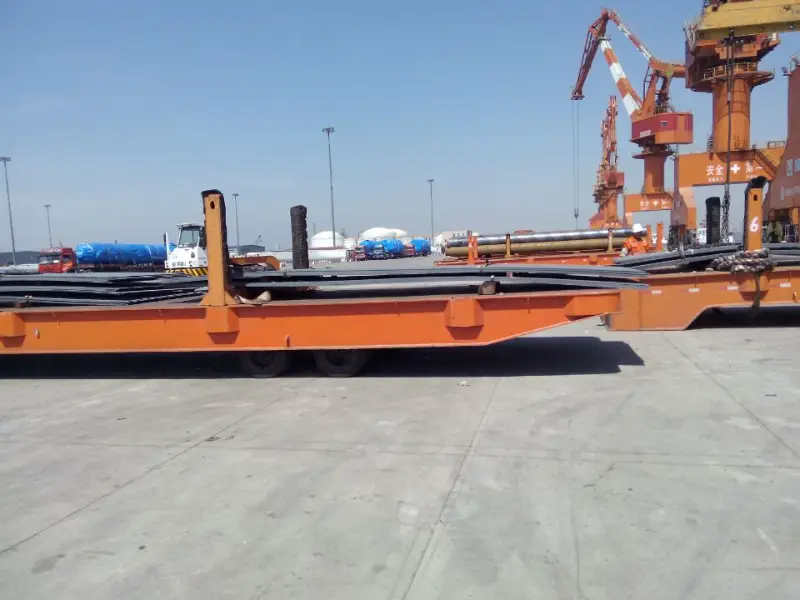
DNV Grade A550 Shipbuilding Steel Plate
DNV Grade A550 Shipbuilding Steel Plate: High-Strength Hull Structural Steel for Arctic & Deep-Sea Vessels
Comprehensive material data sheet for DNV Grade A550 shipbuilding steel plate. Includes chemical composition, mechanical properties (ReH ≥550 MPa), thermal conductivity, and equivalent grades from ABS, LR, CCS, and BV.
Thermomechanical Rolling (TMCP), Normalizing (N), Quenching and Tempering (Q&T)
- Phone : +8618037372205
- Email : [email protected]
- WhatsApp: Contact via Whtsapp
- WeChat: +8618037372205
DNV Grade A550 Shipbuilding Steel Plate Introduction
DNV Grade A550 is an extra-high strength shipbuilding steel plate standardized by Det Norske Veritas (DNV) for welded structures in shipbuilding and offshore engineering. As a normalized or thermomechanically rolled fine-grain steel with a minimum specified yield strength of 550 MPa, it offers an excellent strength-to-weight ratio, enabling lighter structural designs without compromising safety. This grade is engineered for superior low-temperature impact toughness, typically down to -20°C or lower, making it suitable for vessels operating in cold climates and harsh marine environments. Its enhanced weldability and formability reduce fabrication costs, while strict compliance with metallurgical purity ensures resistance to brittle fracture and fatigue, critical for primary hull structures, ice-breakers, and high-stress members in deep-water platforms.
DNV Grade A550 Shipbuilding Steel Plate Chemical Composition
The chemical composition of DNV A550 is strictly controlled to achieve high strength while maintaining excellent weldability and low-temperature toughness. The Carbon Equivalent (CEV) is limited to minimize the risk of cold cracking during welding. Microalloying elements such as Niobium (Nb), Vanadium (V), and Titanium (Ti) are typically added singly or in combination to ensure fine-grain structure and precipitation strengthening.
| Element | Standard Value (max, %) | Remarks |
|---|---|---|
| Carbon (C) | 0.18 | Controlled to ensure weldability |
| Silicon (Si) | 0.10 - 0.55 | Deoxidizer and strength enhancer |
| Manganese (Mn) | 1.70 | Refines grain and improves toughness |
| Phosphorus (P) | 0.025 | Strict limit for ductility |
| Sulfur (S) | 0.025 | Strict limit for ductility |
| Chromium (Cr) | 0.20 | Residual limit |
| Nickel (Ni) | 0.40 | Residual limit (Higher limits may be agreed for specific applications) |
| Molybdenum (Mo) | 0.08 | Residual limit |
| Copper (Cu) | 0.35 | Residual limit |
| Aluminum (Al) (total) | 0.020 min (Acid Soluble if agreed) | Mandatory fine-grain element |
| Niobium (Nb) | 0.05 | Microalloying element (single/combo) |
| Vanadium (V) | 0.10 | Microalloying element (single/combo) |
| Titanium (Ti) | 0.05 | Microalloying element (single/combo) |
| Carbon Equivalent (CEV) | 0.45 | CEV = C + Mn/6 + (Cr+Mo+V)/5 + (Ni+Cu)/15 |
DNV Grade A550 Shipbuilding Steel Plate Physical and Thermal Properties
Physical properties are critical for calculating thermal stress, heat transfer, and structural deformation in ship design. The values provided are typical for low-alloy structural steels at room temperature unless otherwise specified. Thermal conductivity decreases slightly, and specific heat capacity increases with temperature.
| Property | Typical Value | Unit | Condition/Remarks |
|---|---|---|---|
| Density (ρ) | 7850 | kg/m³ | At 20 °C |
| Melting Point | ~1450 - 1520 | °C | Approximate range |
| Elastic Modulus (E) | 205 | GPa | At 20 °C |
| Shear Modulus (G) | ~80 | GPa | Calculated from E and Poisson's ratio at 20 °C |
| Poisson's Ratio (ν) | 0.29 | - | At 20 °C |
| Thermal Expansion Coefficient (α) | 12.0 x 10⁻⁶ | K⁻¹ | Mean value between 20 °C and 100 °C |
| Thermal Expansion Coefficient (α) | 13.0 x 10⁻⁶ | K⁻¹ | Mean value between 20 °C and 200 °C |
| Thermal Expansion Coefficient (α) | 14.0 x 10⁻⁶ | K⁻¹ | Mean value between 20 °C and 400 °C |
| Thermal Conductivity (λ) | ~42 | W/(m·K) | At 20 °C |
| Thermal Conductivity (λ) | ~40 | W/(m·K) | At 100 °C |
| Thermal Conductivity (λ) | ~37 | W/(m·K) | At 200 °C |
| Specific Heat Capacity | ~460 | J/(kg·K) | At 20 °C |
| Specific Heat Capacity | ~550 | J/(kg·K) | At 200 °C |
| Electrical Resistivity (ρ_e) | ~0.25 | µΩ·m | At 20 °C |
DNV Grade A550 Shipbuilding Steel Plate Mechanical Properties
Mechanical properties are verified by tensile and impact testing at the specified delivery condition. The high yield strength of 550 MPa is the defining characteristic. The steel must exhibit sufficient elongation to ensure safe plastic deformation before fracture. Impact toughness is measured on Charpy V-notch specimens to guarantee integrity in cold marine environments.
| Property | Standard Requirement | Unit | Testing Condition |
|---|---|---|---|
| Yield Strength (ReH) | 550 (min) | MPa | Ambient temperature, transverse specimen for products with thickness (t) ≤ 100 mm |
| Tensile Strength (Rm) | 670 - 830 | MPa | Ambient temperature, transverse specimen |
| Elongation (A5) | 16 (min) | % | Gauge length 5.65√So, transverse specimen |
| Impact Energy (KV) at -20 °C, Longitudinal | 27 (min) | J | Charpy V-notch, average of 3 specimens, for t ≤ 50 mm |
| Impact Energy (KV) at -20 °C, Transverse | 18 (min) | J | Charpy V-notch, average of 3 specimens, for t ≤ 50 mm |
| Impact Energy (KV) at -40 °C, Longitudinal | 27 (min) | J | Charpy V-notch, may be agreed for special class notation (e.g., ICE) |
| Impact Energy (KV) at -60 °C, Longitudinal | 27 (min) | J | Charpy V-notch, may be agreed for severe Arctic service |
| Bend Test (Diameter d, Angle 180°) | d = 3t (No cracks or ruptures) | mm | Bending mandrel diameter, t = plate thickness |
DNV Grade A550 Shipbuilding Steel Plate Complete Equivalent Material Standards and Substitutable Grades
| Country/Region | Standard | Grade/Designation | Remarks |
|---|---|---|---|
| International Association of Classification Societies (IACS) | IACS UR W11 | AH550 (As normalized or TMCP) | IACS Unified Requirement for Extra-High Strength Steels |
| USA | ABS (American Bureau of Shipping) | ABS Grade A550 | Identical yield and tensile requirements per IACS |
| UK | LR (Lloyd's Register) | LR Grade A550 | Identical chemical and mechanical requirements |
| China | CCS (China Classification Society) | CCS A550 | Direct equivalent, follows IACS UR W11 |
| France | BV (Bureau Veritas) | BV A550 | Equivalent grade for marine structures |
| Norway/Germany | DNV GL (Now DNV) | VL A550 | Legacy GL designation for A550 within the merged society |
| South Korea | KR (Korean Register) | KR A550 | Equivalent grade per IACS membership |
| Japan | NK (Nippon Kaiji Kyokai / ClassNK) | NK A550 | Equivalent grade for high-strength hull |
| Italy | RINA (Registro Italiano Navale) | RINA A550 | Equivalent grade per IACS requirements |
DNV Grade A550 Shipbuilding Steel Plate Application Introduction
DNV A550 steel is the backbone of modern large-scale shipbuilding, particularly where weight reduction is critical for fuel efficiency and cargo capacity. It provides a predictable safety margin against yielding and fatigue under dynamic wave loads. This grade is fully weldable by all standard shipyard methods, including submerged arc welding (SAW) and flux-cored arc welding (FCAW), using matching consumables (AWS E11018M or equivalent). Its consistent properties through thickness make it suitable for thick-section rolled parts in highly stressed zones.
Product Applications: Integrated hull structures and superstucture framing, Jack-up rig lattice legs and spudcans, Crane pedestals and heavy-lift derrick booms for offshore construction vessels, Pressure hulls for autonomous underwater vehicles (AUVs) and deep-sea submersibles, Arctic icebreaker bow and ice belt plating
Processed into products: Main deck stringer plates and sheer strakes (high longitudinal bending stress regions), Bottom shell and bilge keel components, Transverse bulkhead stiffeners and deep girders, Hatch coaming plates and container cell guides, Heavy-duty fairleads and towing bollard foundations
Application industries: Commercial Shipbuilding (Container Vessels, Bulk Carriers, Tankers), Naval Architecture and Defense (Lightweight armor for naval auxiliaries), Offshore Oil & Gas (Jack-up rig legs, semi-submersible pontoons, FPSO hulls), Renewable Energy (Monopile and transition pieces for offshore wind turbines), Arctic and Ice-Class Vessel Construction (Icebreakers, LNG carriers for Northern Sea Route)
DNV Grade A550 Shipbuilding Steel Plate Comparable and Similar Alternative Material Recommendations
| Country/Region | Standard | Grade/Designation | Remarks/Analysis |
|---|---|---|---|
| Europe | EN 10025-6 | S550QL / S550QL1 | Quenched and tempered structural steel with a minimum yield of 550 MPa. Excellent toughness but significantly different carbon equivalent and welding procedure (preheat required) compared to TMCP A550. |
| Europe | EN 10025-4 | S550M / S550ML | Thermomechanically rolled structural steel with min. 550 MPa yield. S550ML offers guaranteed low-temperature impact properties (-50°C) and is a functional equivalent for offshore structures, though ship-specific certification may be needed. |
| China | GB/T 712 | A550 | Chinese marine steel standard directly harmonized with IACS requirements. This is the national standard equivalent to DNV A550. |
| USA | ASTM A709 / A709M | Grade HPS 100W | High-performance structural steel with 690 MPa yield, higher than DNV A550, used in bridges and potentially offshore, but overmatches A550 in strength and cost. |
| IACS (Older) | IACS UR W11 | DH550 / EH550 | Grades for lower service temperatures (DH: -20°C, EH: -40°C guaranteed impact). These are direct variants within the same strength class but for more severe cold conditions. |
Notes:
Weldability: Despite its high strength, the TMCP delivery condition of DNV A550 provides a lower Carbon Equivalent Value (CEV ≤ 0.45) compared to traditional quenched and tempered steels, enabling cold forming of moderate deformations and reducing the necessity for preheating. Procurement Specifications: When ordering, heat treatment conditions (TMCP or N) must be clearly stated. Supplementary requirements such as ultrasonic testing (UT) in accordance with EN 10160 Class S1/E1, through-thickness tensile test (Z-quality, Z25 or Z35 per EN 10164), and fracture toughness testing (CTOD) can be agreed upon for critical components. Corrosion Protection: As a non-alloyed or low-alloyed steel, it requires standard marine coating systems or cathodic protection for long-term durability in seawater environments.
- Share



