
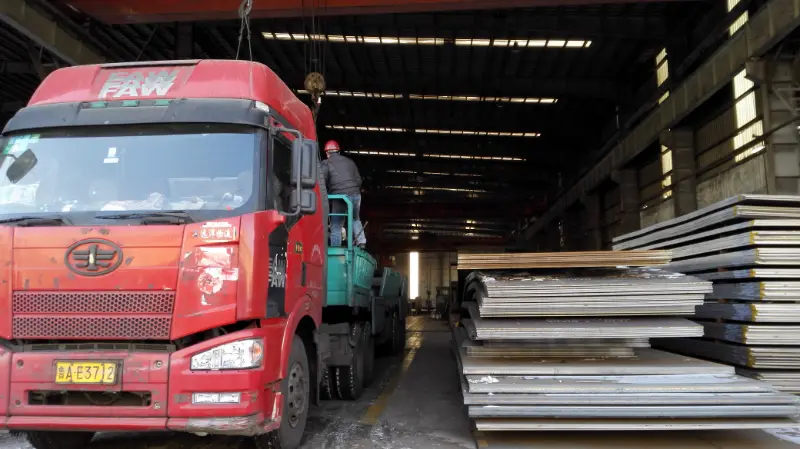
DNV Grade D550 Shipbuilding Steel Plate
DNV Grade D550 Shipbuilding Steel Plate | High Strength 550 MPa Yield for Marine Structures
Comprehensive material data for DNV Grade D550 shipbuilding steel plate: chemical composition, mechanical/physical properties, international equivalents and application guide for marine and offshore engineering.
Welding, cutting, cold forming, bending, straightening
- Phone : +8618037372205
- Email : [email protected]
- WhatsApp: Contact via Whtsapp
- WeChat: +8618037372205
DNV Grade D550 Shipbuilding Steel Plate Introduction
DNV Grade D550 is a high-strength shipbuilding structural steel with a minimum specified yield strength of 550 MPa, certified according to DNV rules. It belongs to the D-grade toughness category, meaning impact testing is performed at -20°C. The steel is typically supplied in a thermomechanically rolled (TMCP) or quenched and tempered (QT) condition, offering an excellent combination of strength, weldability and low-temperature toughness. It is widely used in critical components such as hulls, decks, and offshore platforms where weight savings and structural integrity are paramount. The plate thickness can reach up to 100 mm, with adjusted mechanical properties for thicker gauges.
DNV Grade D550 Shipbuilding Steel Plate Chemical Composition
The chemical composition limits for Grade D550 are in accordance with DNV rules for high-strength structural steel. The steel is fully killed and fine-grain treated. Carbon equivalent (CEV) is controlled to ensure excellent weldability: CEV ≤ 0.43% for thickness ≤50 mm, CEV ≤ 0.45% for 50-100 mm. Elements such as Nb, V and Ti are added for grain refinement and precipitation strengthening.
| Chemical Element | Standard Value (max, %) | Remarks |
|---|---|---|
| Carbon (C) | ≤0.20 | Heat analysis |
| Silicon (Si) | 0.10 – 0.55 | Heat analysis |
| Manganese (Mn) | 0.70 – 2.00 | Heat analysis |
| Phosphorus (P) | ≤0.025 | Heat analysis |
| Sulfur (S) | ≤0.020 | Heat analysis |
| Aluminum (Al) | ≥0.020 (total or acid-soluble) | Minimum for fine grain practice |
| Niobium (Nb) | ≤0.06 | Heat analysis |
| Vanadium (V) | ≤0.10 | Heat analysis |
| Titanium (Ti) | ≤0.05 | Heat analysis |
| Nitrogen (N) | ≤0.012 | Heat analysis |
| Copper (Cu) | ≤0.35 | Residual element |
| Chromium (Cr) | ≤0.25 | Residual element |
| Nickel (Ni) | ≤0.40 | Residual element |
| Molybdenum (Mo) | ≤0.08 | Residual element |
DNV Grade D550 Shipbuilding Steel Plate Physical Properties
The following thermal and electrical properties are typical for high-strength shipbuilding steel and are provided for reference. These values are not part of the DNV D550 specification but are commonly used for design and engineering calculations. Actual values may vary depending on specific manufacturing and composition.
| Property | Typical Value | Unit | Test Condition / Remarks |
|---|---|---|---|
| Density (ρ) | 7.85 | g/cm³ | At 20°C |
| Modulus of Elasticity (E) | 210 | GPa | At 20°C |
| Shear Modulus (G) | 81 | GPa | At 20°C |
| Poisson Ratio (ν) | 0.3 | - | At 20°C |
| Thermal Expansion Coefficient (α) | 12 × 10⁻⁶ | K⁻¹ | Between 20°C and 100°C |
| Thermal Conductivity (λ) | 50 | W/(m·K) | At 20°C |
| Specific Heat Capacity | 460 | J/(kg·K) | At 20°C |
| Electrical Resistivity (ρ_e) | 0.20 | μΩ·m | At 20°C |
DNV Grade D550 Shipbuilding Steel Plate Mechanical Properties
Mechanical properties are specified per DNV rules for plates in the delivery condition (TMCP or QT). The yield strength requirement is relaxed for thicknesses above 50 mm. Impact toughness testing is carried out at -20°C on Charpy V-notch specimens; minimum values apply to longitudinal direction (transverse values are 70% of longitudinal). Bend test is performed with the specified mandrel diameter.
| Property | Standard Requirement Value | Unit | Test Condition / Remarks |
|---|---|---|---|
| Yield Strength (ReH) | ≥550 | MPa | Thickness ≤ 50 mm |
| Yield Strength (ReH) | ≥530 | MPa | Thickness > 50 – 70 mm |
| Yield Strength (ReH) | ≥510 | MPa | Thickness > 70 – 100 mm |
| Tensile Strength (Rm) | 670 – 880 | MPa | All thicknesses |
| Elongation (A5) | ≥16 | % | Thickness ≤ 50 mm |
| Elongation (A5) | ≥15 | % | Thickness > 50 – 70 mm |
| Elongation (A5) | ≥14 | % | Thickness > 70 – 100 mm |
| Bend Test (Mandrel Diameter) | 3t | - | t = plate thickness, for t ≤ 25 mm, bending angle 180° |
| Bend Test (Mandrel Diameter) | 4t | - | t = plate thickness, for t > 25 mm, bending angle 180° |
| Impact Energy (KV, longitudinal) | ≥27 | J | At -20°C, 10×10 mm Charpy V-notch specimen |
| Impact Energy (KV, transverse) | ≥19 | J | At -20°C, 10×10 mm Charpy V-notch specimen, when specified |
DNV Grade D550 Shipbuilding Steel Plate Completely Equivalent International Standards and Designations
| Country/Region | Standard | Grade/Designation | Remarks |
|---|---|---|---|
| International | American Bureau of Shipping (ABS) | DH550 | Same yield & temperature class (D = -20°C) |
| International | Lloyd's Register (LR) | DH550 | Same yield & temperature class |
| International | Bureau Veritas (BV) | DH550 | Same yield & temperature class |
| International | China Classification Society (CCS) | DH550 | Same yield & temperature class |
| International | Nippon Kaiji Kyokai (NK) | KD550 | K = high strength, D = -20°C, 550 MPa yield |
| International | Korean Register (KR) | DH550 | Same yield & temperature class |
| International | RINA Rules | DH550 | Same yield & temperature class |
| International | Russian Maritime Register of Shipping (RS) | DH550 | Same yield & temperature class |
DNV Grade D550 Shipbuilding Steel Plate Application Introduction
DNV D550 steel is specifically designed for highly stressed marine and offshore structures. It is suitable for heavy-load applications where weight reduction and high strength are critical. The steel demonstrates excellent weldability thanks to low carbon equivalent, and its good toughness at -20°C ensures safe operation in cold environments. It can be shaped by cold forming and bending, provided the appropriate bend radii are maintained. Typical delivery condition (TMCP or QT) provides a favorable strength-to-toughness balance and allows welding with standard procedures (preheating may be required for thick sections).
Product Applications: Hull plates and shell plates, Main deck and strength deck plates, Hatch coamings and container cell guides, Heavy-lift crane pedestals and booms, Truss structures for offshore platforms, Caissons and subsea templates
Processed into products: Stiffeners and longitudinals, Bulkheads and frames, Web plates and flange plates in built-up girders, Reinforcement pads and doubler plates, Lifting lugs and padeyes, Transition pieces for wind towers
Application industries: Shipbuilding (commercial and naval vessels), Offshore oil & gas platforms, Offshore wind energy (monopile and transition pieces), Heavy civil engineering and bridge construction (when accepted by project specification), Mining and heavy machinery (if dual certified)
DNV Grade D550 Shipbuilding Steel Plate Similar or Alternative Steel Grades
| Country/Region | Standard | Grade/Designation | Remarks |
|---|---|---|---|
| International | DNV | A550 | Yield 550 MPa, impact test at 0°C (less tough) |
| International | DNV | E550 | Yield 550 MPa, impact test at -40°C (higher toughness) |
| International | ABS | EH550 | Yield 550 MPa, impact test at -40°C |
| Europe | EN 10225 | S550G2+M / S550G2+Q | Offshore structural steel, yield 550 MPa, similar toughness (can substitute with agreement) |
| International | API | 2Y-60 | Offshore structural steel, yield ≥60 ksi (414 MPa) lower strength; only approximate |
| International | ASTM | A514 Grade B / S | Quenched & tempered alloy steel, yield ≥690 MPa; higher strength, may require special welding |
Notes:
This grade is typically ordered to DNV rules including additional testing requirements such as through-thickness property (Z-test) when specified. Material certification is provided according to EN 10204 Type 3.1 or 3.2. Weld repair procedures must meet the relevant DNV welding standard. For thicknesses above 50 mm, close consultation with the steel mill is recommended to verify delivery conditions and mechanical properties. The information corresponds to the latest DNV Pt.2 Ch.1 public edition; always refer to the current ship classification rules for the exact requirements.
- Share



