
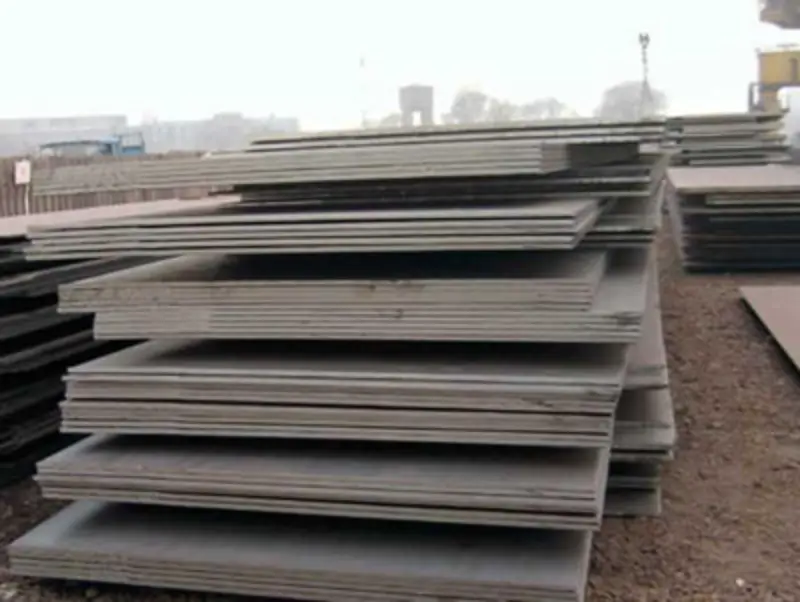
DNV Grade E550 Shipbuilding Steel Plate
DNV Grade E550 Shipbuilding Steel Plate - High-Strength Low-Temperature Hull Structural Steel
Detailed material data for DNV Grade E550 shipbuilding steel plate, including chemical composition, mechanical properties, thermal and electrical physical characteristics, international equivalents, and application guidance.
Typical processes: CNC plasma/laser cutting, automatic submerged arc welding (SAW), gas metal arc welding (GMAW), shielded metal arc welding (SMAW), cold and hot forming, bending, shot blasting, and drilling. Preheating may be required for thick sections before welding.
- Phone : +8618037372205
- Email : [email protected]
- WhatsApp: Contact via Whtsapp
- WeChat: +8618037372205
DNV Grade E550 Shipbuilding Steel Plate Introduction
DNV Grade E550 is a high-strength hull structural steel plate certified by DNV (Det Norske Veritas) classification society. It belongs to the extra high-strength (EHS) category with a minimum yield strength of 550 MPa. The designation "E" indicates guaranteed impact toughness at -40°C, making it suitable for critical ship structures operating in cold environments. Key features:
- Excellent low-temperature toughness (≥50 J at -40°C)
- High strength-to-weight ratio for lightweight designs
- Good weldability with controlled carbon equivalent (Ceq ≤0.43% for TMCP)
- Available in thicknesses up to 100 mm in quenched & tempered or TMCP delivery condition
- Full compliance with DNV Rules Pt.2 Ch.1 for offshore and marine applications
Typical uses include deck plating, bottom shells, longitudinal stiffeners, and offshore platform components.
DNV Grade E550 Shipbuilding Steel Plate Chemical Composition
Typical chemical requirements for DNV Grade E550 according to DNV Rules Pt.2 Ch.1 Sec.3 Table 3. All elements are max values unless a range is indicated. Micro-alloying elements (Nb, V, Ti) are added for grain refinement and precipitation strengthening. The carbon equivalent (Ceq) is limited to ≤0.43% for TMCP condition or ≤0.47% for Q+T condition.
Values shown are for product thicknesses ≤100 mm; for thicker gauges the manufacturer's specification must be checked.
| Chemical Element | Standard Value | Remarks |
|---|---|---|
| Carbon, C | ≤0.20% | Max. for all thicknesses |
| Manganese, Mn | 0.90–1.70% | Typical range |
| Silicon, Si | 0.10–0.55% | Killed steel, fine grain practice |
| Phosphorus, P | ≤0.025% | Max. |
| Sulfur, S | ≤0.025% | Max. |
| Aluminium, Al (acid soluble) | ≥0.015% | Min. for fine grain |
| Niobium, Nb | ≤0.06% | Micro-alloying, grain refinement |
| Vanadium, V | ≤0.10% | Optional strengthening |
| Titanium, Ti | ≤0.02% | Optional, max. |
| Chromium, Cr | ≤0.25% | Residual / intentional |
| Nickel, Ni | ≤0.40% | May be higher for thicker plates |
| Molybdenum, Mo | ≤0.08% | Residual |
| Copper, Cu | ≤0.30% | Residual |
| Nitrogen, N | ≤0.012% | Unless bound by Ti or Al |
| Carbon Equivalent (Ceq) | ≤0.43 (TMCP) ≤0.47 (Q+T) | Based on IIW formula: Ceq = C + Mn/6 + (Cr+Mo+V)/5 + (Ni+Cu)/15 |
DNV Grade E550 Shipbuilding Steel Plate Thermal and Electrical Physical Properties
The physical properties listed are typical for quenched and tempered (or TMCP) high-strength low-alloy steels similar to DNV E550. These values are not mandatory per classification rules but are representative for design calculations. Slight variations can occur based on exact heat treatment and chemical composition.
| Property | Standard Value | Unit | Test Condition / Remarks |
|---|---|---|---|
| Density (ρ) | 7.85 | g/cm³ | Room temperature |
| Modulus of Elasticity (E) | 205 | GPa | Tensile, ambient temperature |
| Shear Modulus (G) | 79 | GPa | Calculated from E and ν |
| Poisson's ratio (ν) | 0.3 | — | Elastic range |
| Thermal expansion (α) | 12.0 13.5 | µm/m·K | 20 – 100 °C 20 – 300 °C |
| Thermal conductivity (λ) | 45 40 | W/m·K | 20 °C 200 °C |
| Specific heat capacity (cp) | 500 550 | J/kg·K | 20 °C 200 °C |
| Electrical resistivity (ρe) | 0.18 | µΩ·m | Ambient temperature |
DNV Grade E550 Shipbuilding Steel Plate Mechanical Properties
Mechanical properties as per DNV rules for finished products. All tensile and impact test specimens are taken transverse to the rolling direction unless otherwise agreed. Impact testing is carried out at -40°C for grade "E".
Bend test: bending angle 180° without cracking, mandrel diameter depending on thickness.
| Property | Required Value | Unit | Test Condition / Remarks |
|---|---|---|---|
| Yield Strength (ReH) | ≥550 | MPa | For thickness t ≤100 mm, transverse |
| Tensile Strength (Rm) | 670 – 830 | MPa | Plate thickness ≤100 mm |
| Elongation (A, Lo=5.65√So) | ≥16 ≥14 ≥12 | % | t ≤ 50 mm 50 < t ≤ 70 mm 70 < t ≤ 100 mm |
| Impact Energy (KV) - longitudinal | ≥50 (average of 3 tests) ≥35 (single min.) | J | -40°C, V-notch, standard specimen |
| Impact Energy (KV) - transverse | ≥34 (average) ≥24 (single min.) | J | -40°C, V-notch |
| Bend Test (180°, mandrel dia. = d) | d = 3a d = 4a | — | t ≤ 50 mm (a = specimen thickness) 50 < t ≤ 100 mm |
DNV Grade E550 Shipbuilding Steel Plate Identical Material Standards and Substitute Grades
| Country / Region | Standard / Specification | Grade | Remarks |
|---|---|---|---|
| International (IACS) | ABS – Bureau of Shipping | EH550 | Identical mechanical and toughness requirements, mutually recognised |
| United Kingdom | LR – Lloyd's Register | EH550 | Fully equivalent for marine applications |
| France | BV – Bureau Veritas | EH550 | Equivalent grade under BV NR216 |
| China | CCS – China Classification Society | EH550 | Same requirements per CCS Rules Part 1 |
| South Korea | KR – Korean Register | EH550 | Identical designation and technical delivery conditions |
| Japan | NK – Nippon Kaiji Kyokai (ClassNK) | EH550 | Corresponds to ClassNK KEH550 |
| Italy | RINA – Registro Italiano Navale | EH550 | Fully interchangeable for shipbuilding |
| Russia | RS – Russian Maritime Register | EH550 | Equivalent under RS Rules for Ships |
DNV Grade E550 Shipbuilding Steel Plate Application Introduction
DNV E550 steel plate is engineered for severe marine and offshore environments where high strength, -40°C low-temperature toughness, and reliable weldability are essential. The steel is suitable for weight-critical ship structures exposed to dynamic loads and cold climatic conditions.
Typical usage guidance:
Product Applications: Hull plates and shell plating for ice-class vessels, Deck plates of large container ships and bulk carriers, Self-elevating platform legs and spudcans, Transition pieces (TP) for offshore wind turbine monopiles, Floating production storage and offloading (FPSO) modules
Processed into products: Longitudinal stiffeners and web frames, Bottom shell and bilge keel components, Crane boom chords and lattice structures, Heavy-lift pad eyes and padeye reinforcements, Jack-up leg rack plates, Foundation grillages and base plates, Low-temperature pressure vessel shells (with supplementary approval)
Application industries: Shipbuilding and marine engineering, Offshore oil & gas platforms (fixed and floating), Renewable offshore wind foundations, Heavy lifting and transport equipment, Port machinery and crane construction
DNV Grade E550 Shipbuilding Steel Plate Similar/Alternative Material Recommendations
| Country / Region | Standard / Specification | Grade | Remarks |
|---|---|---|---|
| EU | EN 10025-6 | S690Q / S690QL | Higher yield strength (690 MPa), also low-temperature toughness, often used as stronger alternative; careful weldability evaluation needed. |
| USA | ASTM A514 / A517 | Grade Q | Quenched & tempered plate, min yield 690 MPa, similar toughness class; dimension range differs from DNV. |
| EU | EN 10025-4 | S550M / S550ML | TMCP structural steel with min 550 MPa yield; comparable structural application but not usually certified for marine class. |
| Japan | JIS G 3106 | SM570 | High tensile structural steel, min tensile 570 MPa; may require supplementary low-temperature treatment for E550-equivalent toughness. |
Notes:
- Plates are normally delivered in trimmed, shot-blasted condition and coated with a temporary shop primer.
- Additional testing such as through-thickness properties (Z-quality), CTOD, or ultrasonic examination (class A/B/S) can be specified at order.
- For thicknesses above 40 mm, transverse impact values are commonly required by classification rules; confirm with the specific project specification.
- Preheating and interpass temperature control during welding must follow approved welding procedure specifications (WPS), typically 75–150°C depending on plate thickness and hydrogen risk.
- Share



