
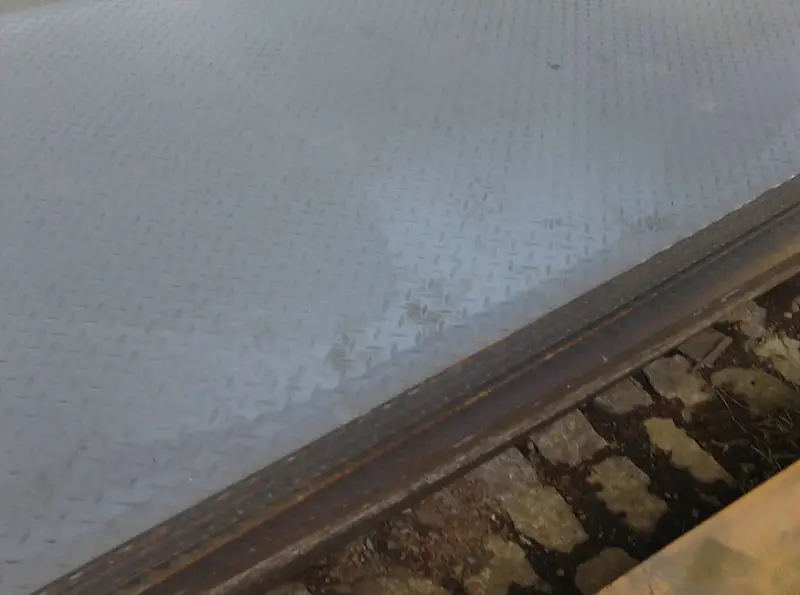
DNV Grade F550 Shipbuilding Steel Plate
DNV Grade F550 Shipbuilding Steel Plate: High-Strength Quenched & Tempered Steel for Arctic Marine Structures
Comprehensive material data for DNV Grade F550 marine steel, including chemical composition, mechanical properties at varying thicknesses, thermophysical values, and international equivalents. Ideal for hulls and offshore structures requiring low-temperature toughness.
Hot rolling followed by quenching and tempering (Q&T); can be cold formed, welded, and machined with appropriate practices
- Phone : +8618037372205
- Email : [email protected]
- WhatsApp: Contact via Whtsapp
- WeChat: +8618037372205
DNV Grade F550 Shipbuilding Steel Plate Introduction
DNV Grade F550 is a high-strength, quenched and tempered structural steel plate regulated by the Det Norske Veritas (DNV) rules for shipbuilding and offshore applications. It is designed to offer a minimum yield strength of 550 MPa combined with excellent toughness at temperatures as low as -40 °C, making it suitable for service in arctic and harsh marine environments. The steel achieves its superior mechanical properties through a precisely controlled thermal regime and fine-grain microstructure, ensuring good weldability and forming characteristics when proper procedures are followed. Typical delivery condition is quenched and tempered (Q&T). Its chemical composition is microalloyed for strength and impact resistance, with restricted impurities to maintain ductility. DNV F550 is widely used in the construction of hulls, decks, and critical structural members of large vessels, icebreakers, and mobile offshore units, where high strength-to-weight ratio and reliability under dynamic loads are essential. Equivalent grades are available from other major classification societies, permitting flexible procurement globally.
DNV Grade F550 Shipbuilding Steel Plate Chemical Composition
The chemical composition of DNV F550 is tightly controlled to achieve high strength and low-temperature toughness. Maximum limits are specified for detrimental elements to ensure weldability and resistance to embrittlement. Microalloying elements like Nb, V, Ti, and Al refine grain size.
- Values are as per DNV rules for Grade F550 with thickness ≤ 100 mm.
- The steel is fully killed and fine grain treated.
- Carbon Equivalent (CEV) typically ≤ 0.52% for improved weldability, calculated as CEV = C + Mn/6 + (Cr+Mo+V)/5 + (Cu+Ni)/15.
| Element | Specified Value (max or range) | Remarks |
|---|---|---|
| Carbon (C) | ≤ 0.18% | Max. for base metal; typical target lower for weldability |
| Silicon (Si) | 0.10 – 0.50% | Deoxidation and strength contribution |
| Manganese (Mn) | 0.90 – 1.60% | Strength and toughness; may be adjusted for thickness |
| Phosphorus (P) | ≤ 0.025% | Maximum for low-temperature service |
| Sulfur (S) | ≤ 0.025% | Maximum for low-temperature service |
| Chromium (Cr) | ≤ 0.80% | Optional; improves hardenability |
| Nickel (Ni) | ≤ 2.00% | Optional; enhances low-temperature toughness |
| Molybdenum (Mo) | ≤ 0.50% | Optional; increases hardenability and temper resistance |
| Copper (Cu) | ≤ 0.35% | Residual element |
| Vanadium (V) | ≤ 0.10% | Microalloying element for grain refinement and precipitation strengthening |
| Titanium (Ti) | ≤ 0.07% | Grain refiner; also protects boron if added |
| Niobium (Nb) | ≤ 0.05% | Grain refiner and precipitation strengthening |
| Aluminum (Al), total | ≥ 0.015% | Minimum for fine grain practice (acid soluble) |
| Nitrogen (N) | ≤ 0.015% | Maximum; higher levels may require binding elements |
| Boron (B) | ≤ 0.005% | Optional; if not intentionally added, residual level is very low |
DNV Grade F550 Shipbuilding Steel Plate Thermal and Electrical Physical Properties
Physical properties of quenched and tempered high-strength steel are comparable to similar low-alloy steels. These values are typical and not part of classification rules but are useful for engineering calculations. Variations may occur depending on actual composition and heat treatment.
- Density is assumed constant across the operational temperature range.
- Thermal conductivity decreases with increasing temperature.
- Electrical resistivity is for direct current at 20 °C.
| Property | Typical Value | Unit | Test Condition / Remarks |
|---|---|---|---|
| Density (ρ) | 7850 | kg/m³ | At 20 °C |
| Elastic modulus (E) | 205 – 210 | GPa | At 20 °C; dynamic or static tensile |
| Shear modulus (G) | ~80 | GPa | Calculated from E and Poisson's ratio |
| Poisson's ratio (ν) | 0.29 – 0.30 | — | Elastic range |
| Thermal expansion coefficient (α) | 11.5 × 10⁻⁶ | K⁻¹ | Mean value between 20 °C and 100 °C |
| Thermal expansion coefficient (α) | 12.5 × 10⁻⁶ | K⁻¹ | Mean value between 20 °C and 200 °C |
| Thermal expansion coefficient (α) | 13.5 × 10⁻⁶ | K⁻¹ | Mean value between 20 °C and 400 °C |
| Thermal conductivity (λ) | 38 – 42 | W/(m·K) | At 20 °C |
| Specific heat capacity (c) | 460 – 480 | J/(kg·K) | At 20 °C |
| Electrical resistivity (ρₑ) | 0.20 – 0.25 × 10⁻⁶ | Ω·m | At 20 °C |
DNV Grade F550 Shipbuilding Steel Plate Mechanical Properties
Mechanical properties are guaranteed for plates in the quenched and tempered state. Values depend on product thickness, with thicker plates showing slightly lower strength. Impact test requirements are specified for -40 °C (F grade). Bend test is performed according to DNV rules.
- Testing direction for tensile: Transverse (perpendicular to rolling direction) unless otherwise agreed.
- Impact test specimens: Charpy V-notch, transverse, minimum average energy of 3 tests, with one individual value not below 70% of specified average.
| Property | Specified Value | Unit | Test Condition / Thickness |
|---|---|---|---|
| Yield strength (ReH, min) | 550 | MPa | t ≤ 50 mm |
| Yield strength (ReH, min) | 530 | MPa | 50 < t ≤ 100 mm |
| Yield strength (ReH, min) | 490 | MPa | 100 < t ≤ 150 mm (subject to agreement) |
| Tensile strength (Rm) | 670 – 880 | MPa | t ≤ 100 mm |
| Elongation (A, min) | 17 | % | Gauge length 5.65√So; transverse; applies for t ≤ 50 mm |
| Elongation (A, min) | 16 | % | 50 < t ≤ 100 mm |
| Impact energy (KV, min) | 50 | J | At -40 °C; transverse; average of 3 tests; t ≤ 50 mm |
| Impact energy (KV, min) | 42 | J | At -40 °C; transverse; average of 3 tests; 50 < t ≤ 100 mm |
| Bend test (mandrel diameter) | 3t | — | 180° bend; t = specimen thickness ≤ 30 mm; width ≥ 30 mm |
| Bend test (mandrel diameter) | 4t | — | 180° bend; specimen thickness > 30 mm |
DNV Grade F550 Shipbuilding Steel Plate Fully Equivalent Material Standards and Substitutions
| Country/Region | Standard | Grade Designation | Remarks |
|---|---|---|---|
| International (IACS member) | DNV Rules Pt.2 Ch.2 | F550 | Original specification; Q&T condition |
| USA | ABS Rules | FQ55 | Yield 550 MPa, -40 °C; directly equivalent |
| United Kingdom | Lloyd's Register Rules | FH55 | FH55 corresponds to F550 requirements |
| France | Bureau Veritas Rules | FH550 | Same strength and toughness level |
| Germany | DNV GL (now DNV) Rules | F550 | Former GL F550 is identical |
| Italy | RINA Rules | FH550 | Alternative designation for same grade |
| Japan | ClassNK Rules | KF55 | KF55 meets same mechanical limits |
| South Korea | Korean Register Rules | FH55 | Equivalent to DNV F550 |
| China | CCS Rules | FH550 | FH550 matches DNV F550 specification |
| Russia | Russian Maritime Register | F550 | Same grade code |
DNV Grade F550 Shipbuilding Steel Plate Application Introduction
DNV F550 is engineered for heavy-load-bearing welded structures exposed to low ambient temperatures. Its high strength enables weight reduction, while the guaranteed toughness at -40°C ensures safety in polar operations. The steel is delivered in the Q&T condition, which provides a uniform tempered martensite/bainite microstructure. Machining, forming, and welding must follow qualified procedures to preserve properties. Preheating, controlled heat input, and post-weld heat treatment may be necessary depending on thickness.
Product Applications: Icebreaker hulls and ice belts, Arctic container ship deck plates and doubler plates, Legs and chord members of self-elevating drilling units, Column and pontoon construction of semi-submersibles, Crane pedestals and A-frames on heavy lift vessels, Blast- and fire-resistant dividers on offshore installations, Pressure hulls for deep-water submersibles, Highly stressed nodes and joints in offshore jacket structures
Processed into products: Plasma/laser-cut plate components for ship framing, Roll-formed or press-formed curved hull sections, Welded built-up box girders and T-beams, Machined jacking mechanisms and rack plates for jack-up rigs, Drilled and bolted structural joints, Precision-cut gusset plates, stiffeners, and brackets
Application industries: Shipbuilding and marine construction, Offshore oil & gas platforms (jack-ups, semi-submersibles, FPSOs), Arctic and ice-going vessel construction, Heavy lifting and transport equipment, Defence and naval shipbuilding (e.g., ice-strengthened patrol ships), Renewable energy (offshore wind turbine foundations, transition pieces)
DNV Grade F550 Shipbuilding Steel Plate Similar or Substitute Materials with Comparable Performance
| Country/Region | Standard | Grade | Remarks |
|---|---|---|---|
| European Union | EN 10025-6 | S550Q / S550QL / S550QL1 | Quenched and tempered structural steel; min. yield 550 MPa at t≤50 mm; QL with improved notch toughness; may require additional agreement for marine use. |
| USA | ASTM A514 / A517 | Grade Q | High-strength quenched and tempered alloy steel plate; min. yield 690 MPa (higher strength, so substitution requires engineering assessment); but similar in concept for offshore structures. |
| USA | ASTM A709 / A709M | Grade HPS 70W | High-performance steel for bridges; 485 MPa yield min. Not a direct match, but shares welding and toughness philosophy; lower yield may necessitate redesign. |
| Germany | DIN EN 10083-3 | 42CrMo4 (1.7225) Q&T | Engineering steel for forged parts, similar UTS range; not normally supplied as plate for shipbuilding; only for small components. |
Notes:
Welding recommendations: Use low-hydrogen processes (SMAW with basic electrodes, SAW, GMAW) with appropriate pre-heating (typically 100-175°C for plate thickness > 20 mm) and interpass temperature control. Maximum heat input often limited to 3.0-4.5 kJ/mm to maintain HAZ toughness. Post-weld heat treatment is generally not required for thicknesses below 50 mm when proper low-hydrogen practices are followed. Non-destructive testing of finished products must comply with DNV rules and can include ultrasonic testing, magnetic particle inspection, etc. Certification: All plates are stamped and accompanied by DNV material certificates in accordance with EN 10204 3.1 or 3.2. Quality assurance: Each heat is tested for chemical composition, tensile, impact, and bend properties as per DNV surveillance. For critical applications, through-thickness tensile testing (Z-quality) may be specified according to EN 10164.
- Share



