
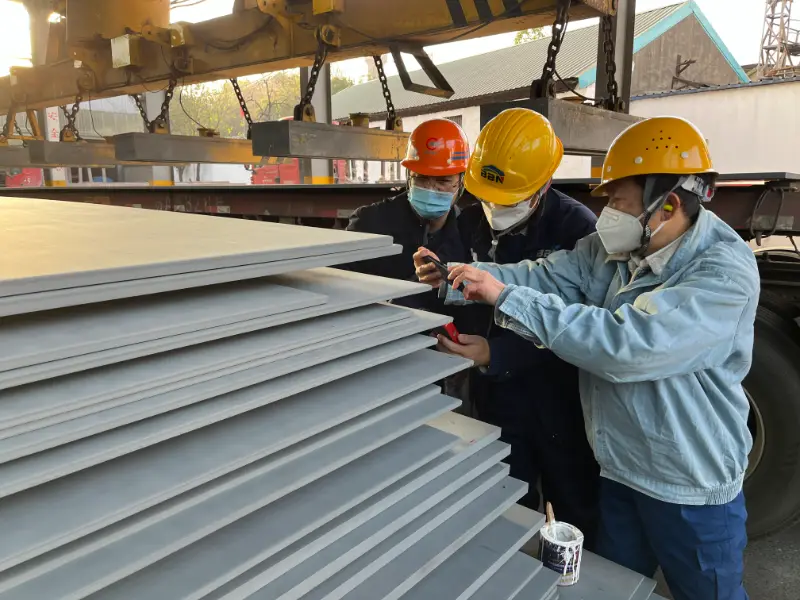
DNV Grade F500 Shipbuilding Steel Plate
DNV Grade F500 Shipbuilding Steel Plate - Extra High Strength Structural Steel for Arctic & Offshore Applications
Comprehensive technical guide for DNV Grade F500 extra high strength shipbuilding steel plate: chemical composition, mechanical & thermal properties, international equivalents, and application cases.
Cutting (flame, plasma, laser), machining, cold forming, hot forming (within controlled temperature ranges), welding (SMAW, SAW, GMAW, FCAW), and drilling. TMCP or QT grades require care to avoid excessive heat input that could degrade mechanical properties.
- Phone : +8618037372205
- Email : [email protected]
- WhatsApp: Contact via Whtsapp
- WeChat: +8618037372205
DNV Grade F500 Shipbuilding Steel Plate Introduction
DNV Grade F500 is an extra high strength structural steel plate for shipbuilding and offshore structures, certified by DNV (Det Norske Veritas). The designation 'F' indicates it meets the most stringent low-temperature toughness requirements (impact testing at -60°C), and '500' denotes a minimum yield strength of 500 MPa. This steel is typically supplied in the quenched and tempered (Q+T) or thermo-mechanical controlled processed (TMCP) condition, offering an optimal combination of high strength, excellent weldability, and superior notch toughness. It is designed for critical structural components subjected to high stresses and severe operating environments, such as heavy-lift crane pedestals, jack-up rig legs, and hulls of ice-going vessels. Its low carbon equivalent (CEV) enables reliable field welding without excessive preheating, making it a go-to material for demanding maritime and offshore engineering projects.
DNV Grade F500 Shipbuilding Steel Plate Chemical Composition
The composition is carefully balanced to achieve high strength and excellent low-temperature toughness while maintaining good weldability. Carbon equivalent (CEV) is controlled to facilitate field welding. Microalloying elements such as Nb, V, and Ti ensure grain refinement and precipitation strengthening. Residual elements are kept low to preserve ductility and through-thickness properties.
| Chemical Element | Specified Value (max unless range or min given) | Remarks |
|---|---|---|
| Carbon (C) | 0.18% | Improves strength but must be limited for weldability. |
| Silicon (Si) | 0.10 – 0.55% | Deoxidizer; contributes to strength. |
| Manganese (Mn) | 0.90 – 1.70% | Key strengthening element; enhances hardenability. |
| Phosphorus (P) | 0.025% | Strictly limited to avoid embrittlement. |
| Sulfur (S) | 0.020% | Minimized for toughness and through-thickness ductility. |
| Aluminium (Al), acid soluble | ≥ 0.020% | Grain refinement and deoxidation. |
| Niobium (Nb) | 0.02 – 0.05% | Microalloy for grain refinement and precipitation hardening. |
| Vanadium (V) | 0.05 – 0.10% | Contributes to strength via carbonitride precipitation. |
| Titanium (Ti) | ≤ 0.05% | Refines grain and improves toughness in heat-affected zone. |
| Nickel (Ni) | ≤ 0.80% | Enhances low-temperature toughness (may be added for thicker plates). |
| Chromium (Cr) | ≤ 0.25% | Limited to maintain corrosion resistance and avoid hardenability issues. |
| Molybdenum (Mo) | ≤ 0.30% | Increases strength at elevated temperatures; careful control required. |
| Copper (Cu) | ≤ 0.35% | Residual; can contribute to corrosion resistance. |
| Nitrogen (N) | ≤ 0.012% | Must be bound by Al, Ti or V to prevent strain ageing. |
| Boron (B) | ≤ 0.0005% | Not intentionally added; residual limit. |
| Carbon Equivalent CEV | ≤ 0.43% (typical for ≤ 50 mm) | Calculated as CEV = C + Mn/6 + (Cr+Mo+V)/5 + (Ni+Cu)/15; value may increase for thicker products. |
DNV Grade F500 Shipbuilding Steel Plate Thermal & Electrical Physical Properties
These properties are representative for low-alloy carbon-manganese steel in the quenched and tempered or TMCP condition. Actual values may vary slightly with exact composition and heat treatment. They are essential for structural analysis, thermal stress calculation, and electrical earthing design. Data derived from accepted literature and material handbooks for similar yield strength classes.
| Physical Property | Typical Value | Unit | Conditions / Remarks |
|---|---|---|---|
| Density (ρ) | 7.85 | g/cm³ | Room temperature; essentially constant across thickness. |
| Elastic modulus (E) | 210 | GPa | At ambient temperature; decreases by ~10% at 300°C. |
| Shear modulus (G) | 80 | GPa | Calculated from E and Poisson's ratio. |
| Poisson's ratio (ν) | 0.3 | - | Within elastic range. |
| Thermal expansion coefficient (α) | 11.5 (20-100°C); 12.0 (20-200°C); 12.8 (20-300°C) | 10⁻⁶/K | Mean coefficient of linear expansion; values increase with temperature. |
| Thermal conductivity (λ) | 45 – 50 (at 20°C); ~40 (at 300°C) | W/(m·K) | Typical for high-strength C-Mn steel; influenced by alloying elements. |
| Specific heat capacity (c) | 460 (at 20°C); ~500 (at 300°C) | J/(kg·K) | Slightly increases with temperature. |
| Electrical resistivity (ρ_e) | 0.22 – 0.28 | µΩ·m | At room temperature; depends on steel composition and microstructure. |
DNV Grade F500 Shipbuilding Steel Plate Mechanical Properties
Mechanical testing is performed on samples taken from delivered plates. Yield strength and tensile properties are mandatory for each lot. Charpy V-notch impact tests are performed at -60°C for Grade F. Bending tests verify formability without cracking. Values depend on product thickness; typical requirements for thickness ≤ 100 mm are listed. For thicker sections, slight reductions in strength may apply.
| Mechanical Property | Required Value | Unit | Test Conditions |
|---|---|---|---|
| Yield strength (ReH) | ≥ 500 | MPa | Ambient temperature; applies to thickness t ≤ 100 mm. For 100 < t ≤ 150 mm: ≥ 480 MPa. |
| Tensile strength (Rm) | 610 – 770 | MPa | Ambient temperature; for thickness t ≤ 100 mm |
| Elongation after fracture (A5) | ≥ 17 | % | Gauge length 5.65√S₀; t ≤ 50 mm. For 50 < t ≤ 100 mm: ≥ 15%. |
| Bend test (transverse) | No cracks or defects; bending angle 180° with former diameter | - | Bend diameter: 3t (t = plate thickness) for t ≤ 50 mm; 4t for 50 < t ≤ 100 mm. Samples width ≥ 30 mm. |
| Charpy-V impact test (KV₂, longitudinal) | ≥ 27 J (average of three tests); single min. 20 J | J | Test temperature -60°C; specimen size 10×10 mm (sub-size values adjusted per standard). For thickness ≤ 50 mm. |
| Charpy-V impact test (KV₂, transverse) | ≥ 27 J (average); single min. 20 J | J | Same temperature and acceptance criteria; transverse testing may be required per project specification. |
DNV Grade F500 Shipbuilding Steel Plate Fully Equivalent Material Standards & Substitutable Grades
| Country / Region | Standard | Grade | Remarks |
|---|---|---|---|
| International | IACS (all major classification societies) | F500 or FH500 grades under respective society rules | Commonly named FH500 with minor variations; all meet minimum yield 500 MPa and -60°C impact toughness. |
| USA | ABS Rules for Building and Classing Steel Vessels | ABS FH50 | Identical mechanical requirements; minor differences in CEV limits may exist. |
| China | CCS Rules and Regulations for the Construction and Classification of Ships | CCS FH500 | Fully equivalent for ship and offshore units. |
| UK | Lloyd's Register Rules | LR FH50 | Sometime designated as LR EH50HT or FH50 depending on product. |
| Japan | Nippon Kaiji Kyokai (ClassNK) Rules | NK FH500 | Same strength and toughness grade. |
| France | Bureau Veritas Rules | BV FH500 | Corresponds to Bureau Veritas extra high strength steel. |
| Italy | RINA Rules | RINA FH500 | Recognized substitute in RINA-classed vessels. |
| Germany | Germanischer Lloyd (now part of DNV) | GL FH500 (amalgamated into DNV) | Historic equivalent; now covered by DNV rules. |
DNV Grade F500 Shipbuilding Steel Plate Application Introduction
DNV Grade F500 is heavily utilized in the maritime and offshore sectors where weight reduction, high load-bearing capacity, and exceptional low-temperature toughness are simultaneously required. Its combination of high strength and excellent notch toughness at -60°C makes it particularly suitable for arctic and harsh environment operations. The steel is also commonly employed in critical welded joints that are subject to fatigue loading. When substituting from the above equivalent grades, ensure traceability to the original mill certificate and compliance with the actual fabrication specification (e.g., weld procedure qualification, post-weld heat treatment restrictions).
Product Applications: Ship hull envelopes (shell plating, weather decks, bottom structures), Self-elevating leg chords and racks on jack-up rigs, Crane booms, slewing rings, and lifting frames, Pressure vessels and storage tanks (when impact tested to -60°C for shipboard use), Strengthened girders and stiffeners in highly stressed areas
Processed into products: Plate girders, stiffeners, and bulkhead plates subjected to high bending moment, Pin connections, gusset plates, and chord segments of truss structures, Bracket, floor, and stringer components for ship frames, Transition piece flanges and tower sections for offshore wind turbines, Milled teeth and rack strips for jacking systems
Application industries: Shipbuilding (cargo ships, ice-class vessels, naval ships), Offshore oil and gas (platforms, FPSOs, subsea templates), Offshore wind (transition pieces, heavy-lift crane pedestals), Marine civil engineering (lock gates, piers, bridge girders in corrosive environments), Heavy equipment manufacturing (mobile cranes, mining machinery components)
DNV Grade F500 Shipbuilding Steel Plate Similar / Comparable Material Grades
| Country / Region | Standard | Grade | Remarks |
|---|---|---|---|
| Europe | EN 10025-6 | S500Q / S500QL / S500QL1 | Quenched and tempered structural steel with min. 500 MPa yield. Impact toughness down to -60°C (QL1 variant). Not a direct shipbuilding grade but often used in heavy construction and crane building. CEV limits similar. Requires additional certification for marine use. |
| Europe | EN 10025-4 | S460ML / S460QL1 | Thermomechanical or quenched and tempered steel with 460 MPa yield. Lower strength than F500 but shares similar toughness and weldability. May be used in less demanding ship structures. |
| USA | ASTM A514 / A517 | Grade B, H, Q | Quenched and tempered alloy steel plates with yield strength 690 MPa. Not a direct shipbuilding grade but used in offshore and structural applications; higher strength requires careful fabrication. |
| China | GB/T 712 | FH500 | Chinese shipbuilding standard; directly comparable to DNV F500. Same strength and low-temperature toughness class. |
| International | DNV Rules | NV E500 | Same strength but less stringent toughness (impact test at -40°C instead of -60°C). Suitable for less severe cold environments. |
| International | DNV Rules | NV F460 | Lower yield strength (460 MPa) with identical F-class low-temperature toughness. An economical alternative when full 500 MPa is not needed. |
Notes:
Additional Considerations:
- Welding consumables should be matched for minimum 500 MPa yield and -60°C impact toughness; preheat and interpass temperatures should follow the manufacturer's WPS and DNV guidelines.
- Through-thickness properties (Z-grade, e.g., Z25, Z35) are available upon request and recommended for tension-loaded joints.
- While the as-delivered condition provides excellent properties, further hot forming or heat treatment may degrade mechanical values; always consult the steel manufacturer.
- DNV certification involves lot-by-lot testing; all plates carry a DNV stamp and traceability number.
- Material data in this sheet is based on the public edition of DNV-OS-C101 Chapter 2, Section 2; for project-specific requirements always refer to the latest version of the rules and the mill's actual test certificate.
- Share



