
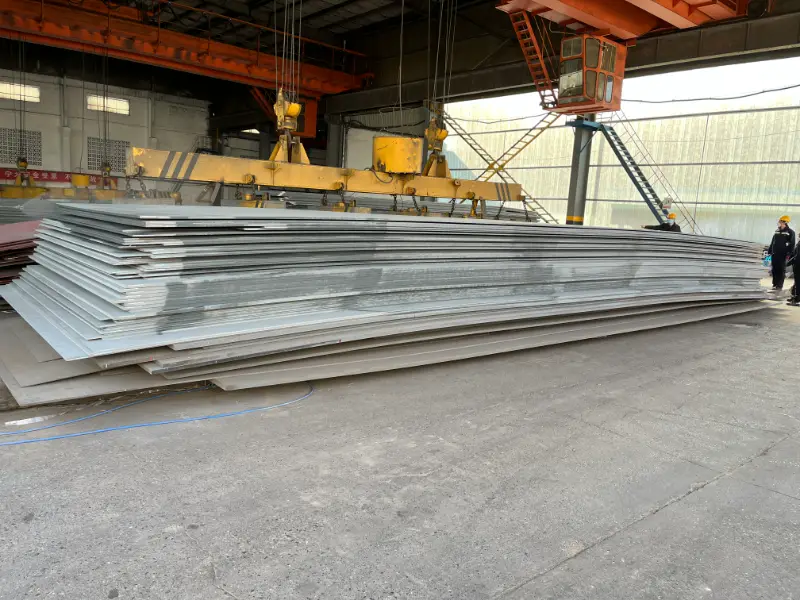
BV Grade DH32 Shipbuilding Steel Plate
BV Grade DH32 Shipbuilding Steel Plate: Comprehensive Material Data
Detailed material specifications for BV Grade DH32 shipbuilding steel plate including chemical composition, mechanical properties, physical properties, equivalent grades, applications, and processing guidelines.
Normalizing, controlled rolling, welding, cutting, forming
- Phone : +8618037372205
- Email : [email protected]
- WhatsApp: Contact via Whtsapp
- WeChat: +8618037372205
BV Grade DH32 Shipbuilding Steel Plate Introduction
BV Grade DH32 is a normalized high-strength hull structural steel plate certified by Bureau Veritas (BV) for marine construction. It offers a minimum yield strength of 315 MPa and excellent toughness at -20°C, suitable for critical ship structures. It is governed by BV NR216 – Rules on Materials and Welding. The steel is supplied in normalized or controlled-rolled condition, ensuring uniform mechanical properties. DH32 provides good weldability and formability, making it widely used in ship hulls, decks, and offshore platforms.
BV Grade DH32 Shipbuilding Steel Plate Chemical Composition
The following table lists the specified alloying elements for BV Grade DH32 as per BV NR216. All values are maximum unless a range is indicated. Microalloying elements Nb, V, Ti are allowed to refine grain size and improve toughness. Carbon Equivalent (CEQ) is also controlled for weldability.
| Element | Standard Value (%) | Remarks |
|---|---|---|
| Carbon, C | ≤0.18 | |
| Silicon, Si | 0.10–0.50 | |
| Manganese, Mn | 0.70–1.60 | |
| Phosphorus, P | ≤0.035 | |
| Sulfur, S | ≤0.035 | |
| Aluminium (acid soluble), Als | ≥0.015 | Grain refining |
| Niobium, Nb (if added) | ≤0.05 | Sum Nb+V+Ti ≤0.12% |
| Vanadium, V (if added) | ≤0.10 | Sum Nb+V+Ti ≤0.12% |
| Titanium, Ti (if added) | ≤0.02 | Sum Nb+V+Ti ≤0.12% |
| Copper, Cu | ≤0.35 | Residual |
| Chromium, Cr | ≤0.20 | Residual |
| Nickel, Ni | ≤0.40 | Residual |
| Molybdenum, Mo | ≤0.08 | Residual |
| Carbon Equivalent (CEV) | ≤0.38 | For thickness ≤50 mm (CEV = C+Mn/6+(Cr+Mo+V)/5+(Ni+Cu)/15) |
| Carbon Equivalent (CEV) | ≤0.40 | For thickness >50–100 mm |
BV Grade DH32 Shipbuilding Steel Plate Thermal and Electrical Physical Properties
The following physical properties are typical for normalized low-alloy carbon steel and are not specified within BV regulations but are representative for DH32 material. Values may vary with heat treatment, composition, and temperature.
| Property | Typical Value | Unit | Condition / Temperature |
|---|---|---|---|
| Density (ρ) | 7.85 | g/cm³ | 20°C |
| Elastic Modulus (E) | 205 | GPa | 20°C |
| Shear Modulus (G) | 80 | GPa | 20°C |
| Poisson's Ratio (ν) | 0.3 | – | 20°C |
| Coefficient of Thermal Expansion (α) | 11.7 × 10⁻⁶ | K⁻¹ | 20–100°C |
| Thermal Conductivity (λ) | 50 | W/(m·K) | 20°C |
| Specific Heat Capacity | 460 | J/(kg·K) | 20°C |
| Electrical Resistivity (ρ_e) | 0.20 × 10⁻⁶ | Ω·m | 20°C |
BV Grade DH32 Shipbuilding Steel Plate Mechanical Properties
Mechanical properties of BV Grade DH32 steel plate are determined according to BV test specifications. Tensile and impact testing are performed in the transverse direction unless otherwise specified. The impact test temperature for DH32 grade is -20°C.
| Property | Standard Requirement Value | Unit | Test Condition |
|---|---|---|---|
| Yield Strength (ReH) | ≥315 | MPa | Ambient temperature; plate thickness ≤100 mm |
| Tensile Strength (Rm) | 440–590 | MPa | Ambient temperature; plate thickness ≤100 mm |
| Elongation (A) | ≥22 | % | Gauge length 5.65√So; transverse; thickness ≤100 mm |
| Charpy V-notch Impact Energy (KV) | ≥34 (average) | J | At -20°C; transverse; specimen 10×10 mm; thickness ≤100 mm |
| Charpy V-notch Impact Energy (KV) | ≥24 (individual) | J | At -20°C; transverse; specimen 10×10 mm |
| Bend Test | No cracks (d=3a; 180°) | – | Thickness ≤30 mm, d = mandrel diameter, a = specimen thickness |
BV Grade DH32 Shipbuilding Steel Plate Exact Equivalent Material Standards and Substitutable Grades
| Country/Region | Standard | Grade | Remarks |
|---|---|---|---|
| International | ABS Rules | ABS DH32 | American Bureau of Shipping |
| Norway/Germany | DNV Rules | DNV DH32 | Det Norske Veritas (now DNV GL) |
| UK | LR Rules | LR DH32 | Lloyd's Register |
| Germany/International | GL Rules (historical) | GL DH32 | Germanischer Lloyd (now DNV GL) |
| South Korea | KR Rules | KR DH32 | Korean Register |
| Japan | NK Rules | NK DH32 | Nippon Kaiji Kyokai (ClassNK) |
| China | CCS Rules | CCS DH32 | China Classification Society |
| USA | ASTM A131/A131M | DH32 | Standard Specification for Structural Steel for Ships |
BV Grade DH32 Shipbuilding Steel Plate Application Introduction
BV DH32 steel is extensively used in shipbuilding and marine engineering due to its balanced strength, toughness, and weldability. It complies with international maritime regulations for hull structures. Typical processing includes hot forming, welding under controlled heat input, and cutting. Post-weld heat treatment may be applied to relieve stresses. Proper edge preparation and preheating are recommended for thicker sections.
Product Applications: Cargo ship hulls, Bulk carriers, Oil tankers, Container ships, Offshore platform decks and legs, Barges, Naval vessels
Processed into products: Main deck plates, Bottom shell plates, Side shell plates, Bulkhead plates, Stiffeners, Brackets, Girder webs, Hatch coamings
Application industries: Shipbuilding, Offshore engineering, Marine structures, Pressure vessel components (with supplementary approval)
BV Grade DH32 Shipbuilding Steel Plate Similar/Comparable Alternative Materials
| Country/Region | Standard | Grade | Comparison Notes |
|---|---|---|---|
| EU | EN 10025-4 | S355ML | Thermo-mechanically rolled; minimum yield 355 MPa vs 315 MPa for DH32; requires additional toughness verification for shipbuilding. |
| EU | EN 10025-2 | S355J2+N | Normalized structural steel; yield 355 MPa, impact -20°C; not marine approved; similar but lacks shipbuilding certifications. |
| USA | ASTM A572 | Grade 50 | High-strength low-alloy structural steel; yield 345 MPa; not specifically for marine use; comparable strength and weldability. |
| International | IMO/Classification Societies | E32/E36 | Higher strength grades (yield 315/355 MPa) with same or better toughness; alternative if higher strength needed with similar applications. |
Notes:
The steel is subject to mandatory inspection and testing by the classification society. Welders and welding procedures must be approved. For thicknesses above 50 mm, higher preheat and interpass temperatures may be required to avoid hydrogen cracking. Available in normalized or controlled rolled condition. CEQ and mechanical properties are verified per heat and batch. Surface condition: descaled, shot blasted, or as-rolled.
- Share



