
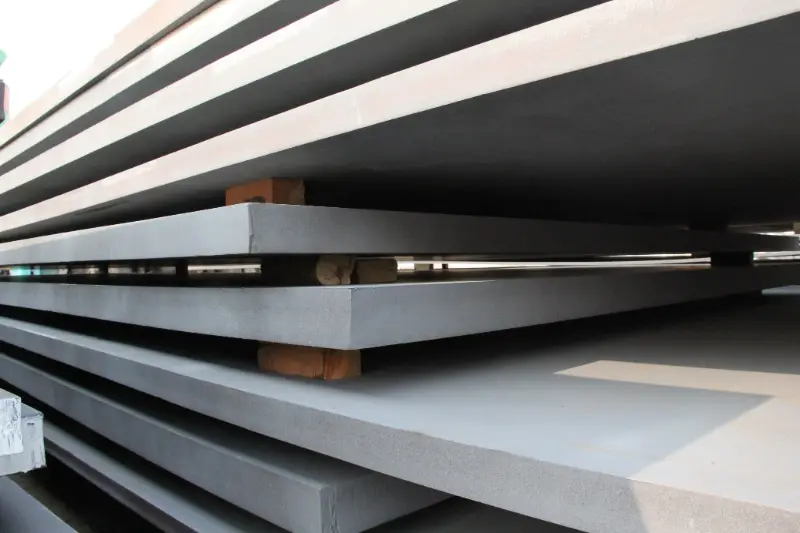
BV Grade EH32 Shipbuilding Steel Plate
BV Grade EH32 Shipbuilding Steel Plate | High Strength Marine Structural Steel
Comprehensive material data for BV Grade EH32 shipbuilding steel plate: chemical composition, mechanical and thermal properties, international equivalents, and typical applications in marine engineering.
Hot rolling, normalizing, thermo-mechanical control process (TMCP), welding, cold bending, cutting, machining
- Phone : +8618037372205
- Email : [email protected]
- WhatsApp: Contact via Whtsapp
- WeChat: +8618037372205
BV Grade EH32 Shipbuilding Steel Plate Introduction
BV Grade EH32 is a high-strength hull structural steel certified by Bureau Veritas, primarily used in shipbuilding and offshore structures. It offers a minimum yield strength of 315 MPa and reliable low-temperature toughness down to -40°C (EH designation). The steel is typically supplied in the normalized or thermo-mechanically controlled processed (TMCP) condition, ensuring fine grain structure and excellent weldability.
- Stringent control on impurities like sulfur and phosphorus
- Fine-grained practice with aluminium as grain refiner
- Microalloying elements (Nb, V, Ti) may be added for strength and toughness improvement
EH32 plates are suitable for critical structural members exposed to high stress and harsh marine environments.
BV Grade EH32 Shipbuilding Steel Plate Chemical Composition
The ladle analysis conforms to IACS UR W11 for yield strength 315 MPa grades. Microalloying elements (Nb, V, Ti) may be used singly or in combination to achieve the required mechanical properties.
- Carbon equivalent (CEV) is typically limited to ensure weldability, often calculated as CEV = C + Mn/6 + (Cr+Mo+V)/5 + (Ni+Cu)/15.
- Optional additions of Cu, Ni, Cr, Mo are permissible within the limits shown.
| Element | Maximum or Range (%) | Remarks |
|---|---|---|
| Carbon (C) | ≤ 0.18 | Ladle analysis |
| Silicon (Si) | ≤ 0.50 | Deoxidizer |
| Manganese (Mn) | 0.90 - 1.60 | For strength and toughness |
| Phosphorus (P) | ≤ 0.035 | Impurity element |
| Sulfur (S) | ≤ 0.035 | Impurity element |
| Aluminium (total Al) | ≥ 0.015 | Grain refining element |
| Niobium (Nb) | ≤ 0.05 | Optional microalloy |
| Vanadium (V) | ≤ 0.10 | Optional microalloy |
| Titanium (Ti) | ≤ 0.02 | Optional microalloy |
| Copper (Cu) | ≤ 0.35 | Tramp element |
| Chromium (Cr) | ≤ 0.20 | Residual element |
| Nickel (Ni) | ≤ 0.40 | Residual element |
| Molybdenum (Mo) | ≤ 0.08 | Residual element |
| Nitrogen (N) | ≤ 0.009 | When nitrogen binding elements are absent |
BV Grade EH32 Shipbuilding Steel Plate Thermal and Electrical Physical Properties
The following values are typical for carbon/microalloyed structural steels. Exact properties may vary slightly depending on composition and processing (e.g., hot-rolled vs normalized).
- Density is assumed at room temperature.
- Elastic moduli are for isotropic material.
- Thermal expansion coefficient is mean value between 20°C and 100°C.
| Property | Typical Value | Unit | Condition |
|---|---|---|---|
| Density (ρ) | 7850 | kg/m³ | At 20 °C |
| Elastic Modulus (E) | 205 | GPa | At 20 °C |
| Shear Modulus (G) | 80 | GPa | At 20 °C |
| Poisson's Ratio (ν) | 0.30 | - | Elastic range |
| Thermal Expansion Coefficient (α) | 12.0 × 10&supminus;&sup6; | K&supminus;¹ | 20-100 °C |
| Thermal Conductivity (λ) | 50 | W/(m·K) | At 20 °C |
| Specific Heat Capacity (c) | 460 | J/(kg·K) | At 20 °C |
| Electrical Resistivity (ρ̭͂) | 0.15 - 0.20 | Ω·mm²/m | At 20 °C |
BV Grade EH32 Shipbuilding Steel Plate Mechanical Properties
The listed mechanical properties are based on transverse test specimens taken from the plate and tested at room temperature, except Charpy impact tests performed at the designated temperature.
- Properties apply to thickness ≤ 50 mm in normalized or TMCP condition.
- For larger thicknesses (50-100 mm), a stress reduction may apply; consult the full standard.
- Bend test mandrel diameter depends on plate thickness and bending angle (usually 180°).
| Property | Minimum or Range | Unit | Test Conditions |
|---|---|---|---|
| Yield Strength (ReH) | ≥ 315 | MPa | t ≤ 50 mm, transverse |
| Tensile Strength (Rm) | 440 - 590 | MPa | t ≤ 50 mm, transverse |
| Elongation (A) | ≥ 22 | % | Gauge length 5.65√So, transverse |
| Charpy V-Notch Impact (KV) | ≥ 31 | J | Longitudinal, at -40 °C (EH grade) |
| Bend Test (180°) | No cracks | - | Bend diameter = 3a (a=thickness) for t ≤ 25 mm; 3a for t ≥ 25 mm |
BV Grade EH32 Shipbuilding Steel Plate Completely Equivalent Material Standards and Substitute Grades
| Country/Region (Classification Society) | Standard | Grade | Remarks |
|---|---|---|---|
| American Bureau of Shipping | ABS Rules | EH32 | Identical toughness and strength requirements |
| DNV GL (now DNV) | DNV Rules | EH32 | Equivalent grade for ship hull structural steel |
| Lloyd's Register | LR Rules | EH32 | Direct substitute; same minimum yield strength |
| China Classification Society | CCS Rules | EH32 | Recognized as equivalent per IACS requirements |
| ClassNK (Nippon Kaiji Kyokai) | NK Rules | EH32 | Equivalent high-strength hull steel |
| Korean Register | KR Rules | EH32 | Same mechanical and chemical requirements |
| RINA (Registro Italiano Navale) | RINA Rules | EH32 | Fully interchangeable with BV EH32 |
| Russian Maritime Register of Shipping | RS Rules | EH32 | Corresponding strength and toughness grade |
BV Grade EH32 Shipbuilding Steel Plate Application Introduction
BV EH32 steel plates are integral to modern ship construction and marine engineering due to their balanced strength, weldability, and low-temperature toughness. Typical applications include:
Product Applications: Ship hull plating (side shell, bottom, strength deck), Longitudinal and transverse stiffeners, Watertight and non-watertight bulkheads, Deckhouses and accommodation ladders, Offshore module structures
Processed into products: Plates cut and welded into hull blocks and sub-assemblies, Bent profiles for frames, stringers, and brackets, Machined parts like bearing housings and shaft supports, Welded girders and box columns for offshore cranes
Application industries: Shipbuilding: hulls, superstructures, bulkheads, decks, and stiffening members for tankers, bulk carriers, container ships, and passenger vessels, Offshore Engineering: jackets, topsides, helidecks, and support structures for oil & gas platforms and wind turbine foundations, Marine Equipment: winch platforms, bollards, towing bars, and other heavy-duty components exposed to sea water, Port & Harbor Infrastructure: lock gates, caissons, floating docks, and guide rails
BV Grade EH32 Shipbuilding Steel Plate Similar or Comparable Steel Grades for Reference
| Country/Region | Standard | Grade | Remarks |
|---|---|---|---|
| France / BV | BV NR216 | AH32 | Same strength, impact temperature 0 °C instead of -40 °C |
| France / BV | BV NR216 | DH32 | Same strength, impact temperature -20 °C |
| France / BV | BV NR216 | FH32 | Same strength, impact temperature -60 °C, for more severe cold service |
| France / BV | BV NR216 | EH36 | Higher strength (min YS 355 MPa), similar low-temperature toughness (-40 °C) |
| European EN | EN 10025-4 | S355M/ML | Thermomechanical rolled structural steel, YS 355 MPa; comparable but not identical chemistry |
Notes:
- Weldability: Preheating may be required for thick sections to avoid cold cracking; consult the manufacturer's welding guidelines.
- Zinc coating: EH32 plates can be hot-dip galvanized or coated for corrosion protection in marine environments.
- Testing: Mechanical tests are typically performed on each heat and from each plate as rolled, depending on the classification society's rules.
- Prime: Many mills produce EH32 to multiple classification society approvals simultaneously, simplifying supply chain for globally operating shipyards.
- Share



