
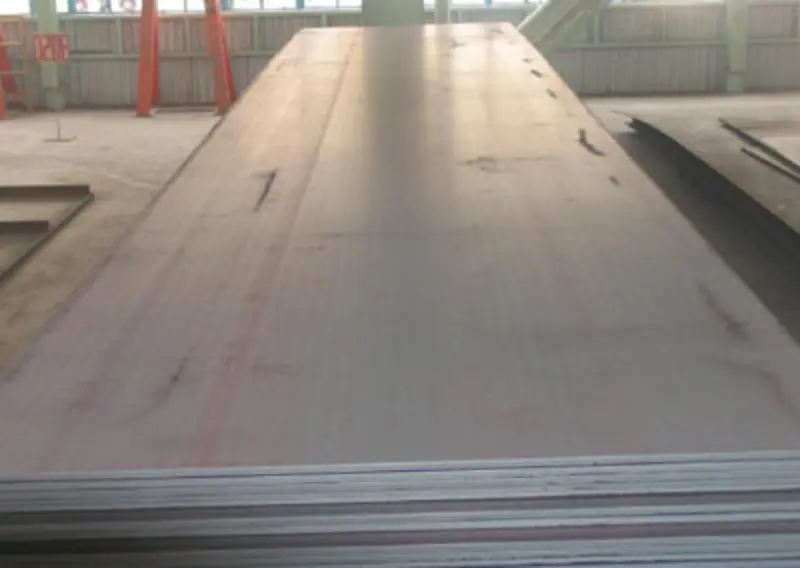
BV Grade FH32 Shipbuilding Steel Plate
BV Grade FH32 Shipbuilding Steel Plate for Low-Temperature Applications
Comprehensive data sheet for BV Grade FH32 high strength shipbuilding steel plate as per Bureau Veritas rules, including chemical composition, mechanical and thermal properties, and international equivalents.
Hot rolling and subsequent delivery conditions: Normalizing (N), Thermo-Mechanical Controlled Process (TMCP), or Quenching and Tempering (QT); suitable for welding, bending, and cold forming procedures typical in shipyards.
- Phone : +8618037372205
- Email : [email protected]
- WhatsApp: Contact via Whtsapp
- WeChat: +8618037372205
BV Grade FH32 Shipbuilding Steel Plate Introduction
BV Grade FH32 is a high strength shipbuilding structural steel plate designated under Bureau Veritas (BV) rules, conforming to IACS UR W11. The "F" signifies minimum impact toughness at -60°C, making it ideal for polar and low-temperature marine environments. It offers a minimum yield strength of 315 MPa and tensile strength in the range 440–590 MPa, combined with excellent weldability and cold-forming capabilities. Delivered primarily in normalized (N), thermo-mechanically controlled processed (TMCP), or quenched and tempered (QT) conditions, FH32 ensures reliable performance for critical hull structures, ice-strengthened vessels, and offshore platforms. Its fine-grain microstructure, controlled through microalloying with Nb, V, and Ti, provides high ductility and resistance to brittle fracture.
BV Grade FH32 Shipbuilding Steel Plate Chemical Composition
Typical ladle analysis based on BV Rules / IACS UR W11 for FH32. Additional grain-refining elements such as Nb, V, and Ti are used individually or in combination. Carbon equivalent (CEV) is controlled to ensure weldability, usually not exceeding 0.38%. Limits for residuals (Cr, Ni, Cu, Mo) are specified to avoid adverse effects on toughness.
| Element | Value (max, %) | Remarks |
|---|---|---|
| Carbon (C) | 0.18 | |
| Manganese (Mn) | 0.90 – 1.60 | Higher Mn may be used when specified |
| Silicon (Si) | 0.10 – 0.50 | |
| Phosphorus (P) | 0.025 | |
| Sulfur (S) | 0.025 | |
| Aluminum (Al total or acid soluble) | ≥ 0.015 | Minimum for grain refinement |
| Niobium (Nb) | 0.02 – 0.05 | Single or combined microalloying |
| Vanadium (V) | 0.05 – 0.10 | Single or combined microalloying |
| Titanium (Ti) | ≤ 0.02 | Single or combined microalloying |
| Copper (Cu) | ≤ 0.35 | Residual |
| Chromium (Cr) | ≤ 0.20 | Residual |
| Nickel (Ni) | ≤ 0.40 | Residual |
| Molybdenum (Mo) | ≤ 0.08 | Residual |
| Nitrogen (N) | ≤ 0.009 | If not bound by Al or other elements |
BV Grade FH32 Shipbuilding Steel Plate Thermal and Electrical Physical Properties
The values below represent typical physical properties for high-strength low-alloy shipbuilding steel. Actual figures may vary slightly depending on exact composition and heat treatment. These are provided for design calculations and are not mandatory in BV rules.
| Property | Typical Value | Unit | Test Condition / Remarks |
|---|---|---|---|
| Density (ρ) | 7.85 | g/cm³ | At room temperature |
| Modulus of elasticity (E) | 205 | GPa | Ambient temperature |
| Shear modulus (G) | ~80 | GPa | Estimated from E and ν |
| Poisson's ratio (ν) | 0.3 | – | Elastic range |
| Thermal expansion coefficient (α) | 11.5 × 10−⁰/K | K−¹ | Between 20°C and 100°C |
| Thermal conductivity (λ) | ~50 | W/(m·K) | At 20°C |
| Specific heat capacity | ~460 | J/(kg·K) | At 20°C |
| Electrical resistivity (ρ_e) | 0.22 – 0.25 | µΩ·m | At 20°C |
BV Grade FH32 Shipbuilding Steel Plate Mechanical Properties
Longitudinal tensile and impact test requirements for FH32. Plate thickness (t) influences yield and tensile requirements. Impact tests are performed at -60°C with average energy not less than 27 J. For transverse impact, minimum average energy is typically 20 J. Bend test is 180° with mandrel diameter = 3×t (t ≤ 50 mm). Properties apply to delivery condition N, TMCP, or QT.
| Property | Requirement | Unit | Test Condition / Thickness (t) |
|---|---|---|---|
| Yield strength (ReH, min) | 315 | MPa | t ≤ 50 mm |
| Yield strength (ReH, min) | 315 | MPa | 50 < t ≤ 70 mm |
| Yield strength (ReH, min) | 295 | MPa | 70 < t ≤ 100 mm |
| Tensile strength (Rm) | 440 – 590 | MPa | t ≤ 100 mm |
| Elongation (A5, min) | 22 | % | t ≤ 50 mm |
| Elongation (A5, min) | 21 | % | 50 < t ≤ 70 mm |
| Elongation (A5, min) | 20 | % | 70 < t ≤ 100 mm |
| Impact energy (KV, longitudinal) | ≥ 27 (average) / ≥ 19 (single) | J | -60°C |
| Impact energy (KV, transverse) | ≥ 20 (average) / ≥ 14 (single) | J | -60°C (if required) |
| Bend test (180°) | No cracks or defects | – | Mandrel dia. = 3t (t ≤ 50 mm) |
BV Grade FH32 Shipbuilding Steel Plate Identical / Directly Equivalent Material Standards and Substitutable Grades
| Country/Region | Standard | Grade | Remarks |
|---|---|---|---|
| International | IACS UR W11 | FH32 | Base requirement for all IACS members |
| France / International | BV Rules | FH32 | Original grade |
| USA | ABS Rules | FH32 | American Bureau of Shipping |
| China | CCS Rules | FH32 | China Classification Society |
| Norway/Germany | DNV Rules | FH32 | DNV classification society |
| UK | LR Rules | FH32 | Lloyd's Register |
| Japan | NK Rules | FH32 | Nippon Kaiji Kyokai |
| Italy | RINA Rules | FH32 | Registro Italiano Navale |
| Russia | RS Rules | FH32 | Russian Maritime Register of Shipping |
| Europe | EN 10025-4 | S355ML / S355NL | Must specify delivery condition and impact test temperature to match FH32 requirements |
| China (GB) | GB 712-2011 | FH32 | National standard, fully equivalent |
BV Grade FH32 Shipbuilding Steel Plate Application Introduction
BV FH32 is designed for critical marine and offshore structures exposed to low temperatures. Its high strength and superior notch toughness make it suitable for ice-strengthened vessels and Arctic/Antarctic service. The steel can be fabricated using conventional shipyard processes including
- Thermal cutting (oxy-fuel, plasma)
- Bending and forming (cold and hot)
- Welding with appropriate low-hydrogen consumables
- Surface preparation and coating
Product Applications: Polar class icebreakers, LNG carriers (membrane and Moss type), FPSO hulls and modules, Heavy lift vessels, Drill ships, Offshore platform legs and jack-up rigs, Submarine pressure hulls and support structures
Processed into products: Main hull plates (bottom, side, deck), Longitudinal and transverse framing, Bilge keels and rubbing strakes, Stiffeners and brackets, Bulkheads and watertight doors, Ice belt regions, Hatch covers and coamings, Foundations for heavy machinery, Structural members in low-temperature cargo tanks
Application industries: Shipbuilding, Offshore oil & gas, Marine engineering, Arctic and polar logistics, Naval defence
BV Grade FH32 Shipbuilding Steel Plate Similar / Nearby Substitute Material Recommendations
| Country/Region | Standard | Grade | Remarks |
|---|---|---|---|
| Europe | EN 10025-4 | S355ML | Similar strength and TMCP delivery; impact temperature must be confirmed as -60°C (commonly -50°C); may need supplementary requirements |
| Europe | EN 10025-4 | S355NL | Normalized condition, similar strength; toughness at -60°C may require special agreement |
| USA | ASTM A131 | FH32 | Same grade under ASTM A131; directly cross-reference |
Notes:
Carbon Equivalent (CEV) is typically limited to ≤0.38% (for t≤50 mm, TMCP condition) to ensure field weldability without excessive preheat. Welding should be performed using matching or undermatching filler metals, low-hydrogen processes, and controlled heat input to preserve HAZ toughness. Non-destructive testing (UT, RT) is conducted according to BV rules and project specifications. For thicknesses outside the given ranges, mechanical properties must be agreed at the time of enquiry and order. Surface condition and flatness tolerances follow BV requirements for hull structural steels.
- Share



