
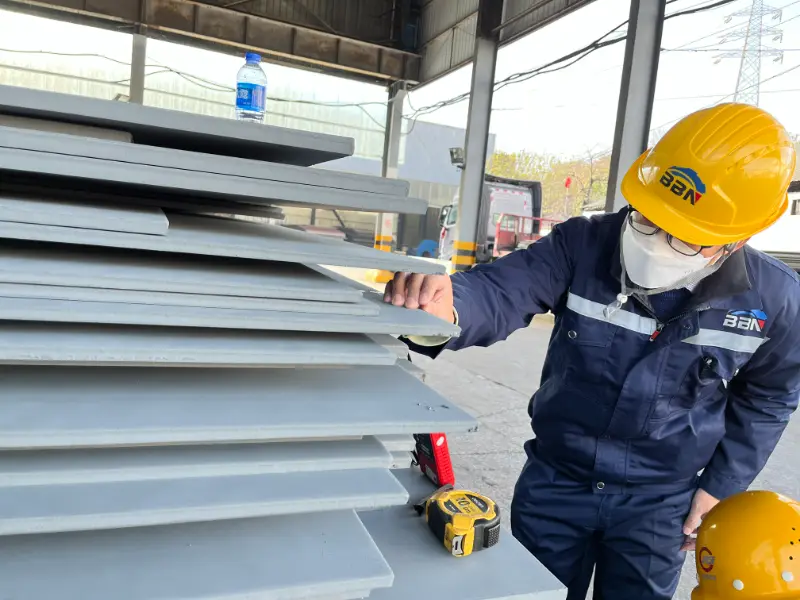
BV Grade AH36 Shipbuilding Steel Plate
BV Grade AH36 Shipbuilding Steel Plate: 355 MPa High-Strength Hull Steel Certified to Bureau Veritas
Complete material data for BV Grade AH36 shipbuilding steel plate: chemical composition, mechanical properties at various thicknesses, thermal and electrical physical properties, international equivalents, and typical applications in ship and offshore structures.
Hot rolling, controlled rolling (TMCP), normalizing, welding, cold forming (with caution due to strength level)
- Phone : +8618037372205
- Email : [email protected]
- WhatsApp: Contact via Whtsapp
- WeChat: +8618037372205
BV Grade AH36 Shipbuilding Steel Plate Introduction
BV Grade AH36 is a high-strength hull structural steel certified by Bureau Veritas (BV) for shipbuilding and offshore engineering. With a minimum yield strength of 355 MPa in plate thicknesses up to 50 mm, it belongs to the normalized/fine-grain-treated steel family and offers excellent weldability, good low-temperature impact toughness (tested at 0°C), and reliable service performance in harsh marine environments.
- Yield strength ≥ 355 MPa (t ≤ 50 mm)
- Tensile strength 490–630 MPa
- Charpy impact energy ≥ 34 J at 0°C (longitudinal)
- Available in thicknesses typically up to 100 mm
- Supplied in normalized or TMCP condition
BV Grade AH36 Shipbuilding Steel Plate Chemical Composition
The chemical composition of BV AH36 steel is tightly controlled to ensure consistent mechanical properties and weldability. The ladle analysis must comply with the limits specified in the BV Rules. Key microalloying elements (Nb, V, Ti) are used individually or in combination to achieve fine grain size and the required strength level. Residual elements are kept low to maintain toughness and avoid brittleness.
- Maximum carbon content 0.18%
- Manganese provides strength and hardenability
- Acid-soluble aluminium is mandatory for grain refinement and deoxidation
- Nb+V+Ti content may be summarised, and individual limits apply when used
| Element | Standard Value (wt%) | Remarks |
|---|---|---|
| Carbon (C) | ≤ 0.18 | Ladle analysis |
| Silicon (Si) | 0.10 – 0.50 | Deoxidation element |
| Manganese (Mn) | 0.90 – 1.60 | Strength and toughness balance |
| Phosphorus (P) | ≤ 0.035 | Maximum to avoid brittleness |
| Sulfur (S) | ≤ 0.035 | Maximum for steel cleanliness |
| Aluminium (Al, total) | ≥ 0.015 | Acid soluble; grain refinement |
| Niobium (Nb) | 0.02 – 0.05 | Optional, for fine grain (may be used alone or combined) |
| Vanadium (V) | 0.05 – 0.10 | Optional, for precipitation strengthening |
| Titanium (Ti) | ≤ 0.02 | Optional, limited to avoid detrimental effect on toughness |
| Copper (Cu) | ≤ 0.35 | Residual element |
| Chromium (Cr) | ≤ 0.20 | Residual element |
| Nickel (Ni) | ≤ 0.40 | Residual element |
| Molybdenum (Mo) | ≤ 0.08 | Residual element |
BV Grade AH36 Shipbuilding Steel Plate Thermal and Electrical Physical Properties
The physical properties listed below are typical for AH36-type normalised structural steel at ambient temperature and are often used in design and simulation. They do not originate directly from the BV standard but are commonly accepted for carbon‑manganese microalloyed steels. Actual values may vary slightly with composition and heat treatment.
- Density is typical for steel; no significant variation for AH36
- Thermal expansion and conductivity are crucial for welding distortion analysis
- Electrical resistivity affects cathodic protection design
| Property | Typical Value | Unit | Test Condition / Remarks |
|---|---|---|---|
| Density (ρ) | 7850 | kg/m³ | At 20°C |
| Modulus of elasticity (E) | 205 | GPa | At room temperature (20°C) |
| Shear modulus (G) | 79 | GPa | Calculated from E and ν |
| Poisson's ratio (ν) | 0.3 | — | Elastic range, room temperature |
| Thermal expansion coefficient (α) | 12.0 × 10⁻⁶ | K⁻¹ | 20°C to 100°C |
| Thermal conductivity (λ) | 50 | W/(m·K) | At 20°C |
| Specific heat capacity (cp) | 460 | J/(kg·K) | At 20°C |
| Electrical resistivity (ρe) | 0.20 | μΩ·m | At 20°C |
BV Grade AH36 Shipbuilding Steel Plate Mechanical Properties
Mechanical properties of BV AH36 plates are guaranteed through tensile and impact tests performed in accordance with BV Rules. Values depend on product thickness. All tests are carried out in the longitudinal direction for plates. The Charpy V‑notch impact test is performed at 0°C for grade AH36, with an average energy of at least 34 J. Bend test is carried out to verify formability.
- Yield strength decreases with increasing thickness above 50 mm
- Tensile strength range narrows at larger thicknesses
- Elongation requirement adjusts for plate gauge
- Impact toughness mandatory for primary structural applications
| Property | Required Value | Unit | Test Condition / Remarks |
|---|---|---|---|
| Yield strength (ReH) min. | ≥ 355 | MPa | Thickness t ≤ 50 mm |
| Yield strength (ReH) min. | ≥ 340 | MPa | Thickness 50 < t ≤ 70 mm |
| Yield strength (ReH) min. | ≥ 325 | MPa | Thickness 70 < t ≤ 100 mm |
| Tensile strength (Rm) | 490 – 630 | MPa | Thickness t ≤ 70 mm |
| Tensile strength (Rm) | 470 – 610 | MPa | Thickness 70 < t ≤ 100 mm |
| Elongation (A5) min. | ≥ 21 | % | Thickness t ≤ 50 mm, gauge length 5.65√So |
| Elongation (A5) min. | ≥ 20 | % | Thickness 50 < t ≤ 70 mm |
| Elongation (A5) min. | ≥ 19 | % | Thickness 70 < t ≤ 100 mm |
| Charpy-V impact (KV) min. | ≥ 34 (average) | J | 0°C, longitudinal, 10×10 mm specimen |
| Bend test (180°) – bend diameter | d = 3a | — | Thickness t ≤ 25 mm, sample width b = 2t |
| Bend test (180°) – bend diameter | d = 4a | — | Thickness 25 < t ≤ 50 mm, sample width b = 2t |
BV Grade AH36 Shipbuilding Steel Plate Fully Equivalent Material Standards and Substitutable Grades
The following shipbuilding steel grades are recognized as equivalent to BV AH36 under the respective classification society rules. They are interchangeable in ship construction with the same strength level, impact test temperature (0°C), and delivery condition. All are grade AH36 within the IACS UR W11 framework.
| Country / Region | Standard / Rule | Grade | Remarks |
|---|---|---|---|
| International (IACS) | IACS UR W11 | AH36 | Common unified requirement for AH36 steels |
| France | BV Rules Pt.2 | AH36 | Original Bureau Veritas rule |
| Norway / Germany | DNV Rules Pt.2 | AH36 | DNV GL (now DNV) – identical requirements |
| United States | ABS Rules | AH36 | American Bureau of Shipping |
| United Kingdom | LR Rules | AH36 | Lloyd's Register |
| China | CCS Rules | AH36 | China Classification Society |
| Japan | NK Rules | AH36 | Nippon Kaiji Kyokai (ClassNK) |
| South Korea | KR Rules | AH36 | Korean Register |
| Italy | RINA Rules | AH36 | Registro Italiano Navale |
| India | IRS Rules | AH36 | Indian Register of Shipping |
| Poland | PRS Rules | AH36 | Polski Rejestr Statków |
BV Grade AH36 Shipbuilding Steel Plate Application Introduction
BV AH36 steel plates are primarily used in the construction of seagoing ships, offshore structures, and other marine equipment where high strength combined with good weldability and reliable low‑temperature toughness is required. The grade is suitable for both longitudinally and transversely stressed members and can be formed, cut, and welded using standard shipyard practices.
- Approved by all major classification societies
- Wide availability in various plate dimensions
- Compatible with common welding consumables (E7018, E71T‑1, etc.)
Product Applications: Bulk carriers, container ships, tankers (hull shell, strength deck), Offshore supply vessels, anchor handling tugs, Floating production storage and offloading (FPSO) units, Offshore substations and converter platforms, Ice‑strengthened vessels (when toughness upgrade is applied)
Processed into products: Hull shell plates, bottom and side shell, Strength deck and stringer plates, Bulkheads and tank boundaries, Longitudinal and transverse web frames, Keel plates and bilge strakes, Hatch coamings and mast houses, Stiffeners, brackets, and doublers
Application industries: Shipbuilding (merchant, passenger, naval), Offshore oil & gas (jackets, topsides), Renewable energy (offshore wind turbine foundations, transition pieces), Port and harbour construction (sheet piling, quay walls), Bridge engineering (when marine environment requires certified steel)
BV Grade AH36 Shipbuilding Steel Plate Similar / Alternative Material Recommendations
Materials listed below are not identical to BV AH36, but they have comparable strength level or improved toughness. They can be considered in design when specific certification or impact temperature requirements differ.
| Country / Region | Standard | Grade | Remarks / Comparison |
|---|---|---|---|
| Multiple (IACS) | IACS UR W11 | DH36 | Same strength as AH36 but impact tested at -20°C; better toughness. |
| Multiple (IACS) | IACS UR W11 | EH36 | Impact tested at -40°C; for cold service environments. |
| Multiple (IACS) | IACS UR W11 | FH36 | Impact tested at -60°C; for arctic applications. |
| Europe | EN 10025-3 | S355N / NL | Thermomechanical rolled fine-grain structural steel; similar yield strength (355 MPa) but different impact temperature options (NL = -50°C). Not ship-class certified. |
| USA | ASTM A572 / A709 | Grade 50 | Structural steel with min. yield 345 MPa; not certified for shipbuilding, weldable, lower toughness guarantee. |
Notes:
Additional information: All plates are supplied with BV inspection certificates (3.1 or 3.2 according to EN 10204) stating the heat chemical composition, mechanical test results, and delivery condition.
- Ultrasonic testing may be required and is carried out in accordance with BV Rules (e.g., for critical zones).
- Welding procedures must be qualified; typical preheat for thick sections is 50‑100°C.
- Z‑property (through‑thickness) can be guaranteed if specified (Z15, Z25, Z35 in accordance with EN 10164).
- Corrosion allowance should be considered in design; AH36 has no specific corrosion resistance beyond ordinary carbon‑manganese steel.
- Share



