
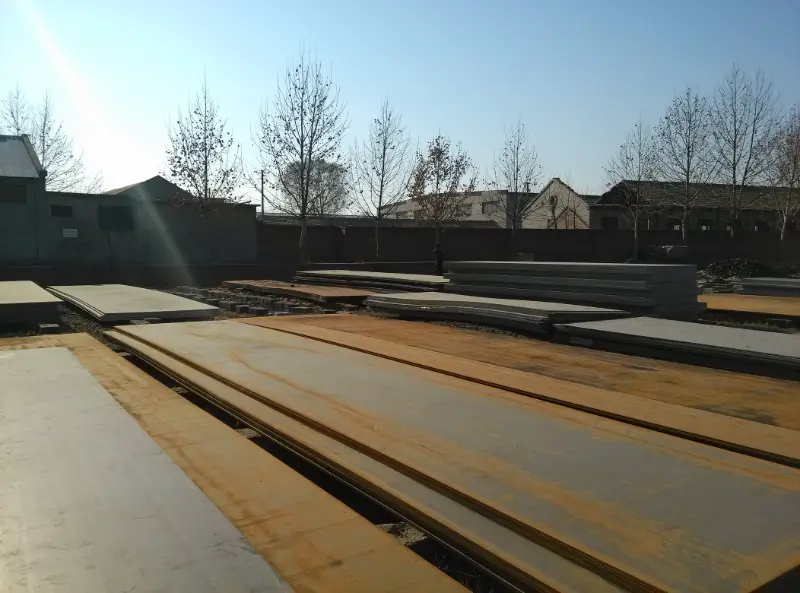
BV Grade DH36 Shipbuilding Steel Plate
BV Grade DH36 Shipbuilding Steel Plate: High-Strength Marine Structural Steel
Detailed material specification and data for BV Grade DH36 shipbuilding steel plate, including chemical composition, mechanical and physical properties, international equivalents, and application guidance.
Hot rolling, controlled rolling, normalizing, normalizing rolling, thermomechanical controlled processing (TMCP), quenching and tempering (optional), welding, cold forming
- Phone : +8618037372205
- Email : [email protected]
- WhatsApp: Contact via Whtsapp
- WeChat: +8618037372205
BV Grade DH36 Shipbuilding Steel Plate Introduction
BV Grade DH36 is a high-strength hull structural steel approved by Bureau Veritas for marine and offshore applications. It offers a minimum yield strength of 355 MPa and excellent low-temperature toughness, with Charpy impact testing at -20°C. The steel is typically supplied in normalized or thermomechanically controlled processed (TMCP) condition, ensuring good weldability and formability. Its balanced chemical composition, often microalloyed with niobium, vanadium, or titanium, provides fine grain structure and reliable mechanical performance in thick sections. DH36 is widely used in ship hulls, decks, and offshore platform structures where strength and durability in harsh marine environments are critical.
BV Grade DH36 Shipbuilding Steel Plate Chemical Composition
The chemical composition of BV DH36 steel is specified to ensure adequate strength, toughness, and weldability. Grain-refining elements such as aluminium, niobium, vanadium, and titanium are commonly added. The values below are according to BV Rules for thickness ≤ 50 mm. For thicker plates, slight adjustments may be permitted but must meet the same mechanical requirements.
| Element | Standard Value (wt%) | Remarks |
|---|---|---|
| Carbon (C) | ≤ 0.18 | |
| Silicon (Si) | ≤ 0.50 | |
| Manganese (Mn) | 0.90 - 1.60 | |
| Phosphorus (P) | ≤ 0.035 | |
| Sulfur (S) | ≤ 0.035 | |
| Aluminium (Al) (acid soluble) | ≥ 0.015 | Grain refinement |
| Niobium (Nb) | 0.02 - 0.05 | Optional microalloy |
| Vanadium (V) | 0.05 - 0.10 | Optional microalloy |
| Titanium (Ti) | ≤ 0.02 | Optional microalloy |
| Nitrogen (N) | ≤ 0.009 | If applicable |
| Chromium (Cr) | ≤ 0.25 | Residual or added |
| Nickel (Ni) | ≤ 0.40 | Residual or added |
| Copper (Cu) | ≤ 0.35 | Residual or added |
| Molybdenum (Mo) | ≤ 0.08 | Residual or added |
| Total others (Cr+Ni+Cu+Mo) | ≤ 0.80 | Combined limit |
BV Grade DH36 Shipbuilding Steel Plate Thermal and Electrical Physical Properties
The following physical properties are typical for a carbon-manganese structural steel like DH36 in the normalized or TMCP condition. Actual values may vary slightly depending on the precise composition and heat treatment. These data are useful for design calculations involving thermal stress, heat transfer, and electrical conductivity.
| Property | Standard Requirement Value | Unit | Test Condition |
|---|---|---|---|
| Density (ρ) | 7850 | kg/m³ | At 20°C |
| Modulus of Elasticity (E) | 200 - 210 | GPa | At 20°C |
| Shear Modulus (G) | 79 - 81 | GPa | At 20°C |
| Poisson's Ratio (ν) | 0.3 | At 20°C | |
| Thermal Conductivity (λ) | 45 - 52 | W/(m·K) | At 20°C |
| Specific Heat Capacity (c) | 460 - 500 | J/(kg·K) | At 20°C |
| Thermal Expansion Coefficient (α) | 11.5 - 12.5 × 10⁻⁶ | K⁻¹ | Between 20°C and 100°C |
| Electrical Resistivity (ρₑ) | 0.15 - 0.25 | µΩ·m | At 20°C |
BV Grade DH36 Shipbuilding Steel Plate Mechanical Properties
Mechanical properties are based on BV Rules for plates and sections with thickness ≤ 50 mm. Testing is performed at ambient temperature unless otherwise noted. Tensile testing is carried out on transverse specimens. Impact tests at -20°C are mandatory for DH36 grade. Bend test requirements ensure adequate ductility.
| Property | Standard Requirement Value | Unit | Test Condition |
|---|---|---|---|
| Yield Strength (ReH) | ≥ 355 | MPa | Thickness ≤ 50 mm |
| Tensile Strength (Rm) | 490 - 620 | MPa | Thickness ≤ 50 mm |
| Elongation after fracture (A) | ≥ 21 | % | Gauge length 5.65√S₀ (50 mm), transverse |
| Bend Test (Mandrel Diameter) | 3t (t = plate thickness) | - | 180° bending, no cracks |
| Charpy Impact Energy (KV) at -20°C | ≥ 34 (average of 3), ≥ 24 (individual) | J | Longitudinal specimens; for transverse specimens value may be reduced to 70% of longitudinal |
BV Grade DH36 Shipbuilding Steel Plate Full Equivalent Standards and Replaceable Grades
| Country / Region | Standard | Grade | Remarks |
|---|---|---|---|
| International (IACS) | UR W11 | DH36 | Normal and higher strength hull structural steel |
| USA | ABS Rules | ABS DH36 | American Bureau of Shipping |
| Norway | DNV Rules | DNV DH36 (NV DH36) | DNV GL, now DNV |
| UK | LR Rules | LR DH36 | Lloyd's Register |
| China | CCS Rules | CCS DH36 | China Classification Society |
| Japan | NK Rules | NK DH36 | Nippon Kaiji Kyokai (ClassNK) |
| Italy | RINA Rules | RINA DH36 | Registro Italiano Navale |
| South Korea | KR Rules | KR DH36 | Korean Register |
| India | IRS Rules | IRS DH36 | Indian Register of Shipping |
| France / International | BV Rules | BV DH36 | Bureau Veritas |
| Russia | RS Rules | RS DH36 | Russian Maritime Register of Shipping |
BV Grade DH36 Shipbuilding Steel Plate Application Introduction
BV DH36 steel is a workhorse material in shipbuilding and marine engineering due to its high strength, good weldability, and guaranteed low-temperature toughness. It can be fabricated by cutting, welding, bending, and machining. The steel is available in a wide range of thicknesses and widths, typically from 6 to 150 mm. In offshore applications, it withstands dynamic loads and harsh environmental conditions. Proper welding procedures, including preheat and interpass temperature control, are recommended for thick sections or when the carbon equivalent is high. Post-weld heat treatment is generally not required but can be applied for stress relief if needed.
Product Applications: Ship hull plates (deck, bottom, side shell), Longitudinal stiffeners, girders, and beams, Transverse bulkheads and watertight doors, Offshore platform main structural frames and deck plating, Piling, sheet piling, and quay wall structures, Crane booms and heavy lifting structures for marine use
Processed into products: Flame-cut and machined ship frames and brackets, Welded built-up sections (T-beams, L-beams) for longitudinal strength, Folded or rolled cylindrical sections for columns and riser supports, Bolted and welded connections for modular offshore units, Repair inserts and doubler plates for hull maintenance
Application industries: Shipbuilding and ship repair, Offshore oil and gas platforms (jackets, topsides), Marine renewable energy (wind turbine foundations, tidal structures), Port and harbor construction, Heavy civil engineering in marine environments
BV Grade DH36 Shipbuilding Steel Plate Similar / Substitute Material Recommendations
| Country / Region | Standard | Grade | Remarks |
|---|---|---|---|
| Europe | EN 10025-4 | S355ML | TMCP structural steel; similar strength and toughness class, but marine class approval not inherent |
| Europe | EN 10025-3 | S355N/NL | Normalized structural steel; S355NL meets low-temperature toughness comparable to DH36 |
| China | GB/T 712 | DH36 | Chinese shipbuilding steel standard, essentially the same as BV DH36 |
| USA | ASTM A131 / A131M | DH36 | Standard specification for structural steel for ships, directly equivalent |
| International | ISO 8500 | 550E | High-strength structural steel with minimum yield 355 MPa and Charpy at -40°C; may be considered but additional qualification needed for marine use |
Notes:
All DH36 steel must be approved by a Bureau Veritas surveyor during production and testing. For thicknesses greater than 50 mm, mechanical properties may be adjusted per BV rules; often the minimum yield strength is slightly reduced (e.g., ≥ 345 MPa for thickness 50-70 mm, ≥ 335 MPa for 70-100 mm). When welding, the carbon equivalent (CEV) should be calculated and suitable welding consumables selected. Typical CEV ≤ 0.38% for TMCP steel, ≤ 0.43% for normalized steel. The steel is resistant to brittle fracture at service temperatures down to -20°C, making it suitable for ice-class vessels. Stock availability includes wide dimensions and various lengths from major steel mills.
- Share



