
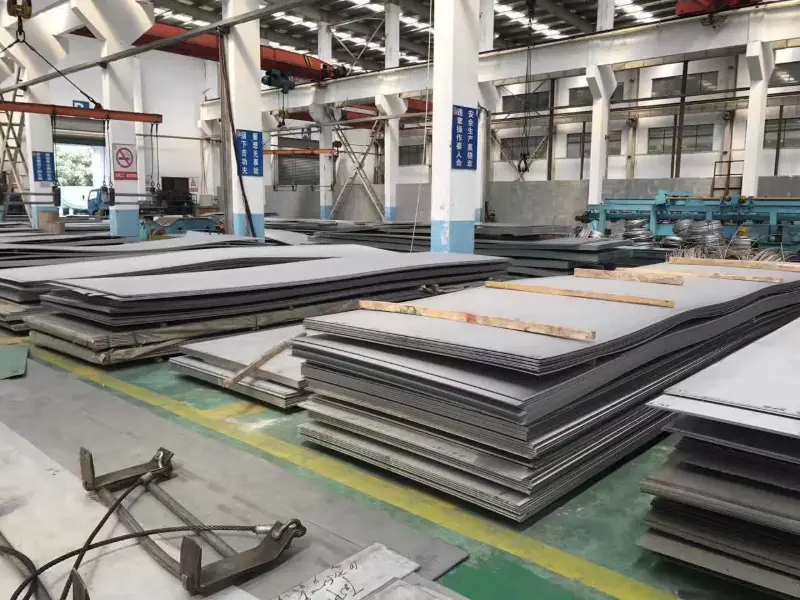
BV Grade EH36 Shipbuilding Steel Plate
BV Grade EH36 Shipbuilding Steel Plate - High Strength Offshore & Marine Structural Steel
Explore BV Grade EH36 steel: chemical composition, mechanical properties, thermal and electrical physical properties, international equivalents, and typical applications in shipbuilding and offshore engineering.
Hot rolling, thermomechanical rolling (TMCP), normalizing, quenching and tempering (as agreed), cutting, bending, welding, machining
- Phone : +8618037372205
- Email : [email protected]
- WhatsApp: Contact via Whtsapp
- WeChat: +8618037372205
BV Grade EH36 Shipbuilding Steel Plate Introduction
BV Grade EH36 is a high-strength, low-temperature service shipbuilding structural steel plate certified by Bureau Veritas (BV) in accordance with its Rules for the Classification of Ships. Designed for critical hull components and offshore structures, it delivers a minimum yield strength of 355 MPa and excellent notch toughness at -40 °C.
The grade belongs to the EH (Extra High quality) series under the BV Part 2, Chapter 1 specification, requiring strict control of chemical composition and thorough deoxidation (normally killed steel). Its enhanced resistance to brittle fracture makes it suitable for heavy-lift vessels, ice-strengthened hulls, and Arctic-class marine constructions. EH36 steel is typically supplied in normalized or thermomechanical rolled condition, offering good weldability and formability for complex structural fabrications.
BV Grade EH36 Shipbuilding Steel Plate Chemical Composition
Chemical composition is based on BV Rules Part 2, Chapter 1, Section 4 for EH36 grade. Maximum limits apply unless a range is specified. Note: For product thicknesses exceeding certain limits, adjusted carbon equivalent (CEV) requirements may be mandated. Grain-refining elements (Nb, V, Ti, Al) are often added at the manufacturer's discretion to meet mechanical requirements.
| Element | Specified Value (max or range) | Remarks |
|---|---|---|
| Carbon (C) | ≤ 0.18% | Maximum |
| Manganese (Mn) | 0.90 – 1.60% | Range |
| Silicon (Si) | ≤ 0.50% | Maximum |
| Phosphorus (P) | ≤ 0.035% | Maximum |
| Sulfur (S) | ≤ 0.035% | Maximum |
| Aluminum (Al) total | ≥ 0.015% (if used for grain refinement) | When specified or necessary to meet impact properties |
| Niobium (Nb) | 0.02 – 0.05% | Typical microalloying element (optional) |
| Vanadium (V) | 0.05 – 0.10% | Typical microalloying element (optional) |
| Titanium (Ti) | ≤ 0.02% | Optional for grain refinement |
| Carbon Equivalent (CE) | Typically ≤ 0.38% (as per BV Rules) | Depending on thickness and grade requirements |
BV Grade EH36 Shipbuilding Steel Plate Thermal and Electrical Physical Properties
Physical properties are typical for quenched and tempered or normalized high-strength structural steel with similar composition. Actual values may slightly vary depending on heat treatment and microalloying. These reference data are useful for structural and thermal analyses.
| Property | Typical Value | Unit | Test Condition / Remarks |
|---|---|---|---|
| Density (ρ) | 7.85 | g/cm³ | At 20 °C |
| Elastic Modulus (E) | 205 – 210 | GPa | At ambient temperature |
| Shear Modulus (G) | 80 – 82 | GPa | Calculated from E and ν |
| Poisson's Ratio (ν) | 0.29 – 0.30 | – | In elastic range |
| Coefficient of Thermal Expansion (α) | 11.5 – 12.5 | 10⁻⁶/K | Between 20 °C and 100 °C (average); slightly increases at higher temperatures |
| Thermal Conductivity (λ) | 42 – 50 | W/(m·K) | At 20 °C; decreases with increasing temperature |
| Specific Heat Capacity (c) | 450 – 490 | J/(kg·K) | At 20 °C; increases up to 600 J/(kg·K) near 600 °C |
| Electrical Resistivity (ρ_e) | 0.20 – 0.25 | μΩ·m | At 20 °C; depends on alloying elements and microstructure |
BV Grade EH36 Shipbuilding Steel Plate Mechanical Properties
Mechanical properties conform to BV Rules Part 2, Chapter 1. Test specimens are oriented transversely, except for plates produced by TMCP where longitudinal testing may be used as agreed.
Thickness ranges reflect common plate dimensions for shipbuilding; specific values for thicker materials (>50 mm) may be subject to separate agreement.
| Property | Standard Value | Unit | Condition / Remarks |
|---|---|---|---|
| Yield Strength (ReH) | ≥ 355 | MPa | For t ≤ 50 mm; for 50 < t ≤ 100 mm, min. ReH = 355 MPa may be reduced by up to 20 MPa as per BV rules |
| Tensile Strength (Rm) | 490 – 620 | MPa | For t ≤ 100 mm |
| Elongation (A) on gauge length 5.65√S₀ | ≥ 21 | % | For t ≤ 50 mm; lower values may apply for thicker sections (e.g., 19% for t > 70 mm) according to standard tables |
| Charpy V-Notch Impact Energy (KV) at -40 °C | ≥ 47 (longitudinal) / ≥ 31 (transverse) | J | Average of 3 specimens; minimum single value 70% of average. Test temperature -40 °C for EH grade. |
| Bend Test (180°) | No cracks or defects | – | Bend diameter = 3 × thickness for t ≤ 25 mm; 4 × thickness for t > 25 mm, on transverse samples |
BV Grade EH36 Shipbuilding Steel Plate Fully Equivalent Material Standards and Substitutable Grades
| Country / Region | Standard | Grade | Remarks |
|---|---|---|---|
| International (IACS) | UR W11 (Normal and Higher Strength Hull Structural Steels) | EH36 | Common basis for all IACS classification societies |
| United Kingdom | LR Rules | EH36 | Lloyd's Register; identical mechanical and toughness criteria |
| United States | ABS Rules | EH36 | American Bureau of Shipping; recognized equivalent |
| Norway | DNV Rules | EH36 | DNV; equivalent for marine and offshore structures |
| China | CCS Rules | EH36 | China Classification Society; directly equivalent to BV EH36 |
| Japan | NK Rules | EH36 | Nippon Kaiji Kyokai; chemically and mechanically equivalent |
| South Korea | KR Rules | EH36 | Korean Register; interchangeable in shipbuilding |
| Italy | RINA Rules | EH36 | Registro Italiano Navale; performance identical to BV EH36 |
BV Grade EH36 Shipbuilding Steel Plate Application Introduction
BV Grade EH36 is utilized where high strength combined with excellent low-temperature toughness is required. The steel plate can be readily cut, welded, and formed using standard shipyard practices. Preheating may be recommended for thick sections or when welding in cold conditions. Post-weld heat treatment is generally not required for thicknesses below 50 mm, but should follow approved procedures when specified.
EH36 plates are suitable for the fabrication of primary and secondary hull structures, ice belts, and critical tensile components subjected to dynamic loading in cold marine environments.
Product Applications: Bulk carriers, tankers, container ships, cruise ships, Ro-Ro ferries, Floating production storage and offloading (FPSO) vessels, Semi-submersible rigs and jack-up platforms, Offshore wind turbine towers and transition pieces, Ice-strengthened hulls for Arctic and Antarctic operations, Heavy-duty deck modules and helidecks
Processed into products: Hull plates (bottom, side, and deck), Longitudinal and transverse web frames and stiffeners, Ice breaker belts and splash zones, Rudder horns and rudder stocks (if fabricated from plate), Foundations for heavy machinery and cranes, Watertight bulkheads and shell plating, Bracket plates and connection doublers
Application industries: Shipbuilding and marine engineering, Offshore oil and gas exploration and production, Renewable energy (offshore wind turbine substructures), Heavy crane and lifting equipment (marine), Polar/ice-class vessels and icebreakers, Naval architecture and defence (naval vessels)
BV Grade EH36 Shipbuilding Steel Plate Similar or Alternative Materials
| Country / Region | Standard | Grade | Remarks |
|---|---|---|---|
| International / Multi-Societies | IACS UR W11 | DH36 | Similar yield and tensile strength but with lower toughness guarantee (impact test at -20 °C instead of -40 °C). Suitable for less severe temperature conditions. |
| Europe | EN 10025-4 | S355ML (Thermomechanical rolled) | Comparable strength level and low temperature toughness (impact at -50 °C for ML option). For structural applications beyond shipbuilding; requires agreement with classification society for marine use. |
| International / Multi-Societies | IACS UR W11 | EH40 | Higher strength grade (min. yield 390 MPa) with comparable –40 °C toughness. Used when weight savings or higher design stress is needed. |
| International / Multi-Societies | IACS UR W11 | EH32 | Lower strength (min. yield 315 MPa) but same low-temperature toughness. An alternative for less stressed components. |
| Russia | GOST R 52927 | E36 (Категория A50) | Russian maritime steel with similar chemistry and mechanical properties; impact test at -40 °C; may be accepted after approval by BV. |
Notes:
Supply condition: Plates are generally delivered with BV inspection certificate 3.1 or 3.2 (EN 10204). The material is subject to hot-dip galvanizing or protective painting systems for corrosion protection in marine environments.
Welding: EH36 exhibits good weldability; consumables should match the required strength and toughness. Preheating (50–150 °C) is recommended for thicknesses above 30 mm.
Forming: Cold forming is permitted up to 5% strain without additional heat treatment; hot forming may be performed followed by normalizing.
Z-test for lamellar tearing: When specified, through-thickness tensile properties (Z35) can be provided per BV rules.
- Share



