
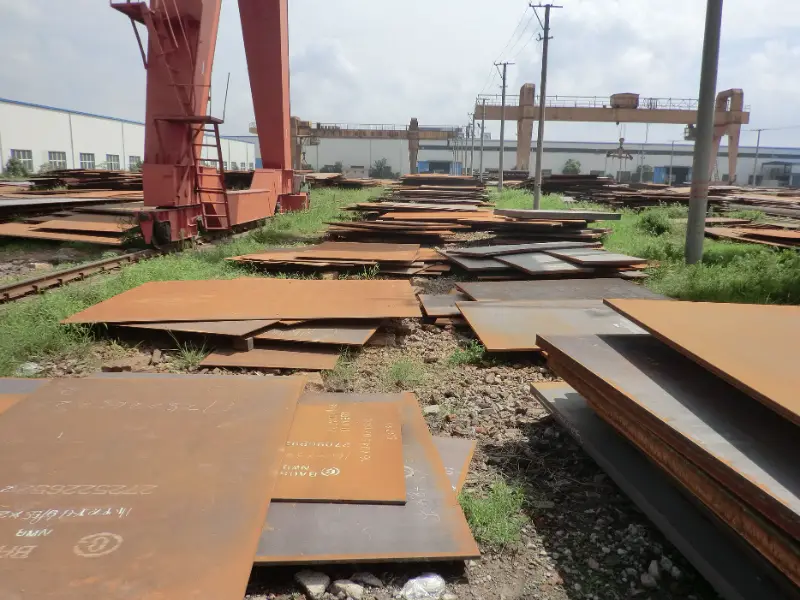
BV Grade FH36 Shipbuilding Steel Plate
BV Grade FH36 Shipbuilding Steel Plate: High-Strength Steel for Arctic and Low-Temperature Hull Structures
Comprehensive material data for BV Grade FH36 shipbuilding plate certified by Bureau Veritas. Includes chemical composition, mechanical properties at various thicknesses, and thermal/electrical physical properties.
Cutting, bending, welding (SAW, SMAW, GMAW), forming, machining, normalizing and stress relieving (if required)
- Phone : +8618037372205
- Email : [email protected]
- WhatsApp: Contact via Whtsapp
- WeChat: +8618037372205
BV Grade FH36 Shipbuilding Steel Plate Introduction
BV Grade FH36 is a high-strength shipbuilding structural steel plate with a minimum specified yield strength of 355 MPa, designed for service temperatures as low as -60°C. It is certified under the rules of Bureau Veritas (BV) and complies with the IACS UR W11 standard for ordinary and high-strength hull structural steels. The steel is characterized by excellent low-temperature toughness, good weldability, and resistance to brittle fracture.
- Thickness range: typically 8–100 mm
- Delivered in normalized (N), thermomechanically rolled (M), or quenched and tempered (Q) conditions
- Widely used in ice-strengthened vessels, Arctic offshore structures, and LNG carriers
- Available as plates, coils, and cut-to-length sheets
BV Grade FH36 Shipbuilding Steel Plate Chemical Composition
The chemical composition of BV Grade FH36 is strictly controlled to ensure high strength and excellent low-temperature toughness. Carbon equivalent (CEV) is typically limited to below 0.38% for improved weldability. Microalloying elements such as niobium, vanadium, and titanium are used for grain refinement and precipitation strengthening.
- All values are according to BV Rules, typical ranges may be tighter in practice.
- Values are for product thickness ≤ 100 mm; for thicker plates slight adjustments may apply.
| Element | Standard Value (max unless range) | Remarks |
|---|---|---|
| Carbon (C) | ≤ 0.16% | Ladle analysis |
| Silicon (Si) | 0.10 – 0.50% | |
| Manganese (Mn) | 0.90 – 1.60% | |
| Phosphorus (P) | ≤ 0.025% | Max 0.030% for product analysis |
| Sulfur (S) | ≤ 0.025% | Max 0.030% for product analysis |
| Niobium (Nb) | 0.02 – 0.05% | |
| Vanadium (V) | 0.05 – 0.10% | |
| Titanium (Ti) | ≤ 0.02% | |
| Aluminium (Al) - acid soluble | ≥ 0.015% | For fine grain practice |
| Copper (Cu) | ≤ 0.35% | Residual element control |
| Chromium (Cr) | ≤ 0.20% | Residual element control |
| Nickel (Ni) | ≤ 0.40% | Residual element control |
| Molybdenum (Mo) | ≤ 0.08% | Residual element control |
| Nitrogen (N) | ≤ 0.009% | If Al or Ti used for grain refinement |
BV Grade FH36 Shipbuilding Steel Plate Thermal and Electrical Physical Properties
The physical properties listed below are typical for high-strength low-alloy (HSLA) structural steels like FH36 in the as-delivered condition. Actual values may vary slightly depending on heat treatment and exact composition. Data sourced from general engineering references for similar grades.
- Measurements at room temperature unless stated otherwise.
| Property | Standard Value | Unit | Test Condition |
|---|---|---|---|
| Density (ρ) | 7.85 | g/cm³ | At 20 °C |
| Elastic Modulus (E) | 200 | GPa | At 20 °C, tension |
| Shear Modulus (G) | ~80 | GPa | At 20 °C, calculated |
| Poisson's Ratio (ν) | 0.3 | — | At 20 °C, elastic range |
| Thermal Expansion Coefficient (α) | 11.5 | 10⁻⁶/°C | Between 20 °C and 100 °C |
| Thermal Expansion Coefficient (α) | 12.4 | 10⁻⁶/°C | Between 20 °C and 300 °C |
| Thermal Conductivity (λ) | 50 | W/(m·K) | At 20 °C |
| Specific Heat Capacity (cp) | 460 | J/(kg·K) | At 20 °C |
| Electrical Resistivity (ρe) | 0.20 | 10⁻⁶ Ω·m | At 20 °C |
BV Grade FH36 Shipbuilding Steel Plate Mechanical Properties
Mechanical properties are determined on test pieces taken from the finished plate in transverse direction. Impact tests are performed on Charpy V-notch specimens at -60°C. Values depend on plate thickness and delivery condition; the table below reflects standard requirements for thicknesses up to 100 mm per BV Rules.
- ReH: Upper yield strength or 0.2% proof strength if yield point not pronounced.
- Rm: Tensile strength.
- A: Percentage elongation after fracture (gauge length 5.65√So).
| Property | Standard Requirement Value | Unit | Test Condition / Remarks |
|---|---|---|---|
| Yield Strength (ReH) | ≥ 355 | MPa | Thickness ≤ 100 mm, transverse |
| Tensile Strength (Rm) | 490 - 630 | MPa | Thickness ≤ 100 mm, transverse |
| Elongation (A) | ≥ 21 | % | Thickness ≤ 50 mm, transverse, gauge length 200 mm or proportional |
| Elongation (A) | ≥ 20 | % | Thickness > 50 mm to ≤ 70 mm, transverse |
| Elongation (A) | ≥ 19 | % | Thickness > 70 mm to ≤ 100 mm, transverse |
| Charpy Impact Energy (KV2) | ≥ 34 (longitudinal) | J | At -60 °C, 10x10 mm specimen |
| Charpy Impact Energy (KV2) | ≥ 24 (transverse) | J | At -60 °C, 10x10 mm specimen (where transverse testing specified) |
| Bend Test (180°) | d = 3a | — | Thickness ≤ 25 mm, a = specimen thickness, no cracks |
| Bend Test (180°) | d = 4a | — | Thickness > 25 mm to ≤ 100 mm, no cracks |
BV Grade FH36 Shipbuilding Steel Plate Recommendations for Fully Equivalent Material Standards and Substitutable Grades
BV Grade FH36 is fully equivalent to other IACS classification society grades with the same designation. These materials share the same chemical and mechanical requirements per IACS UR W11 and are interchangeable when certified by the respective society.
| Country / Region | Standard / Classification Society | Grade | Remarks |
|---|---|---|---|
| France / International | Bureau Veritas (BV) | FH36 | Original certification society |
| USA | American Bureau of Shipping (ABS) | FH36 | Same IACS UR W11 requirements |
| Norway / Germany | DNV | FH36 | Recognized by BV; often material dual-certified |
| United Kingdom | Lloyd's Register (LR) | FH36 | LR FH36 is equivalent |
| China | China Classification Society (CCS) | FH36 | CCS FH36, also per IACS |
| Japan | Nippon Kaiji Kyokai (ClassNK) | FH36 | NK FH36 |
| Italy | Registro Italiano Navale (RINA) | FH36 | RINA FH36 |
| Russia | Russian Maritime Register of Shipping (RS) | FH36 | RS FH36 |
| International | ASTM A131/A131M | FH36 | Standard specification for structural steel for ships |
BV Grade FH36 Shipbuilding Steel Plate Application Introduction
BV Grade FH36 is specifically designed for welded structures operating in extremely low ambient temperatures. Its certified impact toughness at -60°C makes it ideal for Arctic and sub-Arctic marine applications. The steel can be processed by common shipbuilding fabrication methods including cutting, forming, and welding with suitable consumables.
Product Applications: Hull plates and stiffeners, Deck platings and bulkheads, Reinforcement bars and beams, Sea chests and sea water piping (with appropriate coatings), Icebreaker bow and stern sections, Legs of jack-up rigs exposed to low temperature
Processed into products: Shell plating and stringer plates, Longitudinal and transverse frames, Bottom plates and bilge keels, Watertight doors and hatches, Brackets and web frames, Propeller nozzles and rudder structures (when low temperature property required)
Application industries: Shipbuilding (commercial and naval vessels), Offshore oil & gas (topside and hull structures), Arctic engineering and ice-class ships, Liquefied Natural Gas (LNG) carriers and floating storage regasification units (FSRUs), Renewable energy (offshore wind turbine foundations in cold seas), Port and harbour construction in cold climates
BV Grade FH36 Shipbuilding Steel Plate Recommendations for Similar / Analogous Alternative Materials
The following structural steels offer comparable strength levels but may differ in toughness (service temperature). Material substitution should consider design code requirements, especially minimum design temperature and impact test conditions.
| Country / Region | Standard | Grade | Remarks |
|---|---|---|---|
| European Union | EN 10025-4 | S355ML / S355MLO | Thermomechanical rolled fine grain steel, minimum impact energy 27 J at -50°C (similar strength, slightly higher temperature capability) |
| European Union | EN 10025-4 | S420MLO | Higher strength (420 MPa min yield), -50°C impact; may be an alternative where higher strength allows thickness reduction |
| European Union | EN 10225 | S355G10+N / +M | Weldable structural steels for fixed offshore structures, -40°C to -60°C depending on quality |
| International | API 2W / 2Y | Grade 50, 60 | Steel plates for offshore structures, some with sufficient low-temperature toughness |
| Japan | JIS G 3106 | SM570 (special low-temp treatment) | 570 MPa tensile class, but requires additional low-temperature qualification to match FH36 |
Notes:
For welding, low-hydrogen practices and appropriate preheat/interpass temperatures are recommended to avoid cold cracking. Typical carbon equivalent CE(IIW) ≤ 0.38% ensures good weldability. Supplementary requirements (e.g., through-thickness properties, ultrasonic testing, or additional heat treatment) may be agreed upon at the time of enquiry and order. Always refer to the latest BV Rules or the project-specific specification for the most up-to-date requirements.
- Share



