
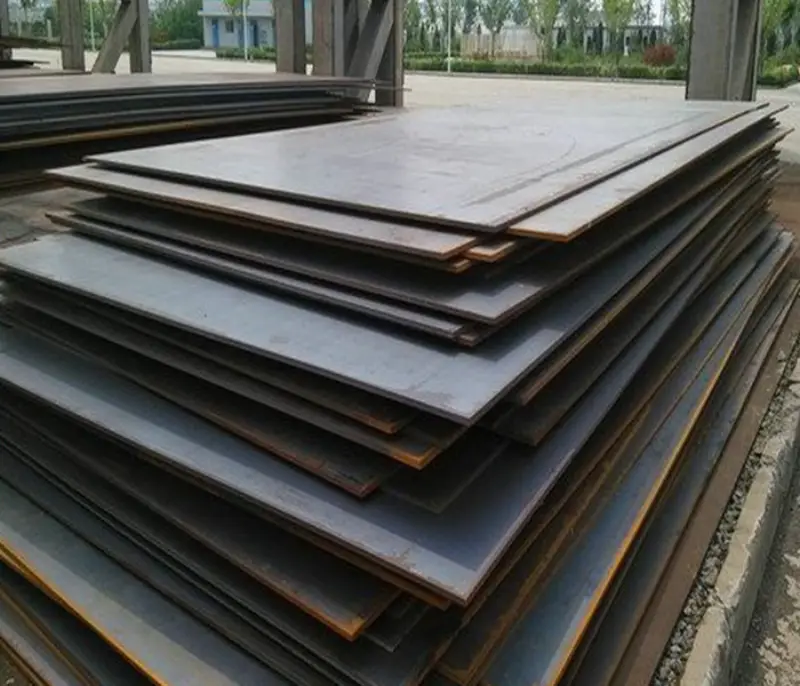
BV Grade AH40 Shipbuilding Steel Plate
BV Grade AH40 Shipbuilding Steel Plate: High Strength & Exceptional Weldability for Marine Structures
Explore the chemical composition, mechanical properties, thermal performance, and international equivalents of BV Grade AH40 shipbuilding steel. Ideal for marine and offshore structural applications.
Hot rolling, normalizing, thermomechanical controlled processing (TMCP), quenching and tempering may be allowed for certain thicknesses
- Phone : +8618037372205
- Email : [email protected]
- WhatsApp: Contact via Whtsapp
- WeChat: +8618037372205
BV Grade AH40 Shipbuilding Steel Plate Introduction
BV Grade AH40 is a high-strength hull structural steel specified by Bureau Veritas (BV) Rules for the Classification of Steel Ships. It falls under the category of high-tensile shipbuilding steels with a minimum yield strength of 390 MPa. The "AH" designation indicates its suitability for service temperatures down to 0 °C, where it must meet minimum impact energy requirements of 41 J (longitudinal) on Charpy V-notch specimens.
- Excellent weldability and formability due to controlled microalloying and fine grain structure.
- Balanced chemistry with restricted carbon, manganese, and microalloying elements (Nb, V, Ti) ensures high strength without sacrificing toughness.
- Supplied typically in normalized, hot-rolled, or thermomechanical controlled processed (TMCP) condition depending on thickness and customer requirements.
- Widely applied in the construction of tankers, bulk carriers, container ships, offshore platforms, and other large marine structures that demand a combination of strength, reliability, and cost-efficiency.
- Conforms to Bureau Veritas material certificate requirements, often with additional testing such as ultrasonic examination and through-thickness tensile testing if specified.
BV Grade AH40 Shipbuilding Steel Plate Chemical Composition
The chemical composition is designed to provide high strength, good weldability, and adequate toughness at 0 °C. The values shown represent ladle analysis limits.
- Carbon (C) is limited to ensure weldability; higher manganese compensates for strength.
- Microalloying elements (Nb, V, Ti) provide grain refinement and precipitation strengthening. Aluminum is required as a grain refiner and deoxidizer (fully killed steel).
- Residual elements (Cr, Ni, Mo, Cu) are controlled to maintain consistency but not deliberately added in standard grades unless specified.
| Element | Max/Min Value (%) | Remarks |
|---|---|---|
| Carbon (C) | ≤ 0.18 | Ladle analysis |
| Silicon (Si) | ≤ 0.50 | |
| Manganese (Mn) | 0.90 – 1.60 | Higher Mn may be agreed for thicker plates |
| Phosphorus (P) | ≤ 0.035 | |
| Sulfur (S) | ≤ 0.035 | |
| Chromium (Cr) | ≤ 0.20 | Residual limit |
| Molybdenum (Mo) | ≤ 0.08 | Residual limit |
| Nickel (Ni) | ≤ 0.40 | Residual limit |
| Copper (Cu) | ≤ 0.35 | Residual limit |
| Niobium (Nb) | 0.02 – 0.05 | |
| Vanadium (V) | 0.05 – 0.10 | |
| Titanium (Ti) | ≤ 0.02 | If Titanium is used, minimum Al content to be agreed |
| Aluminum (Al, total) | ≥ 0.02 | Fully killed, acid-soluble Al usually ≥ 0.015% |
| Nitrogen (N) | ≤ 0.012 | If not intentionally added |
| Carbon Equivalent (Ceq) | ≤ 0.38 (typically) | Ceq = C + Mn/6 + (Cr+Mo+V)/5 + (Ni+Cu)/15; may be adjusted per BV rules |
BV Grade AH40 Shipbuilding Steel Plate Thermal and Electrical Physical Properties
The following physical properties are typical for AH40 steel as a low-alloy high-strength steel and are provided for design purposes. These are not mandatory requirements from the BV specification but are representative values from technical literature.
- Variations may occur depending on actual chemical composition, heat treatment, and microstructural condition.
- Density is taken as 7.85 g/cm³ for weight calculations.
- Thermal conductivity decreases with increasing temperature; the value given is at ambient conditions.
| Property | Typical Value | Unit | Test Condition / Temperature |
|---|---|---|---|
| Density (ρ) | 7850 | kg/m³ | 20 °C |
| Modulus of Elasticity (E) | 205 – 210 | GPa | 20 °C, static |
| Shear Modulus (G) | ~80 | GPa | Calculated from E and Poisson's ratio |
| Poisson's Ratio (ν) | 0.29 – 0.30 | – | In elastic range |
| Coefficient of Thermal Expansion (α) | 11.5 – 12.5 (range) | 10⁻⁶/K (or µm/m·K) | 20 – 100 °C |
| Thermal Conductivity (λ) | ~50 | W/(m·K) | 20 °C |
| Specific Heat Capacity (cp) | ~460 | J/(kg·K) | 20 °C |
| Electrical Resistivity (ρₑ) | ~0.20 – 0.25 | µΩ·m | 20 °C, typical for low-alloy steel |
BV Grade AH40 Shipbuilding Steel Plate Mechanical Properties
Mechanical properties are verified on standard test specimens taken transverse to the rolling direction unless otherwise agreed. Yield strength and tensile strength depend on plate thickness. Charpy impact testing at 0 °C is mandatory for AH40; the required energy is 41 J for longitudinal specimens (27 J for transverse). Bending tests (180°) are performed to confirm formability without cracking.
- Thickness ranges up to 150 mm are covered, but properties may be slightly reduced for very thick plates (as per BV rules).
- Values in the table represent the most common thickness categories; for exact values of plates > 100 mm, reference to BV Part 2, Chapter 1 is necessary.
| Property | Specified Value | Unit | Test Condition / Remarks |
|---|---|---|---|
| Yield Strength (ReH, min) | 390 | MPa | Thickness ≤ 50 mm |
| Yield Strength (ReH, min) | 370 | MPa | 50 mm < Thickness ≤ 70 mm |
| Yield Strength (ReH, min) | 350 | MPa | 70 mm < Thickness ≤ 100 mm |
| Yield Strength (ReH, min) | (As agreed) | MPa | Thickness > 100 mm |
| Tensile Strength (Rm) | 510 – 660 | MPa | Thickness ≤ 100 mm |
| Elongation (A, min) | 20 | % | Gauge length 5.65√So (L0=5d), transverse, Thickness ≤ 50 mm |
| Elongation (A, min) | 19 | % | 50 mm < Thickness ≤ 70 mm |
| Elongation (A, min) | 18 | % | 70 mm < Thickness ≤ 100 mm |
| Bend Test (D=3a, 180°) | No cracks | – | All thicknesses, bend diameter 3 times thickness, 180° bend |
| Charpy Impact (KV, min) | 41 | J | Longitudinal, 0 °C, V-notch, standard 10×10 mm; 27 J for transverse |
| Charpy Impact (KV, min) | 27 | J | Transverse, 0 °C, V-notch, standard 10×10 mm (if agreed) |
BV Grade AH40 Shipbuilding Steel Plate Fully Equivalent Materials: AH40 Grades Recognized by Major Classification Societies
| Country/Region | Standard/Society | Grade | Remarks |
|---|---|---|---|
| United Kingdom | Lloyd's Register (LR) | LR AH40 | Identical strength and impact temperature requirements |
| Norway/Germany | DNV (former DNV GL) | DNV AH40 | Now part of DNV rules |
| USA | American Bureau of Shipping (ABS) | ABS AH40 | Recognized equivalent for AH40 |
| China | China Classification Society (CCS) / GB 712-2011 | CCS AH40 | GB 712 also uses AH40 |
| Japan | Nippon Kaiji Kyokai (NK / ClassNK) | NK AH40 | |
| South Korea | Korean Register (KR) | KR AH40 | |
| Italy | Registro Italiano Navale (RINA) | RINA AH40 | |
| Russia | Russian Maritime Register of Shipping (RMRS) | RMRS AH40 | Strength category A40 with 0 °C impact |
| IACS | IACS UR W11 | High strength steel AH40 | Unified Requirement accepted by all members |
BV Grade AH40 Shipbuilding Steel Plate Application Introduction
BV Grade AH40 is a workhorse material for large welded marine structures. Its combination of high strength and good weldability allows engineers to reduce plate thickness and structural weight without sacrificing safety.
- Shipbuilding: Used for hull envelopes (side shells, bottom plates, weather decks), bulkheads, longitudinal stiffeners, and major structural girders of vessels operating in temperate waters.
- Offshore engineering: Applicable in topside modules, flare booms, and structural components of fixed platforms where 0 °C toughness is sufficient.
- Heavy fabrication: Suitable for pressure vessels, storage tanks, bridges, and crane booms that require high yield strength and reliable toughness at standard temperatures.
Product Applications: Ship hulls and superstructures, Deck plates and bottom plates, Longitudinal and transverse stiffeners, Transverse web frames and girders, Offshore module structural frames, Caisson and sheet pile walls, Bridges and gantry crane main girders
Processed into products: Welded built-up sections (T-beams, L-beams, I-beams in ship framing), Plate field panels (flat and curved) for hulls, Deck and shell plate assemblies, Bulkhead plates with stiffeners, Doubler plates and insert plates under high stress areas, Fatigue-sensitive connections designed with standard AH40 ductility
Application industries: Shipbuilding (tankers, bulk carriers, container ships, ferries), Offshore oil & gas (topside structures, jackets, decks), Port and marine construction (quay wall steel, caisson bodies), Heavy machinery and transportation equipment
BV Grade AH40 Shipbuilding Steel Plate Similar or Alternative Grades with Comparable Strength but Different Toughness Levels
| Country/Region | Standard | Grade | Remarks / Differences |
|---|---|---|---|
| All IACS members | Various class rules | DH40 | Same strength (min 390 MPa), impact test temperature -20 °C, better toughness |
| All IACS members | Various class rules | EH40 | Same strength, impact test temperature -40 °C, for low-temperature service |
| All IACS members | Various class rules | FH40 | Same strength, impact test temperature -60 °C, highest toughness requirement |
| All IACS members | Various class rules | AH36 | Lower strength (min 355 MPa), impact at 0 °C, often used for less critical sections |
| All IACS members | Various class rules | DH36/EH36 | Lower strength, higher toughness alternatives |
| Europe | EN 10025-4 | S460M/ML | Thermomechanical rolled weldable fine grain steel, min 460 MPa, thicker gauge |
| Europe | EN 10025-6 | S460Q/QL/QL1 | Quenched and tempered, higher Ceq, less common in shipbuilding but similar strength range |
Notes:
Additional remarks:
- Material can be delivered with enhanced through-thickness properties (Z-quality, e.g., Z25, Z35) when specified, to prevent lamellar tearing during welding of highly restrained joints.
- Ultrasonic examination according to BV rules (or to EN 10160 or ASTM A578) is common for plates above certain thicknesses (e.g., > 20 mm).
- Surface condition and tolerances typically follow BV requirements or relevant international standards (e.g., EN 10029 for dimensional tolerances).
- Painted or shop-primed plates are available upon request.
- Certification with Bureau Veritas inspection and stamp is mandatory; mills must be approved by BV.
- Share



