
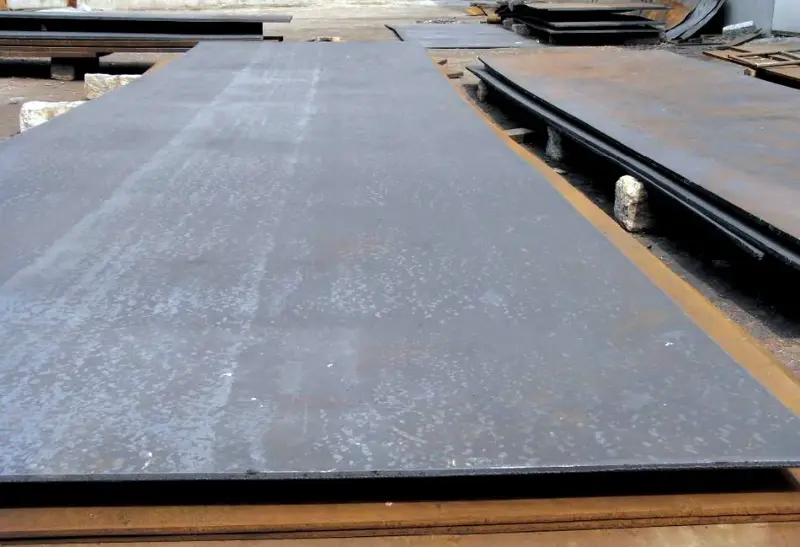
BV Grade DH40 Shipbuilding Steel Plate
BV Grade DH40 Shipbuilding Steel Plate: High-Strength Hull Structural Steel Certified by Bureau Veritas
BV DH40 is a high-strength shipbuilding steel plate certified by Bureau Veritas. It guarantees minimum yield strength of 390 MPa, excellent weldability, and reliable low-temperature toughness at -20°C, widely used in hulls, offshore platforms, and marine structural components.
Hot rolling, normalizing, thermo-mechanical controlled processing (TMCP), welding, flame cutting, cold forming
- Phone : +8618037372205
- Email : [email protected]
- WhatsApp: Contact via Whtsapp
- WeChat: +8618037372205
BV Grade DH40 Shipbuilding Steel Plate Introduction
BV DH40 is a normalized or thermo-mechanical controlled processed (TMCP) high-strength structural steel for shipbuilding, issued by Bureau Veritas (BV) in accordance with the BV Rules for the Classification of Steel Ships. As a D-grade steel in the 40 kgf/mm² class, it combines a minimum yield strength of 390 MPa with notch toughness tested at -20°C, making it suitable for critical marine applications in cold and temperate waters. Its strictly controlled chemical composition, low carbon equivalent, and fine-grained microstructure ensure excellent weldability and resistance to brittle fracture, fatigue, and corrosion in harsh marine environments. Typical delivery condition is normalized or TMCP, with plates available in wide thickness ranges for hulls, decks, bulkheads, and offshore structures.
BV Grade DH40 Shipbuilding Steel Plate Chemical Composition
The chemical composition of BV DH40 steel plate is tightly controlled to achieve high strength and good low-temperature toughness. The maximum limits for impurities and the optional microalloying elements ensure a fine grain structure and improve weldability. Carbon equivalent (CEV) is monitored to avoid cold cracking during welding.
| Element | Standard Value (wt.%) | Remarks |
|---|---|---|
| C | ≤ 0.18 | Max |
| Si | 0.10 – 0.50 | Range |
| Mn | 0.90 – 1.60 | Range |
| P | ≤ 0.030 | Max |
| S | ≤ 0.030 | Max |
| Al (acid soluble) | ≥ 0.015 | Min, for grain refinement |
| Nb | ≤ 0.05 | Optional microalloy, max |
| V | ≤ 0.10 | Optional microalloy, max |
| Ti | ≤ 0.02 | Optional grain-refining addition, max |
| Cu | ≤ 0.35 | Residual element, max |
| Cr | ≤ 0.20 | Residual element, max |
| Ni | ≤ 0.40 | Residual element, max |
| Mo | ≤ 0.08 | Residual element, max |
| CEV | ≤ 0.40 (t ≤ 50 mm) | CEV = C + Mn/6 + (Cr+Mo+V)/5 + (Ni+Cu)/15 |
BV Grade DH40 Shipbuilding Steel Plate Physical Properties
The physical and electrical properties of BV DH40 are typical for low‑carbon high‑strength structural steels. These values are not mandatory specification items but serve as useful reference for design, thermal analysis, and welding simulations. Slight variations may occur depending on exact composition and heat treatment.
| Property | Typical Value | Unit | Test Condition |
|---|---|---|---|
| Density (ρ) | 7.85 | g/cm³ | 20°C |
| Elastic modulus (E) | 207 | GPa | 20°C, static tensile test |
| Shear modulus (G) | 81 | GPa | 20°C, calculated |
| Poisson's ratio (ν) | 0.30 | – | 20°C |
| Thermal expansion coeff. (α) | 11.5 – 12.5 | 10⁻⁶/K | 20 – 100°C |
| Thermal conductivity (λ) | 48 – 52 | W/(m·K) | 20°C |
| Specific heat capacity | 460 – 510 | J/(kg·K) | 20°C |
| Electrical resistivity (ρ_e) | 0.15 – 0.20 | 10⁻⁶ Ω·m | 20°C |
BV Grade DH40 Shipbuilding Steel Plate Mechanical Properties
Mechanical properties of BV DH40 steel plates are verified by tensile and Charpy V‑notch impact tests. Minimum yield strength, tensile strength, and elongation depend on plate thickness. Impact energy is measured at -20°C for longitudinal specimens and must meet the tabulated minima to ensure safe service at low ambient temperatures.
| Property | Requirement | Unit | Test Condition |
|---|---|---|---|
| ReH (Yield Strength) | ≥ 390 | MPa | t ≤ 50 mm, transverse |
| ReH (Yield Strength) | ≥ 380 | MPa | 50 < t ≤ 70 mm, transverse |
| ReH (Yield Strength) | ≥ 370 | MPa | 70 < t ≤ 100 mm, transverse |
| Rm (Tensile Strength) | 510 – 650 | MPa | All thicknesses, transverse |
| A (Elongation) | ≥ 20 | % | t ≤ 50 mm, gauge length 5.65√S0, transverse |
| A (Elongation) | ≥ 20 | % | 50 < t ≤ 70 mm, transverse |
| A (Elongation) | ≥ 19 | % | 70 < t ≤ 100 mm, transverse |
| Bend test (180°) | d = 3a | – | t ≤ 50 mm, no cracks |
| Bend test (180°) | d = 4a | – | 50 < t ≤ 100 mm, no cracks |
| KV2 (Charpy V‑notch) | ≥ 34 | J | -20°C, longitudinal, t ≤ 50 mm |
| KV2 (Charpy V‑notch) | ≥ 27 | J | -20°C, longitudinal, 50 < t ≤ 70 mm |
| KV2 (Charpy V‑notch) | ≥ 24 | J | -20°C, longitudinal, 70 < t ≤ 100 mm |
BV Grade DH40 Shipbuilding Steel Plate Equivalent Material Standards and Substitute Grades
| Country / Region | Standard | Grade | Remarks |
|---|---|---|---|
| International | IACS UR W11 | DH40 | Common unified requirement for shipbuilding steel |
| USA / ABS | ABS Rules | ABS DH40 | Fully equivalent grade by American Bureau of Shipping |
| Norway / DNV | DNV Rules | DNV DH40 | Equivalent high-strength ship plate |
| UK / LR | Lloyd's Register Rules | LR DH40 | Equivalent class society grade |
| China / CCS | CCS Rules | CCS DH40 | Equivalent grade in China Classification Society |
| Japan / NK | NK Rules | NK DH40 | Equivalent grade by Nippon Kaiji Kyokai |
| South Korea / KR | KR Rules | KR DH40 | Equivalent grade by Korean Register |
| Italy / RINA | RINA Rules | RINA DH40 | Equivalent grade |
| Russia / RS | RS Rules | RS DH40 | Equivalent grade |
| Europe | EN 10225:2009 | S420G2+Q/M | Comparable offshore structural steel, higher toughness / specific delivery condition |
BV Grade DH40 Shipbuilding Steel Plate Application Introduction
BV DH40 is primarily employed in shipbuilding and marine environments where high strength combined with dependable low-temperature toughness is required. It can be cut, cold formed, and welded using conventional shipyard processes. Plate thickness is usually chosen according to structural design, with delivery in normalized or TMCP condition. Typical applications include:
Product Applications: Ship hulls and superstructures, Deck plates, bottom plates, and shell plating, Bulkheads and longitudinal stiffeners, Offshore platform jackets and decks, Monopile and jacket foundation elements for wind turbines, Ice-class vessel reinforcements
Processed into products: Web frames and stringers, Girders, brackets, and stiffeners, Rudder horns and shaft brackets, Hatch coamings and corner castings, Crane pedestals and equipment foundations, Mooring and towing components
Application industries: Shipbuilding (commercial, naval, and specialised vessels), Offshore oil and gas platforms, Renewable energy (offshore wind turbine foundations, transition pieces), Marine and coastal infrastructure (jetties, locks, gates), Heavy lifting and harbour machinery
BV Grade DH40 Shipbuilding Steel Plate Similar Alternative Materials
| Country / Region | Standard | Grade | Remarks |
|---|---|---|---|
| International | ASTM A131 / A131M | DH40 | Similar shipbuilding steel under ASTM specification |
| International | API 2W | Grade 50 (with CVN -20°C) | High-strength plate for offshore structures, somewhat comparable |
| Europe | EN 10025-4 | S420M / S420ML | Thermo-mechanically rolled structural steel with similar yield, lower CVN temperature possible |
| Japan | JIS G 3106 | SM490YA/SM490YB | Welded structural steel with similar tensile range, different toughness classes |
| China | GB/T 712 | DH40 | National shipbuilding steel standard, same grade designation |
Notes:
Certification: All DH40 plates must be stamped with the BV mark and accompanied by a 3.1 (or 3.2) inspection certificate per EN 10204.
Welding: Low carbon equivalent (CEV ≤ 0.40) ensures good weldability without excessive preheating. Normal welding consumables for high-strength steels are recommended.
Options: The steel can be ordered with supplementary requirements such as Z‑direction tensile testing (Z15/Z25/Z35), through-thickness properties, or additional ultrasonic testing per BV rules.
Disclaimer: The physical properties listed are typical reference values and shall not be used as acceptance criteria.
- Share



