
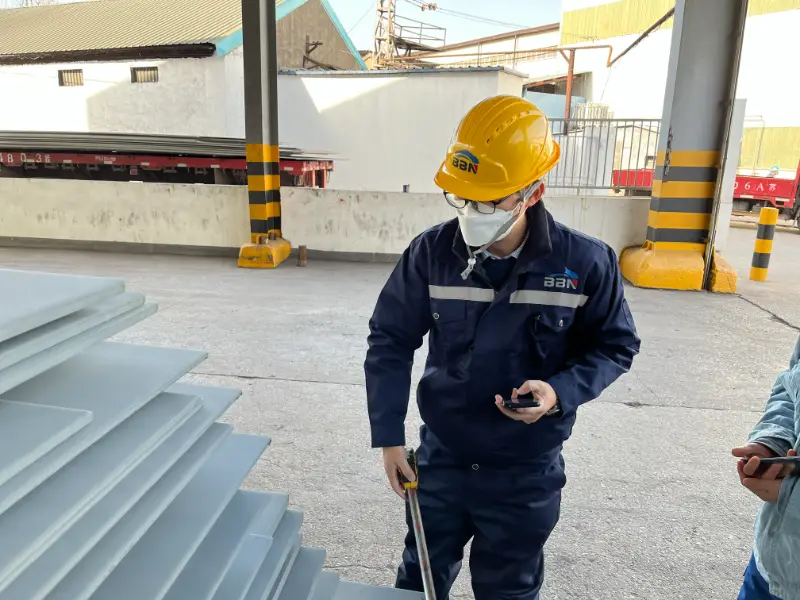
BV Grade EH40 Shipbuilding Steel Plate
BV Grade EH40 Shipbuilding Steel Plate: High-Strength Hull Structural Plate with -40°C Impact Toughness
BV Grade EH40 is a high-strength shipbuilding steel plate defined by Bureau Veritas rules. It offers minimum yield strength of 390 MPa, excellent weldability, and guaranteed impact energy at -40°C, making it suitable for critical hull structures in Arctic-class vessels and offshore units.
Thermomechanical rolling (TMCP), normalizing, or controlled rolling. Suitable for cold forming, hot forming (with care to avoid grain coarsening), flame cutting, and all common welding processes (SMAW, SAW, GMAW, FCAW).
- Phone : +8618037372205
- Email : [email protected]
- WhatsApp: Contact via Whtsapp
- WeChat: +8618037372205
BV Grade EH40 Shipbuilding Steel Plate Introduction
BV Grade EH40 is a high-strength, fine-grain structural steel plate for marine and offshore applications, certified under the Bureau Veritas (BV) Rules for Materials. It belongs to the EH series of high-strength hull steels, where 'E' denotes an impact test temperature of -40°C. The material is designed for welded structures requiring high load-bearing capacity and excellent low-temperature toughness. Key features include min. 390 MPa yield strength, tensile strength of 510–650 MPa, and strict control of carbon equivalent (CEmax 0.40) to ensure good weldability without preheating under normal conditions. It is typically supplied in normalized or thermomechanically rolled condition (TMCP).
BV Grade EH40 Shipbuilding Steel Plate Chemical Composition
The ladle composition limits are in accordance with BV Rules Pt.2, Ch.1, Sec.2 for high-strength hull structural steels. Micro-alloying elements Nb, V, Ti, Cu, Cr, Ni, Mo may be added alone or in combination to achieve the required properties, but total content is restricted to maintain weldability and toughness. Carbon equivalent (CEV) is strictly controlled: CEV = C + Mn/6 + (Cr+Mo+V)/5 + (Ni+Cu)/15 ≤ 0.40 (t ≤ 50 mm), ≤ 0.41 (50 < t ≤ 100 mm).
| Element | Standard Value (wt%) | Remarks |
|---|---|---|
| Carbon (C) | ≤ 0.18 | Max |
| Manganese (Mn) | 0.90 – 1.60 | For all thicknesses |
| Silicon (Si) | ≤ 0.50 | Max |
| Phosphorus (P) | ≤ 0.025 | Max |
| Sulfur (S) | ≤ 0.025 | Max |
| Aluminium (Al, acid soluble) | ≥ 0.015 | Min; grain refining |
| Niobium (Nb) | 0.02 – 0.05 | If added |
| Vanadium (V) | 0.05 – 0.10 | If added |
| Titanium (Ti) | ≤ 0.02 | Max, if added |
| Copper (Cu) | ≤ 0.35 | Max |
| Chromium (Cr) | ≤ 0.20 | Max |
| Nickel (Ni) | ≤ 0.40 | Max |
| Molybdenum (Mo) | ≤ 0.08 | Max |
| Nitrogen (N) | ≤ 0.009 | If not sufficient Al or Ti binding |
BV Grade EH40 Shipbuilding Steel Plate Thermal and Electrical Physical Properties
The following values are typical for a microalloyed high-strength shipbuilding steel at room temperature, unless otherwise noted. Actual values may vary slightly with heat treatment condition, rolling direction, and chemical composition. These data are provided for design and calculation purposes.
| Property | Typical Value | Unit | Condition / Temperature Range |
|---|---|---|---|
| Density (ρ) | ~7.85 | g/cm³ | Ambient temperature |
| Young's modulus (E) | ~210 | GPa | Ambient temperature |
| Shear modulus (G) | ~80 | GPa | Ambient temperature |
| Poisson's ratio (ν) | ~0.3 | – | Ambient temperature |
| Thermal expansion coefficient (α) | 11 – 13 | ×10⁻⁶ K⁻¹ | 20 – 200°C |
| Thermal conductivity (λ) | ~50 | W·m⁻¹·K⁻¹ | 20°C |
| Specific heat capacity (cp) | ~460 | J·kg⁻¹·K⁻¹ | 20°C |
| Electrical resistivity (ρₑ) | ~0.2 – 0.3 | ×10⁻⁶ Ω·m | 20°C |
BV Grade EH40 Shipbuilding Steel Plate Mechanical Properties
Mechanical properties are tested on transverse or longitudinal test pieces as per BV Rules. For plate thickness t ≤ 100 mm, yield strength min is 390 MPa. Tensile strength ranges from 510 to 650 MPa. Elongation is measured on gauge length 5.65√So (A5). Impact energy (KV) is required at -40°C (E-grade) in both longitudinal and transverse directions, with minimum values dependent on thickness. Bending test: mandrel diameter = 3t (t ≤ 35 mm), 4t (35 < t ≤ 100 mm), bending 180° without cracking.
| Property | Required Value | Unit | Test Condition / Thickness Range |
|---|---|---|---|
| Upper yield strength (ReH) | ≥ 390 | MPa | t ≤ 100 mm |
| Tensile strength (Rm) | 510 – 650 | MPa | t ≤ 100 mm |
| Elongation after fracture (A5, L0=5.65√S0) | ≥ 20 | % | Longitudinal, t ≤ 100 mm |
| Impact energy (KV) longitudinal | ≥ 27 | J | -40°C, t ≤ 50 mm |
| Impact energy (KV) longitudinal | ≥ 34 | J | -40°C, 50 < t ≤ 70 mm |
| Impact energy (KV) longitudinal | ≥ 41 | J | -40°C, 70 < t ≤ 100 mm |
| Impact energy (KV) transverse | ≥ 20 | J | -40°C, t ≤ 50 mm |
| Impact energy (KV) transverse | ≥ 24 | J | -40°C, 50 < t ≤ 70 mm |
| Impact energy (KV) transverse | ≥ 27 | J | -40°C, 70 < t ≤ 100 mm |
| Bend test (180° bend) | d = 3t | – | t ≤ 35 mm, no cracks |
| Bend test (180° bend) | d = 4t | – | 35 < t ≤ 100 mm, no cracks |
BV Grade EH40 Shipbuilding Steel Plate Fully Equivalent Material Standards and Substitutable Designations
| Country / Region | Standard / Rules | Grade | Remarks |
|---|---|---|---|
| USA / International | ABS Rules | EH40 | American Bureau of Shipping |
| Norway / International | DNV Rules | EH40 | Det Norske Veritas |
| UK / International | LR Rules | EH40 | Lloyd's Register |
| China / International | CCS Rules | EH40 | China Classification Society |
| Japan / International | NK Rules (ClassNK) | EH40 | Nippon Kaiji Kyokai |
| Korea / International | KR Rules | EH40 | Korean Register |
| Italy / International | RINA Rules | EH40 | Registro Italiano Navale |
| Russia / International | RS Rules | EH40 | Russian Maritime Register of Shipping |
| India / International | IRS Rules | EH40 | Indian Register of Shipping |
BV Grade EH40 Shipbuilding Steel Plate Application Introduction
BV Grade EH40 is designed for welded primary structures that must withstand high static and dynamic loads in low-temperature marine environments. Its excellent notch toughness at -40°C makes it especially suitable for ice-class vessels and Arctic service. Typical delivery condition is TMCP, which ensures fine grain size, good strength–toughness balance, and low residual stresses. It can be processed by cold bending, hot forming (normalized afterwards if strain exceeds limits), and all arc welding methods. Preheating is generally not required for thicknesses up to 50 mm when using low-hydrogen consumables and appropriate heat input.
Product Applications: Plates (normalized or TMCP) – 6 mm to 100 mm thickness, Prefabricated structural elements (built-up girders, T-beams), Pressure hull sections for submarines (with special approval), Ice-strengthened vessel hull shells
Processed into products: Main deck stringer plates, Shear strakes and bilge keels, Strength deck panels, Bottom shell plates in ice regions, Longitudinal frames and girders, Watertight bulkheads, Rudder horns and shaft brackets, Offshore platform node cans (with specific qualification)
Application industries: Shipbuilding (hull, decks, bulkheads, stiffeners), Offshore oil & gas (topsides, jackets, helidecks), Marine engineering (lock gates, docks, caissons), Renewable energy (offshore wind turbine transition pieces, monopile flanges, substructures), Heavy lifting equipment (crane booms, lifting yokes), Bridge construction (cold-climate steel bridges)
BV Grade EH40 Shipbuilding Steel Plate Similar or Substitute Materials with Comparable Properties
| Country / Region | Standard | Grade | Remarks |
|---|---|---|---|
| Europe | EN 10025-4 | S420M / S420ML | Thermomechanical rolled steel, comparable min. yield 420 MPa; ML offers longitudinal impact at -50°C |
| Europe | EN 10225 | S420G2+M | Weldable structural steels for fixed offshore structures; Charpy at -40°C, YS min 400 MPa |
| USA | API 2H | Grade 50 | Offshore structural steel plate, YS min 345 MPa; slightly lower strength but similar toughness |
| USA | ASTM A131 | EH40 | ASTM specification for shipbuilding: EH40 identical properties; cross-accepted |
| China | GB/T 712 | EH40 | Chinese national standard for hull structural steel; technically identical to BV EH40 |
| Japan | JIS G 3106 | SM490A/B/C | Not identical; SM490B with suitable low-temp toughness may serve in less demanding areas, but not direct substitute |
Notes:
BV EH40 must be certified with BV surveyor's stamp and test reports. Supplementary requirements (e.g., Z-grade through-thickness properties, ultrasonic testing, CTOD testing) may be specified in the purchase order. For welding, only approved consumables yielding matching strength and low-hydrogen deposit should be used. Maximum heat input should be controlled to avoid grain growth in the heat-affected zone. Post-weld heat treatment is not mandatory for thicknesses up to 50 mm but may be applied for stress relief; temperature must not exceed the tempering temperature of the TMCP condition (typically below 600°C).
- Share



