
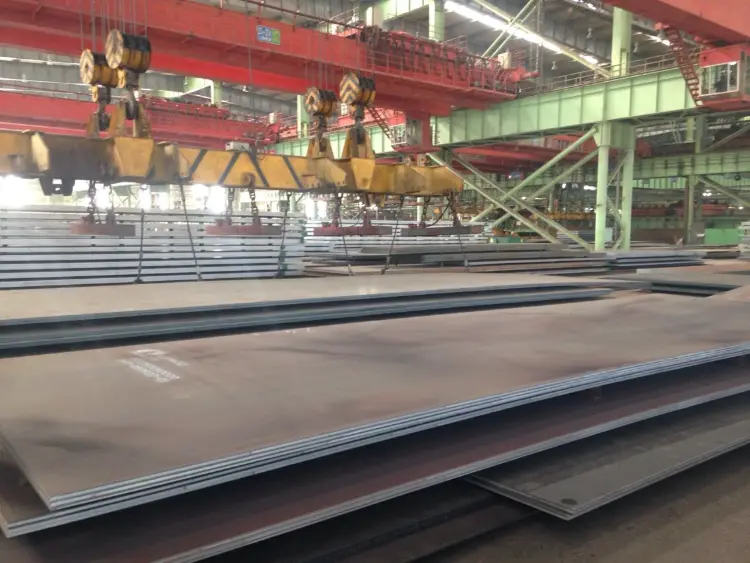
BV Grade FH40 Shipbuilding Steel Plate
BV Grade FH40 Shipbuilding Steel Plate: High Strength & Cryogenic Toughness for Marine Structures
Comprehensive material data for BV Grade FH40 shipbuilding steel plate according to Bureau Veritas rules. Includes chemical composition, mechanical properties at -60°C, physical properties, international equivalents, and application guide for ship hulls and offshore structures.
Welding, cutting, cold forming, hot forming, machining
- Phone : +8618037372205
- Email : [email protected]
- WhatsApp: Contact via Whtsapp
- WeChat: +8618037372205
BV Grade FH40 Shipbuilding Steel Plate Introduction
BV Grade FH40 is a high-strength, fine-grain structural steel plate certified by Bureau Veritas for shipbuilding and offshore applications. It belongs to the FH (special low-temperature) category, delivering a minimum yield strength of 390 MPa and guaranteed impact toughness down to -60 °C. The steel is supplied in normalized or thermo-mechanically rolled condition, offering excellent weldability, formability, and resistance to brittle fracture in cryogenic environments. Typical uses include critical hull members, deck plating, and high-stress zones of ice-class vessels and Arctic offshore platforms.
BV Grade FH40 Shipbuilding Steel Plate Chemical Composition
The chemical composition of BV FH40 is controlled to guarantee high strength and excellent low-temperature toughness. Microalloying elements such as Nb, V, Ti are added singly or in combination to achieve fine grain size. Carbon equivalent (CEV) is normally limited to ≤0.38% to ensure good weldability. The values comply with BV Rules and IACS UR W11.
| Element | Standard Value (max, unless range) | Remarks |
|---|---|---|
| Carbon (C) | ≤ 0.16 | |
| Manganese (Mn) | 0.90 – 1.60 | For thickness ≤ 25 mm; for thicker plates adjusted |
| Silicon (Si) | 0.10 – 0.50 | |
| Phosphorus (P) | ≤ 0.025 | |
| Sulfur (S) | ≤ 0.025 | |
| Aluminum (Al, acid soluble) | ≥ 0.015 | Fine grain requirement |
| Niobium (Nb) | ≤ 0.05 | Microalloy; Nb+V+Ti ≤ 0.12 % |
| Vanadium (V) | ≤ 0.10 | Microalloy; Nb+V+Ti ≤ 0.12 % |
| Titanium (Ti) | ≤ 0.02 | Microalloy; Nb+V+Ti ≤ 0.12 % |
| Copper (Cu) | ≤ 0.35 | |
| Chromium (Cr) | ≤ 0.20 | |
| Nickel (Ni) | ≤ 0.40 | Can be higher upon agreement |
| Molybdenum (Mo) | ≤ 0.08 | |
| Nitrogen (N) | ≤ 0.012 | Nitrogen-binding elements may be added |
| Calcium (Ca) | optional | For inclusion shape control |
BV Grade FH40 Shipbuilding Steel Plate Thermal and Electrical Physical Properties
The following physical properties are representative of low-carbon, high-strength shipbuilding steel. Actual values may vary slightly with chemical composition and heat treatment condition.
| Property | Typical Value | Unit | Test Condition |
|---|---|---|---|
| Density (ρ) | 7850 | kg/m³ | Room temperature |
| Modulus of Elasticity (E) | 205 – 210 | GPa | Room temperature |
| Shear Modulus (G) | 80 | GPa | Room temperature |
| Poisson's Ratio (ν) | 0.3 | - | Room temperature |
| Thermal Expansion Coefficient (α) | 12.0 – 13.0 ×10⁻⁶ | 1/K | 20–200 °C |
| Thermal Conductivity (λ) | 45 – 52 | W/(m·K) | Room temperature |
| Specific Heat Capacity | 450 – 480 | J/(kg·K) | Room temperature |
| Electrical Resistivity (ρ_e) | 0.20 – 0.25 ×10⁻⁶ | Ω·m | Room temperature |
BV Grade FH40 Shipbuilding Steel Plate Mechanical Properties
Mechanical testing is performed on samples taken transverse to the rolling direction. Impact tests are carried out on Charpy V-notch specimens at -60 °C. The values below correspond to plates up to 50 mm thickness; for thicknesses 50–100 mm, a slightly reduced yield strength applies per BV rules.
| Property | Standard Required Value | Unit | Test Condition |
|---|---|---|---|
| Yield Strength (ReH) | ≥ 390 | MPa | Ambient temperature, thickness ≤ 50 mm |
| Tensile Strength (Rm) | 510 – 660 | MPa | Ambient temperature, all thicknesses |
| Elongation (A, L0=5.65√S0) | ≥ 20 | % | Transverse, thickness ≤ 50 mm |
| Impact Energy (KV, longitudinal) | ≥ 34 (average) / 24 (single) | J | -60 °C, 10×10 mm Charpy V-notch |
| Impact Energy (KV, transverse) | ≥ 24 (average) / 17 (single) | J | -60 °C, 10×10 mm Charpy V-notch |
| Bend Test (Mandrel Diameter) | No cracks | - | 180° bending, mandrel = 3 × thickness (t ≤ 25 mm); 4 × thickness (t > 25 mm) |
BV Grade FH40 Shipbuilding Steel Plate Fully Equivalent Designations and Substitute Grades
| Country / Region | Standard / Rule | Grade | Remarks |
|---|---|---|---|
| International | IACS UR W11 | FH40 | Common specification for all IACS members |
| USA | ABS Rules | FH40 | American Bureau of Shipping |
| Norway/Germany | DNV Rules | FH40 | DNV GL (now DNV) |
| UK | Lloyd's Register Rules | FH40 | LR FH40 |
| China | CCS Rules | FH40 | China Classification Society |
| Japan | NK (ClassNK) Rules | FH40 | Nippon Kaiji Kyokai |
| Korea | KR Rules | FH40 | Korean Register |
| Italy | RINA Rules | FH40 | Registro Italiano Navale |
| Russia | RS Rules | FH40 | Russian Maritime Register of Shipping |
| India | IRS Rules | FH40 | Indian Register of Shipping |
| Europe | EN 10025-4:2004 | S420ML (mod.) | Thermo-mechanically rolled; CEV and toughness requirements match FH40 after supplementary agreement |
| Europe | EN 10025-6:2004 | S420QL (mod.) | Quenched and tempered; requires Charpy -60°C agreement |
BV Grade FH40 Shipbuilding Steel Plate Application Introduction
BV FH40 steel is purpose-designed for highly stressed structural members in ships and offshore units operating at very low temperatures. Its combination of high yield strength and guaranteed -60 °C toughness makes it indispensable for ice-class vessels, Arctic offshore structures, and cryogenic cargo containment. The steel is extensively used in the following sectors:
Product Applications: Icebreaker hulls and frames, LNG carrier containment and structural transitions, Arctic drillship main decks and turrets, Polar supply vessel side shells, Offshore platform columns and braces, Wind turbine transition pieces and monopile tops
Processed into products: Main deck and sheer strake plates, Bottom and side shell plates in high stress areas, Bilge keel and stringer plates, Transverse web frames and girders, Hatch coamings and corner reinforcements, Rudder horns and stern frames, Foundation plates for heavy machinery (e.g. cranes, winches), Fatigue-critical welded joints
Application industries: Shipbuilding (commercial and naval), Offshore oil and gas platforms, Renewable offshore energy (wind turbine foundations), Arctic marine engineering, Heavy-lift and crane vessels, Bridge and heavy civil structures (with special approval)
BV Grade FH40 Shipbuilding Steel Plate Closely Related / Similar Performance Alternatives
| Country / Region | Standard / Rule | Grade | Remarks |
|---|---|---|---|
| IACS | UR W11 | FH36 | Yield ≥355 MPa, same -60°C toughness; lower strength |
| IACS | UR W11 | EH40 | Yield ≥390 MPa, impact -40°C; higher temperature toughness |
| BV | BV Rules | DH40/EH40 | Same strength levels, but less demanding low-temperature toughness (+0°C / -40°C) |
| Europe | EN 10025-4 | S420ML | Yield 420 MPa, TMCP delivered; typical -50°C toughness, may be upgraded to FH40 with special agreement |
| ASTM | ASTM A131 / A131M | FH40 | Identical chemistry/mechanical boundaries under ASTM shipbuilding steel specification |
Notes:
Welding: FH40 requires low-hydrogen welding consumables and adequate preheating (typically 50–150 °C depending on equivalent carbon and thickness). Post-weld heat treatment is not normally required for TMCP plates unless specified. Certification: All plates are delivered with BV 3.2 inspection certificate and marked with BV stamp, grade, heat number, and melting practice. Supplementary requirements such as Z-direction testing (through-thickness) for lamellar tearing, ultrasonic testing, and high tensile ductility can be ordered with additional BV suffixes (e.g., Z35).
- Share



