
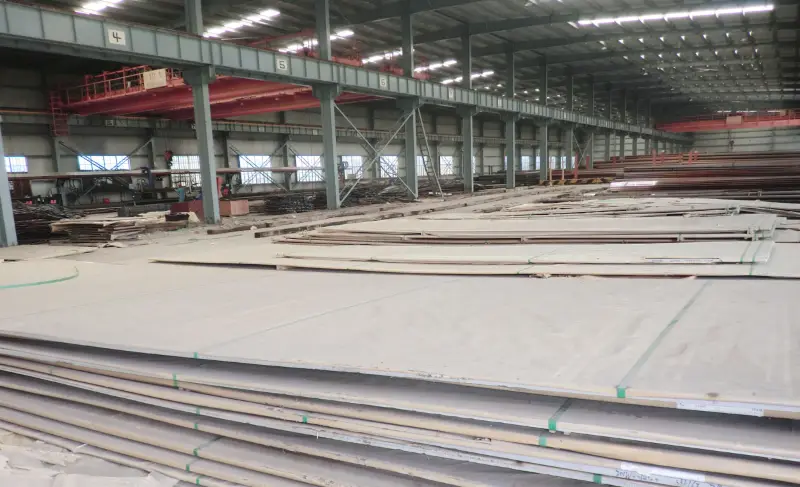
BV Grade A420 Shipbuilding Steel Plate
BV Grade A420 Shipbuilding Steel Plate - Properties, Equivalents & Uses
Comprehensive data for BV Grade A420 high-strength shipbuilding steel: chemical composition, mechanical and thermal properties, international equivalents, and applications for marine structures.
Hot rolling, controlled rolling, normalizing, thermomechanical controlled processing (TMCP), welding, gas/plasma cutting, cold forming
- Phone : +8618037372205
- Email : [email protected]
- WhatsApp: Contact via Whtsapp
- WeChat: +8618037372205
BV Grade A420 Shipbuilding Steel Plate Introduction
BV Grade A420, also designated as AH42, is a high-strength hull structural steel plate under Bureau Veritas rules (Part 2, Chapter 1). It delivers a minimum yield strength of 420 MPa and is intended for welded structures in shipbuilding and offshore engineering. The steel is produced via controlled rolling or thermomechanical controlled processing (TMCP) and offers excellent weldability, formability, and notch toughness at 0°C. It is commonly used for critical components such as shell plating, decks, and longitudinal stiffeners, where weight reduction and high reliability are essential.
BV Grade A420 Shipbuilding Steel Plate Chemical Composition
The chemical composition complies with the BV Rules for Grade A420/AH42. Maximum values are specified unless a range is given. Microalloying elements such as Nb, V, and Ti may be added singly or in combination to achieve grain refinement and strength. The carbon equivalent (CEV) is restricted to ensure good weldability.
| Element | Standard Value (max or range) | Remarks |
|---|---|---|
| C | ≤ 0.21 | Depending on product thickness |
| Si | 0.10 – 0.50 | |
| Mn | 0.60 – 1.60 | Minimum 0.60% required for strength |
| P | ≤ 0.030 | |
| S | ≤ 0.030 | |
| Al (acid soluble) | ≥ 0.015 | Minimum for fine-grain practice |
| Nb | ≤ 0.05 | Optional, grain refiner |
| V | ≤ 0.10 | Optional, grain refiner |
| Ti | ≤ 0.02 | Optional, grain refiner |
| Ni | ≤ 0.40 | |
| Cr | ≤ 0.25 | |
| Mo | ≤ 0.08 | |
| Cu | ≤ 0.35 | |
| CEV (typical) | ≤ 0.43 | For thickness ≤ 50 mm: C+Mn/6+(Cr+Mo+V)/5+(Ni+Cu)/15 |
BV Grade A420 Shipbuilding Steel Plate Thermal and Electrical Physical Properties
The following thermal and electrical properties are typical for welded structural steels of this strength class and are not part of the mandatory BV specification. They may vary slightly with exact chemical composition and manufacturing route, and are suitable for general design calculations and simulations.
| Property | Typical Value | Unit | Test Condition / Remarks |
|---|---|---|---|
| Density (ρ) | 7.85 | g/cm³ | At 20°C |
| Modulus of elasticity (E) | 200 – 210 | GPa | At 20°C, dynamic method |
| Shear modulus (G) | ≈ 80 | GPa | At 20°C |
| Poisson's ratio (ν) | 0.3 | — | In the elastic range |
| Thermal expansion (α) | 11.5 – 12.5 × 10⁻⁶ | K⁻¹ | 20 – 100°C range |
| Thermal conductivity (λ) | 45 – 55 | W/(m·K) | At 20°C |
| Specific heat capacity (cₚ) | 460 – 500 | J/(kg·K) | At 20°C |
| Electrical resistivity (ρₑ) | 0.13 – 0.20 | μΩ·m | At 20°C |
BV Grade A420 Shipbuilding Steel Plate Mechanical Properties
Tests are performed on transverse test pieces taken from the plate. The tensile properties and impact energy values are in accordance with BV AH42 requirements. Impact test temperature is 0°C for the A420 grade. The bend test is carried out at ambient temperature.
| Property | Value | Unit | Test Condition / Remarks |
|---|---|---|---|
| Yield strength (ReH) | ≥ 420 | MPa | Room temperature, thickness ≤ 50 mm |
| Tensile strength (Rm) | 530 – 680 | MPa | Thickness ≤ 50 mm |
| Elongation after fracture (A) | ≥ 18 | % | Gauge length 5.65√So, thickness ≤ 50 mm |
| Bend test (cold) | 3a (180°) | — | Bend diameter = 3 × thickness, for thickness ≤ 50 mm |
| Impact energy (KV2) | ≥ 34 (longitudinal) | J | At 0°C, Charpy V-notch, 10×10 mm specimen |
| Impact energy (KV2) | ≥ 24 (transverse) | J | At 0°C, optional for thinner products |
BV Grade A420 Shipbuilding Steel Plate Fully Equivalent Grades According to Other Standards
| Country / Region | Standard | Grade | Remarks |
|---|---|---|---|
| International | IACS UR W11 | AH42 | Unified Requirement for Higher Strength Hull Structural Steel |
| USA | ASTM A131/A131M | AH42 | Specification for structural steel for ships |
| Norway / Germany | DNV GL Ship Rules | NV A420 | Equivalent high-strength grade |
| UK | Lloyd's Register Rules | LR AH42 | Same strength and toughness class |
| China | GB 712 | AH420 | High strength hull structural steel |
| Japan | NK Rules (ClassNK) | NK KA42 | Corresponding Nippon Kaiji Kyokai designation |
| Korea | KR Rules | KR AH42 | Korean Register equivalent |
| Italy | RINA Rules | RINA AH420 | Registro Italiano Navale |
| Russia | RS Rules | RS A420 | Russian Maritime Register of Shipping |
BV Grade A420 Shipbuilding Steel Plate Application Introduction
BV Grade A420/AH42 is a preferred material for weight-critical and safety-sensitive marine and offshore structures. Its combination of high strength and dependable toughness at 0°C enables thinner sections, reducing structural weight without compromising integrity. Typical uses include:
Product Applications: Bulk carriers, Container ships, Oil tankers, LNG/LPG carriers, FPSO (Floating Production, Storage and Offloading), Offshore platforms (jackets, topsides), Wind turbine foundation structures, Caissons and barges
Processed into products: Main deck and bottom shell plates, Side shell plating, Longitudinal stiffeners and girders, Transverse bulkheads and web frames, Hatch coamings and corner plates, Bilge keels, Structural columns and braces, Brackets and doubler plates
Application industries: Commercial shipbuilding, Naval vessels, Offshore oil and gas, Renewable offshore energy (wind, tidal), Port and harbour infrastructure
BV Grade A420 Shipbuilding Steel Plate Similar Materials with Comparable Mechanical Strength
| Country / Region | Standard | Grade | Remarks |
|---|---|---|---|
| Europe | EN 10025-4 | S420ML | Thermomechanical rolled weldable fine grain structural steel; suitable for non-marine heavy structures |
| USA | ASTM A572/A572M | Grade 60 [415] | General structural steel; yield ~415 MPa, not specifically for shipbuilding |
| Japan | JIS G 3106 | SM570 | Higher yield (~460 MPa); used in welded structures, sometimes substituted for higher safety margin |
| International | API Spec 2W | Grade 50 (345 MPa) | Offshore structural steel, lower strength but similar applications, may require thickness upgrade |
Notes:
- For thicknesses above 50 mm, mechanical property requirements may be subject to special agreement with the classification society.
- If toughness at lower service temperatures is required, consider D-, E-, or F-grade variants (DH42, EH42, FH42) with impact test temperatures of -20°C, -40°C, and -60°C respectively.
- Welding consumables must match the base metal strength and the minimum design temperature; low-hydrogen processes are recommended to avoid cold cracking.
- Preheating may be necessary for thick sections or in cold ambient conditions, following BV-approved welding procedures.
- All material must be traceable to its original cast and supplied with BV 3.1 or 3.2 inspection certificates.
- Share



