
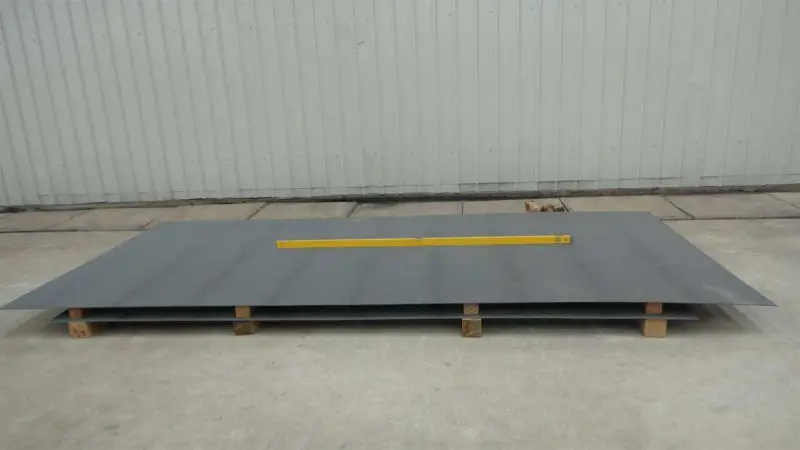
BV Grade D420 Shipbuilding Steel Plate
BV Grade D420 Shipbuilding Steel Plate - High-Strength Hull Structural Material (420 MPa Yield)
Comprehensive analysis of BV Grade D420 steel plate for shipbuilding: chemical composition, mechanical and physical properties, international equivalents, and application guidance.
Thermomechanical rolling (TMCP), normalizing (N), or normalizing rolling (NR); suitable for cutting, cold forming, welding
- Phone : +8618037372205
- Email : [email protected]
- WhatsApp: Contact via Whtsapp
- WeChat: +8618037372205
BV Grade D420 Shipbuilding Steel Plate Introduction
BV Grade D420 is a high-strength shipbuilding steel plate classified under the rules of Bureau Veritas (BV). It belongs to a family of normalized or thermomechanical rolled weldable fine-grain structural steels with a minimum yield strength of 420 MPa.
- Offers excellent toughness at sub-zero temperatures, designated by the letter D meaning guaranteed impact properties at -20°C.
- Combines high strength with good weldability and formability, making it suitable for critical hull structures, offshore platforms, and other marine applications.
- Complies with IACS UR W11, ensuring global acceptance and availability.
BV Grade D420 Shipbuilding Steel Plate Chemical Composition
The chemical composition limits for BV D420 are as stipulated in BV Rules Part 2, Chapter 4. Microalloying elements such as Nb, V, and Ti are used individually or in combination to achieve the required strength and toughness. A fine-grain practice is mandatory (Al≥0.015% or other grain-refining elements). Carbon Equivalent (CE) is normally ≤0.43% for thickness ≤50 mm and ≤0.45% for thickness >50 mm to ensure good weldability.
| Element | Standard Value (wt%) | Remarks |
|---|---|---|
| C | ≤ 0.20 | max |
| Mn | 0.90 – 1.60 | range |
| Si | 0.10 – 0.50 | range |
| P | ≤ 0.030 | max |
| S | ≤ 0.025 | max |
| Al (acid soluble) | ≥ 0.015 | min for fine-grain practice |
| Nb | 0.02 – 0.05 | optional, when used alone |
| V | 0.05 – 0.10 | optional, when used alone |
| Ti | ≤ 0.02 | max, when used for grain refining |
| Cu | ≤ 0.35 | max |
| Cr | ≤ 0.20 | max |
| Ni | ≤ 0.40 | max |
| Mo | ≤ 0.08 | max |
| N | ≤ 0.012 | max (unless sufficient Al or other N-binders) |
| Others (residual) | Cr+Ni+Mo+Cu ≤ 0.80 | sum of residual elements |
BV Grade D420 Shipbuilding Steel Plate Thermal and Electrical Physical Properties
The following physical properties are not mandatory in the BV specification but are representative for this type of low-alloy shipbuilding steel at room temperature. These values may vary slightly with actual composition and processing. They are useful for design calculations, heat transfer analysis, and electrical considerations.
| Property | Typical Value | Unit | Test Conditions |
|---|---|---|---|
| Density (ρ) | 7850 | kg/m³ | at 20°C |
| Elastic modulus (E) | 210 | GPa | at 20°C |
| Shear modulus (G) | ~81 | GPa | calculated from E and ν |
| Poisson's ratio (ν) | 0.3 | – | typical for steel |
| Thermal expansion coefficient (α) | 12 × 10⁻⁶ | K⁻¹ | 20–100°C average |
| Thermal conductivity (λ) | 50 | W/(m·K) | at 20°C |
| Specific heat capacity (cp) | 460 | J/(kg·K) | at 20°C |
| Electrical resistivity (ρe) | ~0.20 – 0.25 | μΩ·m | at 20°C |
BV Grade D420 Shipbuilding Steel Plate Mechanical Properties
Mechanical properties are determined on specimens taken from the finished product in the delivery condition. Tensile testing is performed in accordance with ISO 6892-1 on proportional test pieces (L₀=5.65√S₀). Impact tests are Charpy V-notch, with D grade requiring testing at -20°C. Bending tests are conducted over a former of specified diameter depending on thickness.
- Yield and tensile values may reduce slightly for thicknesses above 50 mm.
- Impact energy minimum average values apply; one individual value may be below the average, but not below 70% of that average.
| Property | Standard Requirement | Unit | Test Conditions |
|---|---|---|---|
| Yield Strength (ReH) – t ≤ 50 mm | ≥ 420 | MPa | Transverse or longitudinal, as agreed |
| Yield Strength (ReH) – 50 < t ≤ 100 mm | ≥ 400 | MPa | |
| Tensile Strength (Rm) – all t ≤ 100 mm | 530 – 680 | MPa | |
| Elongation (A5) – t ≤ 40 mm | ≥ 19 | % | L₀=5.65√S₀ |
| Elongation (A5) – 40 < t ≤ 50 mm | ≥ 18 | % | |
| Elongation (A5) – 50 < t ≤ 100 mm | ≥ 17 | % | |
| Charpy V-notch impact energy – t ≤ 50 mm | ≥ 27 | J | at -20°C, longitudinal (transverse min 20 J if specified) |
| Charpy V-notch impact energy – 50 < t ≤ 100 mm | ≥ 31 | J | at -20°C, longitudinal |
| Bend test – t ≤ 25 mm | No cracks | – | Former diameter = 3t, bend 180° |
| Bend test – t > 25 mm | No cracks | – | Former diameter = 4t, bend 180° |
BV Grade D420 Shipbuilding Steel Plate Completely Equivalent Standards and Replaceable Grades
| Country/Region | Standard | Grade | Remarks |
|---|---|---|---|
| International (IACS) | IACS UR W11 | D420 / DH420 | Unified requirement for high-strength hull structural steels |
| USA | ABS Rules | DH420 | American Bureau of Shipping – identical toughness and strength |
| Norway/Germany | DNV Rules | D420 | DNV – directly equivalent |
| UK | LR Rules | DH420 | Lloyd's Register – directly equivalent |
| Japan | ClassNK Rules | KD420 | Nippon Kaiji Kyokai – K designation for high-strength |
| China | CCS Rules | D420 | China Classification Society – directly equivalent |
| Italy | RINA Rules | D420 | Registro Italiano Navale – directly equivalent |
| South Korea | KR Rules | DH420 | Korean Register – directly equivalent |
BV Grade D420 Shipbuilding Steel Plate Application Introduction
BV D420 combines high strength and excellent low-temperature toughness, making it ideal for weight-critical and safety-critical marine structures. Its good weldability allows efficient fabrication using standard shipyard techniques.
Product Applications: Hull plates (shell, bottom, side, strength deck), Deck plates and stringer plates, Bulkhead plates and stiffeners, Longitudinal and transverse framing sections, Girders, beams, and brackets
Processed into products: Main deck and bottom shell longitudinals, Transverse web frames and floors, Bilge keels and stem/ stern posts, Hatch coamings and deck openings reinforcements, Crane pedestals and mast houses, Offshore jacket structures and topsides modules
Application industries: Shipbuilding (commercial and naval vessels), Offshore oil & gas platforms and FPSOs, Marine heavy engineering (docks, caissons, lock gates), Bridge construction (in marine environments), Pressure vessel and boiler shells (with additional certifications)
BV Grade D420 Shipbuilding Steel Plate Similar/Comparable Material Recommendations
| Country/Region | Standard | Grade | Remarks |
|---|---|---|---|
| International | BV Rules | AH420, EH420, FH420 | Same strength, different toughness levels (A: 0°C, E: -40°C, F: -60°C) |
| Europe | EN 10025-4 | S420M / S420ML | Thermomechanical rolled structural steel, ML option for -20°C impact; not identical due to different delivery conditions |
| Europe | EN 10025-6 | S460QL / S500QL | Quenched and tempered; higher strength but may serve as alternative for thicker sections |
| USA | ASTM A572 | Grade 60 (415 MPa) | Lower minimum yield but often used in structural applications; not certified for shipbuilding |
| USA | ASTM A131 | DH42 | ASTM shipbuilding grade; slight differences in composition limits |
| Japan | JIS G 3106 | SM490B / SM490C | Structural steel with 490 MPa tensile, SM490C has impact at 0°C; comparable weldability, lower yield |
| China | GB/T 712 | D420 / DH420 | Chinese shipbuilding steel standard, essentially identical to BV D420 |
Notes:
Additional Requirements:
- Ultrasonic testing may be required per BV rules for critical applications (e.g., hull strength members).
- Through-thickness properties (Z-grade) can be specified for improved lamellar tearing resistance in welded connections.
- Carbon Equivalent (CE) limits and crack tip opening displacement (CTOD) testing may be imposed for certain offshore projects.
- The grade is normally supplied with a BV surveyor's stamp and a 3.2 certificate per EN 10204.
- Share



