
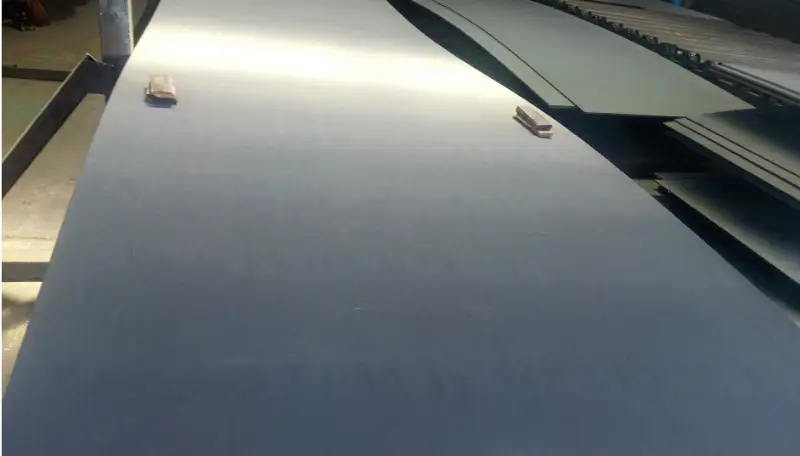
BV Grade E420 Shipbuilding Steel Plate
BV Grade E420 Shipbuilding Steel Plate - High-Strength Low-Temperature Toughness
Explore BV Grade E420 shipbuilding steel: a 420 MPa yield strength grade with guaranteed toughness at -40°C, approved by Bureau Veritas according to IACS UR W11. Ideal for critical ship and offshore structures.
Hot rolling, normalizing (N), thermo-mechanically controlled rolling (TMCP), quenching and tempering (Q&T) as per delivery condition agreement
- Phone : +8618037372205
- Email : [email protected]
- WhatsApp: Contact via Whtsapp
- WeChat: +8618037372205
BV Grade E420 Shipbuilding Steel Plate Introduction
BV Grade E420 is a high-strength shipbuilding steel plate certified by Bureau Veritas (BV) in accordance with the International Association of Classification Societies (IACS) Unified Requirements. It belongs to the EH420 category, offering a minimum yield strength of 420 MPa and exceptional low-temperature impact toughness down to -40°C. This fine-grain, fully killed steel is designed for critical structural components of ships and offshore platforms where high strength and reliable brittle fracture resistance are mandatory. The steel is typically supplied in normalized or thermo-mechanically controlled rolled (TMCP) condition, ensuring uniform mechanical properties through controlled processing. Its balanced chemistry with microalloying elements (Nb, V, Ti) provides excellent weldability and formability, making it suitable for demanding marine environments.
BV Grade E420 Shipbuilding Steel Plate Chemical Composition
Chemical composition as specified by IACS UR W11 for EH420 grade. Values are maximum unless a range is given. Nb+V+Ti ≤ 0.12% for grain refinement and precipitation strengthening. Als (acid soluble) is required for deoxidation. The low carbon and carbon equivalent (CEV) values ensure good weldability and reduce cold cracking risk.
| Element | Standard Value | Remarks |
|---|---|---|
| C | ≤ 0.18 | Ladle analysis; typical target ≤ 0.16 for improved toughness |
| Mn | 0.90 – 1.60 | Depending on thickness; higher Mn for thicker plates |
| Si | ≤ 0.50 | Deoxidizer residue |
| P | ≤ 0.025 | Maximum for all thicknesses |
| S | ≤ 0.025 | Maximum for all thicknesses |
| Cr | ≤ 0.25 | Residual element |
| Ni | ≤ 0.80 | Improves toughness |
| Mo | ≤ 0.08 | Residual element |
| Cu | ≤ 0.35 | Residual element |
| Nb | ≤ 0.05 | Microalloying; grain refiner |
| V | ≤ 0.10 | Optional microalloying |
| Ti | ≤ 0.02 | Microalloying; grain refiner |
| Al (acid soluble) | ≥ 0.015 | Minimum for fine grain practice |
| N | ≤ 0.012 | Usually not reported, relevant for TmCP |
| Nb + V + Ti | ≤ 0.12 | Sum of microalloy additions |
BV Grade E420 Shipbuilding Steel Plate Thermal and Electrical Physical Properties
Physical properties are typical for low-alloy HSLA shipbuilding steel and are provided as reference values for engineering calculations. They are not part of BV classification requirements but are commonly used for design and fabrication. Density is taken as 7850 kg/m³ for mass calculations. Thermal conductivity and specific heat are average values for the temperature range 0–100°C unless noted.
| Property | Standard Value | Unit | Test Condition |
|---|---|---|---|
| Density (ρ) | 7850 | kg/m³ | At 20°C |
| Modulus of elasticity (E) | 210 | GPa | At room temperature |
| Shear modulus (G) | 80.8 | GPa | Calculated from E and ν |
| Poisson's ratio (ν) | 0.3 | – | Elastic range |
| Thermal expansion coefficient (α) | 12.0 × 10⁻⁶ | K⁻¹ | 20–100°C range |
| Thermal expansion coefficient (α) | 13.0 × 10⁻⁶ | K⁻¹ | 20–200°C range |
| Thermal expansion coefficient (α) | 13.5 × 10⁻⁶ | K⁻¹ | 20–400°C range |
| Thermal conductivity (λ) | 50 | W/(m·K) | At 20°C |
| Thermal conductivity (λ) | 47 | W/(m·K) | At 100°C |
| Specific heat capacity (c) | 460 | J/(kg·K) | 20–100°C average |
| Electrical resistivity (ρₑ) | 0.17 | µΩ·m | At 20°C |
BV Grade E420 Shipbuilding Steel Plate Mechanical Properties
Mechanical properties as required by IACS UR W11 for EH420 grade, verified by BV survey. Properties are valid for plates in normalized or TMCP condition. Impact test temperature: -40°C (E-grade). Absorption values given for transverse (T) and longitudinal (L) orientation, but the primary requirement is transverse (27 J minimum). For longitudinal, average ≥41 J is required. Bending test uses mandrel diameter related to plate thickness and actual tensile strength.
| Property | Standard Requirement | Unit | Test Condition / Remarks |
|---|---|---|---|
| Yield strength (ReH) | ≥ 420 | MPa | Thickness ≤ 50 mm |
| Yield strength (ReH) | ≥ 400 | MPa | Thickness > 50 mm ≤ 70 mm |
| Yield strength (ReH) | ≥ 390 | MPa | Thickness > 70 mm ≤ 100 mm |
| Yield strength (ReH) | ≥ 380 | MPa | Thickness > 100 mm ≤ 150 mm (if available) |
| Tensile strength (Rm) | 530 – 680 | MPa | All thicknesses |
| Elongation (A) | ≥ 18 | % | Gauge 200 mm or proportional, thickness ≤ 50 mm |
| Elongation (A) | ≥ 17 | % | Thickness > 50 mm ≤ 100 mm |
| Bend test (mandrel diameter) | D = 2a | – | 180° bend, tensile strength ≤ 600 MPa, thickness ≤ 50 mm |
| Bend test (mandrel diameter) | D = 3a | – | 180° bend, tensile strength > 600 MPa, thickness ≤ 50 mm |
| Bend test (mandrel diameter) | D = 3a | – | 180° bend, thickness > 50 mm (regardless of strength) |
| Impact energy KV₂, -40°C (transverse) | ≥ 27 (average, T) | J | Three specimens, single min. 19 J |
| Impact energy KV₂, -40°C (longitudinal) | ≥ 41 (average, L) | J | Three specimens, single min. 29 J (if longitudinal specified) |
BV Grade E420 Shipbuilding Steel Plate Exact Equivalent Materials
| Country / Region | Standard / Classification Society | Grade | Remarks |
|---|---|---|---|
| International | Bureau Veritas (BV) | EH420 / Grade E420 | Original grade |
| International | American Bureau of Shipping (ABS) | EH420 | Same requirements per IACS UR W11 |
| International | Lloyd's Register (LR) | EH420 | Same requirements per IACS UR W11 |
| International | DNV (Det Norske Veritas) | EH420 | Same requirements per IACS UR W11 |
| International | China Classification Society (CCS) | EH420 | Same requirements per IACS UR W11 |
| International | Nippon Kaiji Kyokai (NK / ClassNK) | EH420 | Same requirements per IACS UR W11 |
| International | Korean Register (KR) | EH420 | Same requirements per IACS UR W11 |
| International | Registro Italiano Navale (RINA) | EH420 | Same requirements per IACS UR W11 |
| International | Russian Maritime Register (RS) | EH420 | Same requirements per IACS UR W11 |
| International | Indian Register of Shipping (IRS) | EH420 | Same requirements per IACS UR W11 |
BV Grade E420 Shipbuilding Steel Plate Application Introduction
BV Grade E420 is engineered for highly stressed structural components of ships, offshore units, and Arctic equipment where weldability, strength, and fracture toughness at -40°C are essential. It is supplied as plates that can be fabricated into large sub-assemblies using common shipyard practices: cutting, bending, welding. Preheating is often not required due to low carbon equivalent, but post-weld heat treatment may be avoided. The steel performs reliably in extreme marine environments and fatigue-loaded structures.
Product Applications: Hull bottom, side shell, and deck plating of large container ships and bulk carriers, Legs and spudcans of jack-up rigs, Primary frames and girders of offshore platforms, Ice belts and icebreaker hulls for Arctic operations, High-capacity crane pedestals and A-frames on vessels
Processed into products: Shell plates and sheer strake inserts, Bracket plates and web frames in high-stress zones, Heavy longitudinal stiffeners and stringer plates, Fatigue-critical nodes (e.g., tubular joint cans on jackets), Gusset plates and transition plates connecting different strength levels
Application industries: Shipbuilding (merchant vessels, naval, passenger), Offshore & marine engineering (jack-up rigs, semi-submersibles, FPSO modules), Arctic and ice-class vessels (icebreakers, ice-strengthened hulls), Heavy structural engineering (bridges, offshore wind substructures), Pipe laying / subsea frames (high-stress node connections)
BV Grade E420 Shipbuilding Steel Plate Similar / Proximate Alternative Grades
| Country / Region | Standard | Grade | Remarks |
|---|---|---|---|
| International | IACS UR W11 | EH36 | Lower yield strength (355 MPa), same low-temperature toughness (-40°C), suitable for less stressed structures |
| International | IACS UR W11 | EH40 | Yield strength 390 MPa, toughness at -40°C, intermediate between 36 and 42 classes |
| International | IACS UR W11 | EH460 | Higher yield strength (460 MPa), similar or slightly stricter chemistry, for weight-sensitive very high-strength design |
| International | IACS UR W11 | DH420 | Same strength, but impact temperature only -20°C (D-grade), not suitable for Arctic or severe low-temperature service |
| Europe | EN 10025-4 | S420ML / S420MLO | Thermomechanical rolled steel for offshore structures with minimum yield 420 MPa, -50°C impact (L-grade). Can substitute with further evaluation |
Notes:
Delivery condition strongly influences mechanical properties. TMCP plates provide high strength without excessive alloying, improving weldability and heat-affected zone toughness. Normalized plates may have slightly lower yield but uniform impact properties. Carbon equivalent (CEV) is frequently limited to ≤ 0.40% (if required by BV for specific applications). Ultrasonic testing (UT) is mandatory per BV rules; plates must meet the requirements of BV NR 216 for internal soundness. Certification includes 3.2 type inspection certificate, and material can be supplied with BH or EH suffix to denote extra notch toughness orientation. Special end use (e.g., for anchors, chain stoppers) may require additional fracture toughness tests.
- Share



