
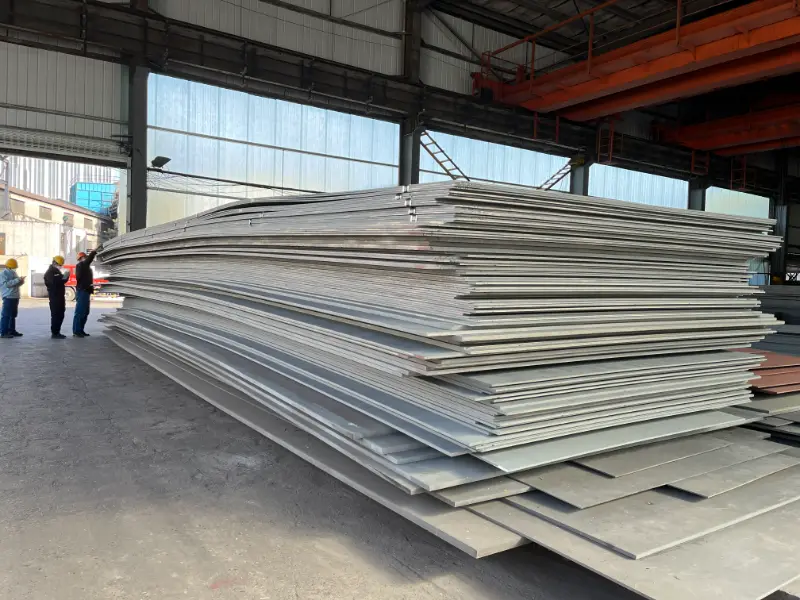
BV Grade F420 Shipbuilding Steel Plate
BV Grade F420 Shipbuilding Steel Plate - High Strength Quenched & Tempered Structural Steel for Marine Applications
Comprehensive datasheet for BV Grade F420 shipbuilding steel plate covering chemical composition, mechanical properties, physical data, international equivalents, and application guidelines.
Hot rolling, controlled rolling, quenching and tempering; subsequent processing by cutting, welding, bending, machining
- Phone : +8618037372205
- Email : [email protected]
- WhatsApp: Contact via Whtsapp
- WeChat: +8618037372205
BV Grade F420 Shipbuilding Steel Plate Introduction
BV Grade F420 is a high strength quenched and tempered (Q&T) shipbuilding steel governed by Bureau Veritas (BV) classification rules. It offers a minimum yield strength of 420 MPa, excellent notch toughness at low temperatures (down to -40 °C), and good weldability. The steel is primarily intended for heavily loaded structural components in ship hulls, offshore platforms, and marine equipment where weight savings and high strength are critical. Typical delivery condition is quenched and tempered (Q&T), ensuring a fine martensitic or bainitic microstructure with uniform mechanical properties. Due to its high strength-to-weight ratio, F420 enables design of lighter structures without compromising safety. Strict compliance with BV material specifications guarantees reliable performance in harsh maritime environments.
BV Grade F420 Shipbuilding Steel Plate Chemical Composition
The chemical composition as per BV Rules for high strength quenched and tempered steels. Elements are tightly controlled to ensure sufficient hardenability, toughness, and weldability.
- Carbon Equivalent (CEV) max is typically 0.45%, based on CEV = C + Mn/6 + (Cr+Mo+V)/5 + (Ni+Cu)/15.
- Fine grain practice with aluminium, niobium, or vanadium additions is mandatory.
- Specified limits may be tightened for thicker plates or special requirements.
| Element | Standard Value (max, unless range) | Remarks |
|---|---|---|
| Carbon (C) | 0.18 | |
| Silicon (Si) | 0.10 – 0.50 | |
| Manganese (Mn) | 0.90 – 1.60 | |
| Phosphorus (P) | 0.025 | |
| Sulfur (S) | 0.025 | |
| Chromium (Cr) | 0.25 | |
| Nickel (Ni) | 0.40 | |
| Molybdenum (Mo) | 0.08 | |
| Copper (Cu) | 0.35 | |
| Niobium (Nb) | 0.05 | |
| Vanadium (V) | 0.10 | |
| Titanium (Ti) | 0.02 | |
| Aluminium (Al, total) | Min 0.015 | Fine grain practice |
| Nitrogen (N) | 0.012 |
BV Grade F420 Shipbuilding Steel Plate Physical Properties
The following values are typical for quenched and tempered low-alloy structural steels at room temperature unless otherwise noted. Actual data may vary slightly with heat treatment and test method. These properties are not part of the BV specification but are commonly used for design purposes.
- Values are based on published data for similar Cr-Mo-Ni bearing high strength steels.
- Thermal conductivity and specific heat may change with temperature.
| Property | Standard Reference Value | Unit | Test Condition / Remarks |
|---|---|---|---|
| Density (ρ) | 7.85 | g/cm³ | Room temperature |
| Modulus of Elasticity (E) | 210 | GPa | Room temperature |
| Shear Modulus (G) | 80 | GPa | Calculated from E and Poisson's ratio |
| Poisson's Ratio (ν) | 0.30 | Room temperature | |
| Thermal Expansion Coefficient (α) | 11.7 (20–100 °C); 12.5 (20–200 °C); 13.6 (20–400 °C) | 10⁻⁶ / K | Temperature range dependent |
| Thermal Conductivity (λ) | Approx. 45 (at 100 °C) | W/(m·K) | Typical for low alloy Q&T steel |
| Specific Heat Capacity (c) | 460 – 480 | J/(kg·K) | Room temperature |
| Electrical Resistivity (ρ_e) | 0.20 – 0.25 | µΩ·m | Room temperature |
BV Grade F420 Shipbuilding Steel Plate Mechanical Properties
Mechanical properties are determined on test specimens taken from quenched and tempered plates.
- Values depend on plate thickness; data below covers common thickness range up to 50 mm.
- Tensile testing is performed in the transverse direction unless otherwise agreed.
- Charpy V-notch impact tests are conducted at -40 °C (longitudinal specimens).
- Bend test mandrel diameter: for thickness ≤ 25 mm, d = 4a; for thickness > 25 mm, d = 5a (where a = thickness).
| Property | Standard Required Value | Unit | Test Condition / Remarks |
|---|---|---|---|
| Yield Strength (ReH) | ≥ 420 | MPa | Transverse, t ≤ 50 mm |
| Tensile Strength (Rm) | 530 – 680 | MPa | Transverse, t ≤ 50 mm |
| Elongation (A5) | ≥ 18 | % | Gauge length 5.65√S0, transverse |
| Charpy V-Notch Impact (KV2) | ≥ 42 (longitudinal) / ≥ 28 (transverse) | J | -40 °C, average of 3 tests |
| Bend Test (Bend Angle 180°) | No cracks or ruptures | Mandrel diameter d = 4a (t ≤ 25 mm); d = 5a (t > 25 mm) |
BV Grade F420 Shipbuilding Steel Plate Strict Equivalents – International Classification Society Grades with Identical or Closely Matching Specification
| Country / Region | Standard / Rules | Grade | Remarks |
|---|---|---|---|
| France / International | BV (Bureau Veritas) | F420 | Original grade; quenched & tempered |
| Norway / International | DNV (Det Norske Veritas) | F420 | Identical requirements (DNV-OS-B101) |
| USA / International | ABS (American Bureau of Shipping) | FH420 | FH420: impact at -40 °C; similar to F420 |
| UK / International | LR (Lloyd's Register) | FH420 | FH420: impact at -40 °C; identical scope |
| China / International | CCS (China Classification Society) | F420 | CCS F420 matches BV F420 |
| Japan / International | NK (ClassNK) | KF420 | KF420: impact at -40 °C; equivalent |
| Korea / International | KR (Korean Register) | RF420 | RF420: impact at -40 °C; equivalent |
| Italy / International | RINA | F420 | RINA F420 same as BV F420 |
BV Grade F420 Shipbuilding Steel Plate Application Introduction
BV Grade F420 is designed for highly stressed structural components in marine and offshore environments. Its high yield strength allows for weight reduction in ship construction. It is suitable for welding and forming processes common in shipyards. Due to its quenched and tempered condition, certain precautions like preheating and controlled heat input are necessary to maintain mechanical properties in welded joints.
Product Applications: Ship hull plating (outer shell, keel, bilge), Deck stringer plates and deck plating, Hatch coamings and corner castings, Structural members of jack-up rigs, Transition pieces and nodes in offshore structures
Processed into products: Longitudinal and transverse frames, Watertight bulkheads and doors, Rudder horn and rudder plates, Propulsion brackets and engine seatings, Lifting lugs and padeyes, Crane pedestals and boom supports on ships/offshore
Application industries: Commercial shipbuilding (container ships, tankers, bulk carriers), Military naval vessels, Offshore oil & gas platforms (jackets, topsides), Renewable energy (offshore wind turbine foundations), Heavy civil engineering with marine exposure
BV Grade F420 Shipbuilding Steel Plate Similar/Alternative Materials – Non-Marine Structural Steels with Comparable Strength and Heat Treatment
| Country / Region | Standard / Specification | Grade | Remarks |
|---|---|---|---|
| Europe | EN 10025-6 | S420QL | Hot-rolled high strength structural steel, quenched & tempered; minimum yield 420 MPa, but not certified for marine use; CEV comparable; requires separate ship class approval. |
| USA | ASTM A514 / A517 | Grade F (approx.) | ASTM A514 Grade F has min yield 100 ksi (690 MPa), higher than 420 MPa; closest is ASTM A572 Grade 65 (450 MPa) but not Q&T; A709 Grade HPS 70W (485 MPa) could be an alternative after careful evaluation. |
| Japan | JIS G 3106 | SM520B / SM570 | SM570 is Q&T with min yield 460 MPa; not directly matching but commonly used in heavy construction; requires supplementary marine specification. |
| International | API 2W | Grade 50 | API 2W Grade 50 has min yield 345 MPa; lower strength but used for offshore structures; F420 offers significant strength advantage. |
| Europe | EN 10225 | S420G2+Q | Offshore structural steel for fixed structures, quenched & tempered; yield 420 MPa; closer to marine offshore applications but not for ship hulls; can be an alternative with additional certification. |
Notes:
Welding: Preheating may be required depending on plate thickness and carbon equivalent. Minimum preheat temperatures are often 50–100 °C. Post-weld heat treatment: Not typically required for shipbuilding applications but may be considered for heavy sub-assemblies. Certification: Plates must be delivered with full BV certification and 3.2 inspection certificate according to EN 10204. Marking includes grade, heat number, and manufacturer identification. Condition: Unless otherwise agreed, plates are delivered in the quenched and tempered condition; they should be protected from prolonged exposure to temperatures above 250 °C to avoid loss of strength.
- Share



