
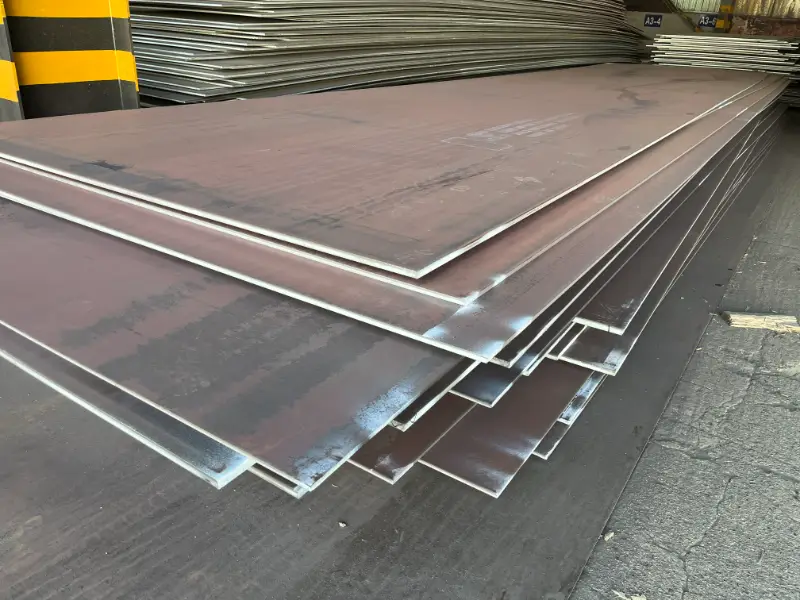
BV Grade A460 Shipbuilding Steel Plate
BV Grade A460 Shipbuilding Steel Plate - High Strength Marine Steel for Hull Structures
Comprehensive material data sheet for BV A460 shipbuilding steel plate, including chemical composition, mechanical properties, physical characteristics, equivalent grades, and application guidance based on Bureau Veritas rules and IACS UR W11.
Hot rolling, controlled rolling, normalizing, thermomechanical rolling (TMCP) depending on delivery condition requirement
- Phone : +8618037372205
- Email : [email protected]
- WhatsApp: Contact via Whtsapp
- WeChat: +8618037372205
BV Grade A460 Shipbuilding Steel Plate Introduction
BV Grade A460 is a normalized or thermomechanically rolled high-strength hull structural steel certified by Bureau Veritas (BV). It is designed for use in ship and offshore structures where a minimum yield strength of 460 MPa is required. The steel conforms to the IACS UR W11 standard for normal and high-strength hull structural steels, ensuring consistent quality and global acceptance. Typical delivery condition involves controlled rolling, normalizing, or thermomechanical controlled processing (TMCP) to achieve fine-grain microstructure and excellent toughness. This grade offers a good balance of strength, weldability, and low-temperature notch toughness, with impact testing performed at 0°C (Grade A). It is widely employed for critical members in ship hulls, offshore platforms, and heavy marine construction, providing reliable performance in demanding environments. The combination of high strength and good ductility allows for weight reduction in large structures while maintaining safety margins under dynamic loads.
BV Grade A460 Shipbuilding Steel Plate Chemical Composition
Chemical composition requirements for BV A460 are in accordance with IACS UR W11 for high-strength hull structural steels. The steel shall be fully killed, usually aluminum-treated, and contain sufficient grain-refining elements such as Nb, V, Ti, or combinations thereof. Residual elements like Cr, Ni, Mo, Cu are allowed up to certain limits and may be added to enhance specific properties.
- Carbon equivalent (CEV) is typically calculated based on the actual composition to ensure weldability; typical limit CEV ≤ 0.43% (ladle analysis).
- Fine grain practice is mandatory; aluminum content or other grain-refining additions are controlled.
| Element | Specified Value (Heat Analysis, %) | Remarks |
|---|---|---|
| Carbon (C) | ≤ 0.18 | Lower carbon improves weldability |
| Manganese (Mn) | 0.90 – 1.60 | Increases strength and hardenability |
| Silicon (Si) | 0.10 – 0.50 | Deoxidizer; may be slightly higher in certain practices |
| Phosphorus (P) | ≤ 0.035 | Low residual for toughness |
| Sulfur (S) | ≤ 0.035 | Low sulfur for through-thickness properties |
| Aluminum (Al, total) | ≥ 0.020 (or sufficient Nb/V/Ti) | Grain-refining element; acid soluble Al |
| Niobium (Nb) | ≤ 0.05 | Micro-alloying element for grain refinement |
| Vanadium (V) | ≤ 0.10 | Micro-alloying element for precipitation strengthening |
| Titanium (Ti) | ≤ 0.03 | Grain refinement and inclusion shape control |
| Niobium + Vanadium + Titanium | ≤ 0.15 | Summation limit for micro-alloys |
| Carbon Equivalent (CEV) | ≤ 0.43 (typical) | Based on IIW formula; actual limit per specification |
BV Grade A460 Shipbuilding Steel Plate Thermal and Electrical Physical Properties
Physical properties are typical for a low‑alloy structural steel at ambient temperature and may vary slightly with composition and heat treatment. These values are representative and suitable for design calculations.
- Density is assumed constant over the normal service temperature range.
- Thermal expansion coefficient is linear over the indicated range.
- Thermal conductivity and specific heat capacity govern temperature distribution in welding and fire scenarios.
| Property | Typical Value | Unit | Test Condition / Reference |
|---|---|---|---|
| Density (ρ) | 7.85 | g/cm³ | 20°C |
| Modulus of Elasticity (E) | 205 | GPa | Room temperature |
| Shear Modulus (G) | 79 – 81 | GPa | Calculated from E and Poisson ratio |
| Poisson's Ratio (ν) | 0.30 | — | Room temperature, within elastic limit |
| Coefficient of Thermal Expansion (α) | 11.0 – 12.5 | 10⁻⁶ /K | 20°C to 100°C |
| Thermal Conductivity (λ) | 46 – 54 | W/(m·K) | At 20°C |
| Specific Heat Capacity (Cp) | 460 – 490 | J/(kg·K) | At 20°C |
| Electrical Resistivity (ρe) | 0.20 – 0.25 | μΩ·m | At 20°C |
BV Grade A460 Shipbuilding Steel Plate Mechanical Properties
Mechanical properties are determined on test specimens in the delivery condition. Requirements vary with product thickness. Tensile testing at room temperature, Charpy V-notch impact testing at 0°C for Grade A designation, and bend tests are mandatory.
- Yield strength (ReH) specification is based on thickness ranges: ≤ 50 mm, > 50–100 mm, > 100–150 mm.
- Charpy impact energy requirements are for longitudinal specimens. Transverse values are 70% of the longitudinal requirement.
- Bend test: no cracks or defects after bending to a specified angle (usually 180°) around a mandrel of diameter 'd' = 3× thickness (t ≤ 25 mm).
| Property | Specified Requirement | Unit | Test Condition |
|---|---|---|---|
| Yield Strength (ReH) | ≥ 460 | MPa | Thickness ≤ 50 mm, transverse |
| Yield Strength (ReH) | ≥ 440 | MPa | 50 < thickness ≤ 100 mm, transverse |
| Yield Strength (ReH) | ≥ 400 | MPa | 100 < thickness ≤ 150 mm, transverse |
| Tensile Strength (Rm) | 570 – 720 | MPa | All thicknesses up to 150 mm |
| Elongation (A5) | ≥ 17 | % | Thickness ≤ 50 mm, gauge length 5.65√S₀ |
| Elongation (A5) | ≥ 17 | % | Thickness > 50–100 mm |
| Elongation (A5) | ≥ 16 | % | Thickness > 100–150 mm |
| Charpy Impact Energy (KV, longitudinal) | ≥ 34 (average of 3) | J | Test temperature: 0°C (Grade A) |
| Charpy Impact Energy (KV, transverse) | ≥ 24 (average of 3) | J | Test temperature: 0°C (when specified) |
| Bend Test | d = 3 a | — | 180° bend, a = specimen thickness ≤ 25 mm |
| Bend Test | d = 4 a | — | 180° bend, a > 25–50 mm |
BV Grade A460 Shipbuilding Steel Plate Completely Equivalent Material Standards and Substitutable Grade Recommendations
| Country / Region | Standard / Rule | Equivalent Grade | Remarks |
|---|---|---|---|
| International (IACS) | IACS UR W11 | High Strength Steel – Strength Level 460 (A Grade) | Base standard adopted by all member societies |
| American Bureau of Shipping | ABS Rules, Part 2, Chapter 1 | ABS A460 | Identical requirements under IACS framework |
| DNV (Det Norske Veritas) | DNV Rules Pt.2 Ch.2 | DNV A460 | Same strength and toughness class |
| Lloyd's Register | LR Rules Pt.2, Ch.2 | LR A460 | Full equivalency |
| China Classification Society | CCS Rules Pt.2 Ch.2 | CCS A460 | Same specification (also GB/T 712 A460) |
| ClassNK (Nippon Kaiji Kyokai) | NK Rules Pt.K, Ch.1 | NK A460 | Equivalent high‑strength hull steel |
| Korean Register | KR Rules Pt.2, Ch.2 | KR A460 | IACS UR W11 compliant |
| Registro Italiano Navale | RINA Rules Pt.C, Ch.2 | RINA A460 | Same family |
| Russian Maritime Register | RS Rules Pt.X, Ch.1 | RS A460 | Corresponding grade |
BV Grade A460 Shipbuilding Steel Plate Application Introduction
BV A460 steel plate is engineered for high‑strength applications in shipbuilding and offshore engineering. Its excellent combination of strength, weldability, and low‑temperature toughness makes it suitable for critical structural members subject to high static and dynamic loads.
- Typical processing includes thermal cutting, cold forming, hot forming (within specified temperature ranges), and welding with low‑hydrogen processes.
- Preheating may be required for thick sections or when CEV is at the upper end of the specification to avoid hydrogen cracking.
- Post‑weld heat treatment is generally not required if impact properties are maintained.
Product Applications: Main hull plates (deck, bottom, side shell, bulkheads), Longitudinal stiffeners, keel, stringers, frames, Transverse webs and girders, Helicopter decks on offshore installations, Crane pedestal and leg structures on jack‑up rigs, Structural components of heavy-lift vessels
Processed into products: Hull shell plates and plating, Stiffeners and T‑bars, Deck girders and beams, Bulkhead corrugations, Gusset plates and brackets, Offshore module primary structural steel, Jack‑up rig legs and chords (if toughness requirements are satisfied)
Application industries: Marine and shipbuilding (naval and commercial vessels), Offshore oil and gas platforms (jackets, topsides, modules), Renewable energy structures (offshore wind turbine foundations), Heavy civil engineering (bridges, locks, gates where marine corrosion resistance is required), Port and harbor construction equipment
BV Grade A460 Shipbuilding Steel Plate Similar / Alternative Material Recommendations
| Country / Region | Standard | Grade | Remarks |
|---|---|---|---|
| European Union | EN 10025‑3 | S460N / S460NL | Normalized fine-grain structural steel; yield 460 MPa; NL provides low‑temperature toughness. Not ship‑specific, but often used in marine structures with additional certification. |
| European Union | EN 10025‑6 | S460Q / S460QL | Quenched and tempered structural steel; strength and toughness similar; QL offers low‑temperature properties. Requires special agreement for shipbuilding. |
| United States | ASTM A572 / A572M | Grade 65 (450 MPa) | Slightly lower minimum yield (450 MPa). Not explicitly for ship hulls; supplementary requirements needed. |
| United States | ASTM A656 / A656M | Grade 80 (550 MPa) | Higher tensile strength but different chemistry; toughness may not match shipbuilding requirements. |
| China | GB/T 712 | A460 | Chinese shipbuilding standard, identical to CCS A460; thus fully equivalent as a domestic alternative. |
| International | ISO 4995 / ISO 630‑3 | S460 | Structural steel with similar yield; may be used with additional ship classification certification. |
Notes:
For through‑thickness property requirements (e.g., Z35), supplementary specifications such as IACS UR W with Z-quality (Z25, Z35) must be invoked. Ultrasonic testing (UT) is routinely carried out per BV rules to guarantee internal soundness. When specifying BV A460, the purchaser should clearly indicate the delivery condition (N, M, Q), any supplementary impact test temperatures (e.g., D or E grades for lower temperature), and documentary requirements (BV certificate type). Always refer to the latest IACS UR W11 and applicable BV rule edition for exact limits.
- Share



