
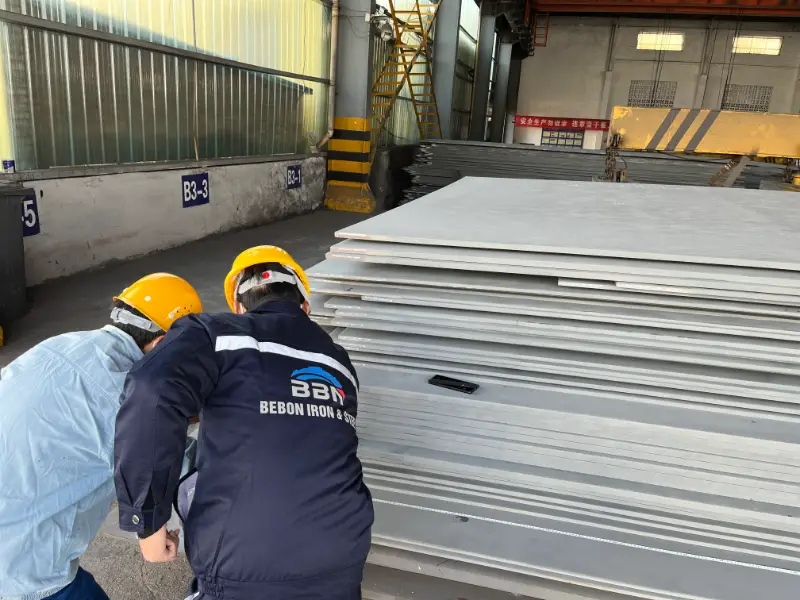
BV Grade D460 Shipbuilding Steel Plate
BV Grade D460 Shipbuilding Steel Plate - Full Property & Equivalent Analysis
Complete technical data for BV Grade D460 high-strength shipbuilding steel: chemical composition, mechanical properties, thermal and electrical physical properties, international equivalents, and application guidance.
Hot rolling, TMCP (thermo-mechanical controlled processing), normalizing, quenching and tempering (depending on thickness and specification)
- Phone : +8618037372205
- Email : [email protected]
- WhatsApp: Contact via Whtsapp
- WeChat: +8618037372205
BV Grade D460 Shipbuilding Steel Plate Introduction
BV Grade D460 is a high-strength structural shipbuilding steel plate certified by Bureau Veritas (BV) with a minimum yield strength of 460 MPa. Designed for critical hull and marine structures, it is supplied in a thermo-mechanically controlled rolled (TMCP) or normalized condition, offering excellent weldability, good low-temperature toughness, and high resistance to brittle fracture. The 'D' designation requires Charpy V-notch impact testing at -20°C, ensuring reliable performance in cold environments. Typical applications include heavy ship frames, decks, hatch coamings, and offshore platform components. The steel is produced with fine grain practice and microalloying elements, meeting stringent BV Rules for the Classification of Steel Ships, Part D. The grade complies with IACS UR W11 and is fully equivalent to DH460 across all major classification societies.
BV Grade D460 Shipbuilding Steel Plate Chemical Composition
Typical ladle analysis according to BV Rules for D460 grade (TMCP or normalized) . Fine grain practice and microalloying are applied to achieve the required strength and toughness. Carbon equivalent Ceq = C + Mn/6 + (Cr+Mo+V)/5 + (Ni+Cu)/15 is controlled to ensure good weldability. Actual values may vary with plate thickness and manufacturing process.
| Element | Specified Values (max unless range) | Remarks |
|---|---|---|
| Carbon (C) | ≤ 0.18% | Thicker plates may have lower C for weldability |
| Manganese (Mn) | 1.00 – 1.60% | Adjustable to meet tensile requirements |
| Silicon (Si) | ≤ 0.50% | Deoxidizer, improves strength |
| Phosphorus (P) | ≤ 0.025% | Stringent control for toughness |
| Sulfur (S) | ≤ 0.020% | Low sulfur improves lamellar tearing resistance |
| Aluminium (Al, total) | ≥ 0.020% | Fine grain practice, acid soluble Al typically 0.015-0.060% |
| Niobium (Nb) | ≤ 0.05% | Microalloy, grain refinement |
| Vanadium (V) | ≤ 0.10% | Optional, precipitation strengthening |
| Titanium (Ti) | ≤ 0.05% | Grain refinement, nitrogen fixation |
| Nitrogen (N) | ≤ 0.012% | Limited for ageing resistance |
| Copper (Cu) | ≤ 0.35% | Residual, may be added for corrosion resistance |
| Chromium (Cr) | ≤ 0.20% | Residual, supplementary hardenability |
| Nickel (Ni) | ≤ 0.40% | Optional for improved toughness |
| Molybdenum (Mo) | ≤ 0.08% | Residual |
| Carbon Equivalent (Ceq) | ≤ 0.47% (typical) | For thicknesses up to 100 mm; higher may be allowed with approval |
BV Grade D460 Shipbuilding Steel Plate Thermal & Electrical Physical Properties
Representative physical properties for BV D460 based on similar high-strength low-alloy (HSLA) structural steels. Actual values may vary slightly depending on composition and manufacturing process. These data are useful for design calculations involving heat transfer, thermal expansion, and electrical resistance. Testing temperature: room temperature except for thermal expansion and specific heat which are given over temperature ranges.
| Property | Typical Value | Unit | Condition / Temperature |
|---|---|---|---|
| Density (ρ) | 7850 | kg/m³ | At 20°C |
| Elastic modulus (E) | 205 | GPa | At 20°C, tensile |
| Shear modulus (G) | 80 | GPa | Calculated from E and ν |
| Poisson's ratio (ν) | 0.30 | – | Elastic range |
| Thermal expansion coefficient (α) | 12.0 × 10⁻⁶ | K⁻¹ | 20 – 100°C |
| Thermal expansion coefficient (α) | 12.8 × 10⁻⁶ | K⁻¹ | 20 – 200°C |
| Thermal expansion coefficient (α) | 13.5 × 10⁻⁶ | K⁻¹ | 20 – 400°C |
| Thermal conductivity (λ) | 50 | W/(m·K) | At 20°C |
| Thermal conductivity (λ) | 45 | W/(m·K) | At 200°C |
| Specific heat capacity (cp) | 460 | J/(kg·K) | 20 – 100°C average |
| Specific heat capacity (cp) | 510 | J/(kg·K) | 100 – 500°C average |
| Electrical resistivity (ρ_e) | 0.25 | μΩ·m | At 20°C, typical for C-Mn steel |
BV Grade D460 Shipbuilding Steel Plate Mechanical Properties
Tensile and impact properties according to BV Rules for D460 steel plates in TMCP or normalized condition. Test specimens are taken in the transverse direction unless longitudinal is specified. For thickness > 50 mm, small reductions in minimum yield strength may apply. Charpy impact test temperature is -20°C (D grade). All values are minimum unless otherwise noted.
| Property | Required Value | Unit | Test Condition / Remarks |
|---|---|---|---|
| Yield strength (ReH) | ≥ 460 | MPa | Thickness t ≤ 50 mm |
| Yield strength (ReH) | ≥ 430 | MPa | 50 < t ≤ 70 mm |
| Yield strength (ReH) | ≥ 410 | MPa | 70 < t ≤ 100 mm |
| Tensile strength (Rm) | 570 – 720 | MPa | All thicknesses, typical range |
| Elongation (A) | ≥ 17 | % | Gauge length 5.65√S₀, transverse specimen |
| Elongation (A) | ≥ 18 | % | Longitudinal specimen (for reference) |
| Bend test (d = mandrel diameter, a = specimen thickness) | 180° d = 3a | – | t ≤ 50 mm, no cracks |
| Bend test | 180° d = 4a | – | 50 < t ≤ 100 mm |
| Charpy V-notch impact (KV₂) | ≥ 31 (longitudinal) | J | at -20°C, average of 3 specimens |
| Charpy V-notch impact (KV₂) | ≥ 22 (transverse) | J | at -20°C, average of 3 specimens |
| Charpy V-notch impact (KV₂) | ≥ 24 (individual min) | J | Single value allowance |
BV Grade D460 Shipbuilding Steel Plate Fully Equivalent Material Standards & Substitute Grades
| Country / Region | Standard / Classification Society | Grade | Remarks |
|---|---|---|---|
| United Kingdom | Lloyd's Register (LR) | DH460 | Identical toughness (-20°C) and strength requirements |
| USA | American Bureau of Shipping (ABS) | DH460 | Per ABS Rules, Part 2, Chapter 1 |
| Norway | DNV (DNV GL) | D460 | DNV-OS-B101; designates NV D460 |
| China | China Classification Society (CCS) | DH460 | CCS Rules for Material and Welding |
| Japan | Nippon Kaiji Kyokai (ClassNK) | KD460 | K indicates high-strength, D for -20°C |
| Italy | Registro Italiano Navale (RINA) | D460 | Equivalent grade in RINA Rules |
| Russia | Russian Maritime Register of Shipping (RS) | D460 | D460 per RS Rules |
| South Korea | Korean Register (KR) | DH460 | Equivalent to D460 in KR rules |
| India | Indian Register of Shipping (IRS) | D460 | D460 available in IRS META-Ship |
BV Grade D460 Shipbuilding Steel Plate Application Introduction
BV D460 steel is primarily deployed in the maritime and offshore sectors where high strength combined with good low-temperature toughness and weldability is essential. The grade is suitable for both new-building and repair work. Its TMCP processing route ensures fine grain size and balanced properties across thick sections, minimizing the need for preheating during welding.
Product Applications: Container ships: hull side plates, deck stringer plates, hatch coamings, Bulk carriers & tankers: bottom plates, bilge strakes, bulkhead stiffening, Offshore structures: node cans, brace members, helideck beams, Port equipment: heavy-duty crane booms, ship unloader structures
Processed into products: Longitudinal and transverse stiffeners in ship frames, Rudder horns and stern frames, Main deck and shell plating in high stress zones, Cargo hold frames and stringers, Offshore platform deck legs and bracing, Welded girders and T-beams for heavy sections, Crane pedestals and lifting lugs
Application industries: Shipbuilding (commercial and naval vessels), Offshore oil & gas platforms (jackets, topsides, FPSOs), Marine engineering (harbor cranes, bridges, heavy lifting equipment), Renewable energy (offshore wind turbine foundations, transition pieces)
BV Grade D460 Shipbuilding Steel Plate Similar or Alternative Materials with Comparable Performance
| Country / Region | Standard | Grade | Remarks |
|---|---|---|---|
| Europe | EN 10025-6 | S460QL / S460QL1 | Quenched & tempered structural steel; not ship class approved unless additionally certified, similar tensile and impact at -20°C |
| Europe | EN 10025-4 | S460M / S460ML | TMCP fine-grain structural steel; may substitute for non-marine applications |
| USA | ASTM A572 / A572M | Grade 65 | Yield 450 MPa but lower minimum tensile, not impact tested unless specified; offshore structural use possible with supplementary requirements |
| Japan | JIS G3106 | SM570 | Rolled steels for welded structure, tensile 570–720 MPa, yield ≥ 460 MPa for thin plates; not automatically certified for ships |
| International | IACS UR W11 | DH460 | Unified requirement for high strength hull steels, basis for all major class societies |
| Offshore | API 2W / 2Y | Grade 60 | Steel for offshore structures with 414–552 MPa yield; can approach D460 with proper selection |
Notes:
Welding recommendations: Preheating temperatures of 75–150°C are typical for thicknesses above 20 mm, using low-hydrogen consumables matched to the strength level. Nondestructive testing: Ultrasonic examination may be required per class rules for thicknesses above 30 mm. Corrosion protection: In marine environments, standard coating systems or cathodic protection are essential. Formability: Cold bending can be performed with a larger radius (≥ 6t for severe forming). Hot forming should be followed by normalizing. Documentation: Mill certificates with full traceability and 3.2 inspection class are standard for shipbuilding plates. Ordering note: When placing an order, specify target thickness, width, length, quantity, delivery condition, and any supplementary requirements (e.g., through-thickness properties per Z-quality).
- Share



