
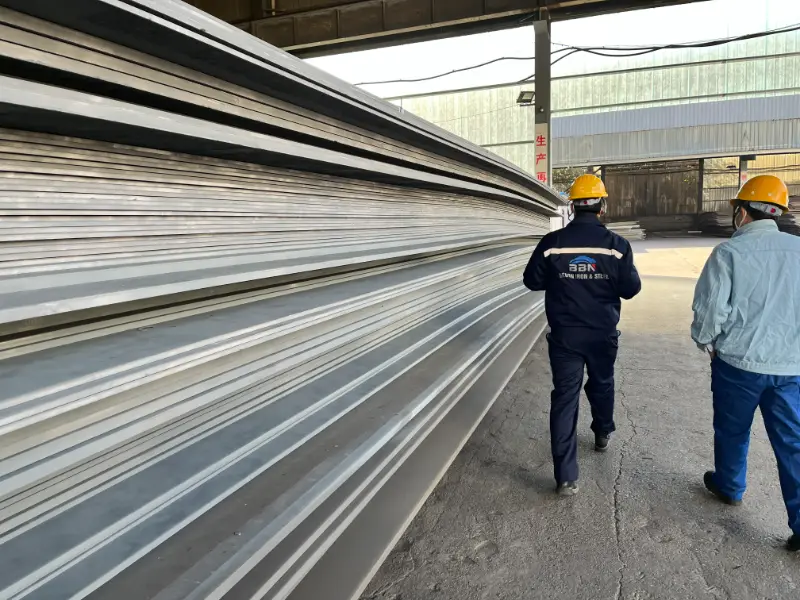
BV Grade E460 Shipbuilding Steel Plate
BV Grade E460 Shipbuilding Steel Plate: Full Data, Equivalents & Uses
Comprehensive technical reference for BV Grade E460 shipbuilding steel plate – chemical composition, mechanical properties at various thicknesses, thermal and electrical physical properties, international equivalents (ABS EH46, LR EH46, DNV E460), similar materials (EN S460ML), and typical applications in ship hulls and offshore structures.
Thermo‑Mechanical Controlled Process (TMCP), Normalizing, Quenching and Tempering (as per thickness and specification)
- Phone : +8618037372205
- Email : [email protected]
- WhatsApp: Contact via Whtsapp
- WeChat: +8618037372205
BV Grade E460 Shipbuilding Steel Plate Introduction
BV Grade E460 is a high‑strength structural steel for shipbuilding, certified by Bureau Veritas (BV) in accordance with BV Rules for Materials and Welding. The letter E indicates guaranteed impact toughness at -40°C. With a minimum yield strength of 460 MPa in the as‑rolled/thermo‑mechanically treated condition, it offers an excellent strength‑to‑weight ratio for large marine constructions.
Key features:
- Minimum yield strength 460 MPa (thickness ≤50 mm)
- Excellent low‑temperature toughness (Longitudinal KV₂ ≥41 J at -40°C)
- Good weldability when following established shipyard procedures
- Delivered primarily in TMCP condition, also normalized or Q&T
- Fully compliant with IACS UR W11 for EH46 steel
Typical thicknesses range from 6 mm to 100 mm, used for hull plating, frames, and offshore modules.
BV Grade E460 Shipbuilding Steel Plate Chemical Composition
The chemical composition of BV Grade E460 is controlled to ensure high strength and excellent weldability. Maximum contents are given unless a range is indicated. All values comply with IACS UR W11 for EH46 high‑strength shipbuilding steel. Routine additions such as aluminium are required, while micro‑alloying elements (Nb, V, Ti) may be used singly or in combination to achieve the mechanical properties.
Note: Elements not listed shall not be intentionally added.
| Element | Standard Value (max. unless range) | Remarks |
|---|---|---|
| Carbon (C) | ≤ 0.18% | |
| Manganese (Mn) | 0.90 – 1.70% | |
| Silicon (Si) | ≤ 0.55% | |
| Phosphorus (P) | ≤ 0.025% | |
| Sulfur (S) | ≤ 0.025% | |
| Aluminium (Al) | ≥ 0.020% (acid‑soluble or total) | Grain refinement |
| Niobium (Nb) | ≤ 0.05% | Micro‑alloying |
| Vanadium (V) | ≤ 0.10% | Micro‑alloying |
| Titanium (Ti) | ≤ 0.02% | Optional |
| Copper (Cu) | ≤ 0.35% | |
| Chromium (Cr) | ≤ 0.20% | |
| Nickel (Ni) | ≤ 0.30% | May be raised for thicker plates |
| Molybdenum (Mo) | ≤ 0.08% | |
| Nitrogen (N) | ≤ 0.012% | Unless bound by strong nitride formers |
| Boron (B) | ≤ 0.0005% | Not normally added |
BV Grade E460 Shipbuilding Steel Plate Thermal and Electrical Physical Properties
The following physical properties are typical for normalized or TMCP high‑strength shipbuilding steels at room temperature, unless otherwise stated. They serve as engineering design data and are not part of the mandatory material standard. Actual values may vary slightly depending on the exact chemical composition and heat treatment condition.
| Property | Typical Value | Unit | Test Conditions / Remarks |
|---|---|---|---|
| Density (ρ) | 7850 | kg/m³ | 20°C |
| Density (ρ) | 7.85 | g/cm³ | 20°C |
| Modulus of elasticity (E) | 205 – 210 | GPa | 20°C, dynamic or static |
| Shear modulus (G) | ≈ 80 | GPa | 20°C |
| Poisson's ratio (ν) | 0.30 | — | Elastic range |
| Thermal expansion coefficient (α) – 20 to 100°C | 11.5 × 10⁻⁶ | K⁻¹ | Mean linear expansion |
| Thermal expansion coefficient (α) – 20 to 200°C | 12.0 × 10⁻⁶ | K⁻¹ | Mean linear expansion |
| Thermal conductivity (λ) | 48 – 52 | W/(m·K) | 20°C |
| Specific heat capacity (cₚ) | ≈ 480 | J/(kg·K) | 20°C |
| Electrical resistivity (ρₑ) | 0.22 × 10⁻⁶ | Ω·m | 20°C |
| Electrical resistivity (ρₑ) | 0.022 | Ω·mm²/m | 20°C (alternative unit) |
BV Grade E460 Shipbuilding Steel Plate Mechanical Properties
Mechanical tests are performed in the transverse direction for plates and wide flats, and in the longitudinal direction for other products. Requirements are related to the specified thickness t (in mm).
Impact test: Charpy V‑notch tests at -40°C (Grade E). Values given are for longitudinal specimens; transverse requirements are typically 25–30% lower (refer to the vessel's specification). Single values must be at least 70% of the specified average.
| Property | Requirement | Unit | Test conditions |
|---|---|---|---|
| Yield strength (ReH) – t ≤ 50 mm | ≥ 460 | MPa | Transverse, t ≤ 50 mm |
| Yield strength (ReH) – 50 < t ≤ 70 mm | ≥ 440 | MPa | Transverse, 50 < t ≤ 70 mm |
| Yield strength (ReH) – 70 < t ≤ 100 mm | ≥ 420 | MPa | Transverse, 70 < t ≤ 100 mm |
| Tensile strength (Rm) – all thicknesses ≤100 mm | 570 – 720 | MPa | Transverse, t ≤ 100 mm |
| Elongation (A5) – t ≤ 50 mm | ≥ 17 | % | Transverse, gauge 5.65√S₀ |
| Elongation (A5) – 50 < t ≤ 70 mm | ≥ 16 | % | Transverse, gauge 5.65√S₀ |
| Elongation (A5) – 70 < t ≤ 100 mm | ≥ 15 | % | Transverse, gauge 5.65√S₀ |
| Bend test – t ≤ 25 mm | Bend diameter 3a, 180° | — | No cracks; a = specimen thickness |
| Bend test – t > 25 mm | Bend diameter 4a, 180° | — | No cracks; a = specimen thickness |
| Impact energy (KV₂) – t ≤ 50 mm | Average ≥ 41 J, min. single ≥ 28 J | J | -40°C, longitudinal, 10×10 mm sub‑size |
| Impact energy (KV₂) – 50 < t ≤ 70 mm | Average ≥ 37 J, min. single ≥ 26 J | J | -40°C, longitudinal, 10×10 mm sub‑size |
| Impact energy (KV₂) – 70 < t ≤ 100 mm | Average ≥ 34 J, min. single ≥ 24 J | J | -40°C, longitudinal, 10×10 mm sub‑size |
| Through‑thickness reduction of area (optional Z35) | ≥ 35% (if supplementary requirement) | % | Z‑direction testing to BV Pt.2, Ch.2, Sec.6 |
BV Grade E460 Shipbuilding Steel Plate Full Equivalents – Identical / Officially Recognized Grades
| Country / Region | Standard / Class Society | Grade | Remarks |
|---|---|---|---|
| International | IACS UR W11 | EH46 | Unified requirement for EH46 high‑strength hull structural steel |
| American Bureau of Shipping | ABS Rules | EH46 | Identical toughness class and strength level |
| Lloyd's Register | LR Rules | EH46 | EH46 grade; LR approval equivalent |
| DNV (now DNV GL) | DNV Rules Pt.2 Ch.2 | E460 | E460 (NV E460) identical to BV E460 |
| Nippon Kaiji Kyokai (ClassNK) | NK Rules | KEH46 | Japanese ship class notation for EH46 |
| China Classification Society | CCS Rules | EH460 | EH460; fully interchangeable |
| Registro Italiano Navale | RINA Rules | EH46 | Same requirements |
| Korean Register | KR Rules | EH46 | Same requirements |
| Russian Maritime Register of Shipping | RS Rules | EH46 | Identical in composition and properties |
| European Standard | EN 10025‑6 (+ shipbuilding supplementary requirements) | S460ML | TMCP plate with -40°C toughness; often accepted as EH46 when BV‑certified |
BV Grade E460 Shipbuilding Steel Plate Application Introduction
BV Grade E460 is intended for heavily loaded welded structures in marine and offshore environments. Its high strength permits a reduction in scantlings compared with ordinary 235 MPa steel, leading to significant weight savings and improved payload capacity. The guaranteed low‑temperature toughness makes it suitable for service in cold climates and ice‑class vessels.
The steel is typically delivered in the thermo‑mechanically controlled (TMCP) condition, which provides an ultra‑fine grain structure and excellent weldability. Welding should be performed with low‑hydrogen consumables and appropriate pre‑heat/interpass temperatures following recognized shipyard practices and BV guidelines.
Product Applications: Hull shell plates and bottom plating, Main deck and strength deck plates, Longitudinal and transverse framing, Bulkhead plating (watertight and oiltight), Offshore platform legs and braces, Transition rings for wind turbine towers (marine environment)
Processed into products: Hull shell plating (side, bottom, bilge strakes), Deck stringers and sheer strakes, Transverse and longitudinal stiffeners, Bulkhead panels and stiffeners, Flare towers and flare booms, Helideck supporting structures, Jacket leg cans and node joints, Mooring winch foundations, Rudder and stern frame components
Application industries: Shipbuilding (merchant, naval, ice‑class vessels), Offshore engineering (platforms, FPSOs, jack‑up rigs), Marine construction (floating docks, port structures), Oil & Gas (structural components in arctic environments), Heavy machinery (marine cranes, lifting appliances)
BV Grade E460 Shipbuilding Steel Plate Similar / Alternative Materials
| Country / Region | Standard | Grade | Remarks |
|---|---|---|---|
| European Union | EN 10025‑6 | S460ML | TMCP structural steel, yield 460 MPa, -40°C impact. Requires additional BV approval for marine use. |
| European Union | EN 10025‑4 | S460ML (TM) or S460Q | Thermo‑mechanically rolled or quenched and tempered. Similar strength but different delivery condition. |
| United States | ASTM A131 / A131M | EH46 | ASTM shipbuilding steel; EH46 matches BV E460 but check specification edition and supplementary requirements. |
| Japan | JIS G 3106 | SM570 | High‑strength welded structural steel, 570 MPa tensile, TMCP. Not a direct ship class grade but often used for non‑classed marine structures. |
| China | GB/T 712 | EH460 | Chinese shipbuilding steel, very similar to BH (CCS) EH460; can be considered equivalent after certification. |
| International | BV Rules | E420 or E550 | If 460 MPa yield is not critical. E420 (lower strength) or E550 (higher strength) may be used with design adjustment. |
Notes:
BV certification mandatory – The material must be produced by a BV‑approved manufacturer and be stamped with the BV mark. The steel is subject to full traceability and lot‑wise tensile, bend, and Charpy V‑notch testing in the presence of a BV surveyor.
Welding considerations: For thicknesses above 25 mm, a hydrogen‑controlled procedure is recommended; pre‑heat may be required depending on carbon equivalent and plate thickness. PWHT is generally not required for TMCP E460 but may be specified for heavy highly restrained joints.
Corrosion: As a carbon‑manganese steel, it requires protective coatings or cathodic protection in seawater immersion zones.
- Share



