
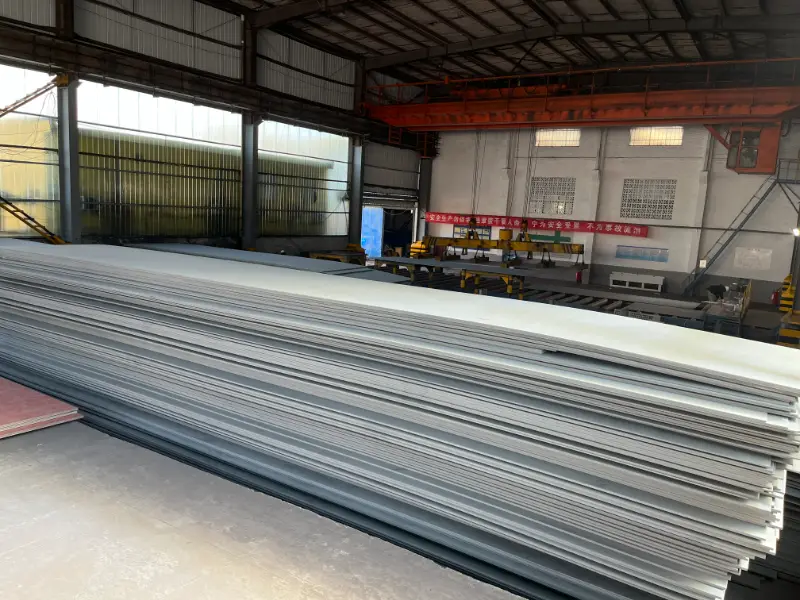
BV Grade F460 Shipbuilding Steel Plate
BV Grade F460 Shipbuilding Steel Plate: High Strength Arctic Hull Steel (FH460)
In-depth material data sheet for BV Grade F460 high strength shipbuilding steel plate. Covers chemical composition, mechanical properties, thermal/physical properties, international equivalents, similar grades, and application guidance for marine and offshore engineering.
Thermo-mechanical controlled rolling (TMCP), normalizing, welding, cutting, bending, forming
- Phone : +8618037372205
- Email : [email protected]
- WhatsApp: Contact via Whtsapp
- WeChat: +8618037372205
BV Grade F460 Shipbuilding Steel Plate Introduction
BV Grade F460 is a high-strength structural steel plate certified by Bureau Veritas for use in shipbuilding and offshore structures. Designated as FH460 according to IACS UR W11, it belongs to the F-temperature class (maximum impact test temperature -60°C), making it suitable for Arctic and low-temperature environments. Key features:
- High yield strength (min 460 MPa) and tensile strength (570–720 MPa) ensuring excellent structural integrity.
- Excellent notch toughness at low temperatures (Charpy impact energy ≥50 J at -60°C) for safety in cold waters.
- Controlled chemical composition with low carbon equivalent (CEV) to provide good weldability.
- Fine-grain killed steel produced by thermo-mechanical controlled rolling (TMCP) or normalizing, offering uniform mechanical properties.
- Wide thickness range up to 100 mm compliant with BV rules.
This grade is extensively employed for main hull structural members such as decks, shell plating, bottom and side longitudinals, and in ice-class vessels where low-temperature toughness is mandatory. Its balance of strength and toughness reduces steel weight, improves payload capacity, and meets stringent classification society requirements for heavy-duty marine applications.
BV Grade F460 Shipbuilding Steel Plate Chemical Composition
Chemical composition according to IACS UR W11 and BV rules for high strength steel plates. All values are weight percentages. The carbon equivalent (CEV) is typically controlled to ≤0.45 for good weldability. Note: For thickness ≤50 mm, carbon is often limited to ≤0.18, while for greater thicknesses up to 100 mm the maximum may be ≤0.20 with adjusted CEV requirements.
| Chemical Element | Standard Value (wt%) | Remarks |
|---|---|---|
| C | ≤0.18 | Max; for t ≤50 mm |
| Mn | 1.00–1.60 | |
| Si | 0.10–0.55 | |
| P | ≤0.035 | |
| S | ≤0.035 | |
| Al (total) | ≥0.020 | Fine grain practice |
| Cr | ≤0.25 | |
| Ni | ≤0.80 | |
| Mo | ≤0.10 | |
| Cu | ≤0.35 | |
| Nb | ≤0.05 | |
| V | ≤0.10 | |
| Ti | ≤0.02 | |
| N | ≤0.012 | |
| Carbon Equivalent (CEV) | ≤0.45 | For TMCP delivery (typical) |
BV Grade F460 Shipbuilding Steel Plate Thermal and Electrical Physical Properties
Typical physical properties for carbon-manganese high-strength structural steel. These values are not mandatory in BV rules but are representative for design and simulation purposes. They are based on published data for similar grades and may vary slightly with actual chemical composition and heat treatment.
| Property | Typical Value | Unit | Test Condition / Temperature |
|---|---|---|---|
| Density (ρ) | 7850 | kg/m³ | Ambient temperature |
| Modulus of Elasticity (E) | 205–210 | GPa | At room temperature |
| Shear Modulus (G) | ~80 | GPa | Approximate |
| Poisson's Ratio (ν) | 0.3 | – | Within elastic range |
| Thermal Expansion Coefficient (α) | 11.5–12.5 ×10⁻⁶/K | 10⁻⁶/K | 20–100°C |
| Thermal Conductivity (λ) | 45–55 | W/(m·K) | At 20°C |
| Specific Heat Capacity (cₚ) | 460–500 | J/(kg·K) | At 20°C |
| Electrical Resistivity (ρₑ) | 0.18–0.22 | 10⁻⁶ Ω·m | At 20°C |
BV Grade F460 Shipbuilding Steel Plate Mechanical Properties
Mechanical property requirements for BV Grade F460 plates in normalized or TMCP delivery condition, according to BV rules and IACS UR W11. Tensile and impact specimens are taken in the designated orientation (longitudinal or transverse) depending on plate thickness and classification rules. Multiple rows indicate property variations with thickness range.
| Property | Requirement | Unit | Test Condition |
|---|---|---|---|
| Yield Strength (ReH) | ≥460 | MPa | t ≤100 mm |
| Tensile Strength (Rm) | 570–720 | MPa | t ≤100 mm |
| Elongation (A) | ≥17 | % | t ≤50 mm |
| Elongation (A) | ≥16 | % | 50 < t ≤100 mm |
| Charpy Impact (KV), longitudinal, -60°C | 50 | J | t ≤50 mm |
| Charpy Impact (KV), longitudinal, -60°C | 50 | J | 50 < t ≤63 mm |
| Charpy Impact (KV), longitudinal, -60°C | 60 | J | 63 < t ≤75 mm |
| Charpy Impact (KV), longitudinal, -60°C | 70 | J | 75 < t ≤100 mm |
| Charpy Impact (KV), transverse, -60°C | 34 | J | t ≤50 mm |
| Charpy Impact (KV), transverse, -60°C | 34 | J | 50 < t ≤63 mm |
| Charpy Impact (KV), transverse, -60°C | 41 | J | 63 < t ≤75 mm |
| Charpy Impact (KV), transverse, -60°C | 48 | J | 75 < t ≤100 mm |
BV Grade F460 Shipbuilding Steel Plate Fully Equivalent Material Standards and Replacement Grades
| Country/Region | Standard | Grade | Remarks |
|---|---|---|---|
| International (IACS) | IACS UR W11 | FH460 | Direct equivalent notation |
| Norway / International (DNV) | DNV Rules Pt.2 Ch.1 | NV F460 | Fully equivalent |
| United Kingdom (Lloyd's) | LR Rules | FH460 | Fully equivalent |
| USA (ABS) | ABS Rules | FH460 | Fully equivalent |
| China (CCS) | CCS Rules | FH460 | Fully equivalent |
| Japan (NK) | NK Rules | FH460 | Fully equivalent |
| Italy (RINA) | RINA Rules | FH460 | Fully equivalent |
| South Korea (KR) | KR Rules | FH460 | Fully equivalent |
BV Grade F460 Shipbuilding Steel Plate Application Introduction
BV Grade F460 is specified for heavy-loaded ship hull structures that must retain excellent toughness under Arctic conditions. Typical uses include:
- Icebreakers and ice-class tankers
- Offshore support vessels and FPSO hulls
- Naval combatant hulls
- Heavy-lift and crane vessels
- Polar research and supply ships
The steel is suitable for all conventional fabrication processes such as welding (with appropriate preheat and consumables), flame cutting, bending, and machining.
Product Applications: Ice-class and polar vessels, FPSO and FPU hull structures, Offshore platform jacket and deck structures, Heavy-lift crane barges, Naval auxiliary and patrol vessels, Large container ships' upper decks, Bulk carrier and tanker hulls
Processed into products: Deck plating and shell plating, Bottom plates and bilge keels, Web frames and stringers, Longitudinal stiffeners (side, bottom, deck), Hatch coamings, Transverse bulkheads, Rudder horn and propeller brackets, Sheer strake, Mast houses and crane pedestals
Application industries: Shipbuilding (commercial and naval), Offshore oil & gas exploration, Marine engineering construction, Arctic/subarctic infrastructure, Heavy-lift crane manufacturing, Bridge building (low-temperature environments)
BV Grade F460 Shipbuilding Steel Plate Similar/Alternative Materials with Comparable Performance
| Country/Region | Standard | Grade | Remarks |
|---|---|---|---|
| EU (EN) | EN 10025-4 | S460ML | Thermo-mechanical rolled; min. yield 460 MPa; impact at -50°C (27 J); close match but toughness temperature is slightly higher. |
| EU (EN) | EN 10025-6 | S460QL1 | Quenched and tempered; min. yield 460 MPa; impact at -60°C (27 J); different delivery route, suitable for some marine applications. |
Notes:
The F460 grade requires stringent control of welding parameters to avoid cold cracking. Post-weld heat treatment (PWHT) is generally not required for thicknesses below 50 mm; preheating may be necessary for thick sections or high-restraint joints. Supply condition is typically TMCP or normalized at the manufacturer's option, and the buyer should specify the required thickness range, impact test orientation, and any supplementary testing (ultrasonic examination, Z‑direction properties). Carbon equivalent (CEV) is limited to ≤0.45 to ensure good weldability and crack resistance. Consultation with the classification society is advised for special applications such as pressure vessels or cryogenic service.
- Share



