
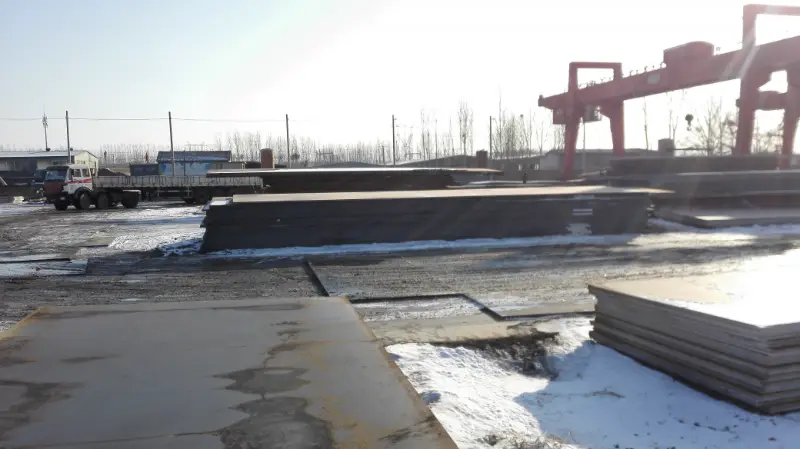
BV Grade A500 (AH50) High-Strength Shipbuilding Steel Plate
BV Grade A500 Shipbuilding Steel Plate: High-Strength Marine Steel for Polar and Arctic-Class Vessels
BV Grade A500 is a high-strength shipbuilding steel plate certified by Bureau Veritas, offering minimum yield strength of 500 MPa and designed for critical structural applications in demanding marine environments.
Hot rolling, normalizing, quenching and tempering (Q&T), thermo-mechanical controlled processing (TMCP), welding, bending, cutting
- Phone : +8618037372205
- Email : [email protected]
- WhatsApp: Contact via Whtsapp
- WeChat: +8618037372205
BV Grade A500 High-Strength Shipbuilding Steel Plate Introduction
BV Grade A500 is a high-strength shipbuilding steel plate certified by Bureau Veritas (BV). It belongs to the series of extra-high-strength structural steels for ship and offshore construction, with a minimum specified yield strength of 500 MPa. The 'A' designation indicates that this grade meets impact toughness requirements at 0 °C. Delivered in normalized, quenched and tempered, or thermo-mechanically rolled condition, BV A500 offers excellent weldability, good formability, and high resistance to brittle fracture, making it ideal for heavy-load-bearing hull structures, deck plating, and critical components in ice-class vessels, large container ships, and offshore platforms. Its chemistry is strictly controlled to ensure consistent mechanical properties across a wide thickness range while maintaining low carbon equivalent for improved weldability.
BV Grade A500 High-Strength Shipbuilding Steel Plate Chemical Composition
The chemical composition of BV Grade A500 is controlled to achieve the required strength and toughness while maintaining good weldability. The limits below are based on typical ladle analysis according to BV rules for extra-high-strength hull steels. Micro-alloying elements such as Nb, V, Ti, and Al are often added to refine grain size. Carbon equivalent (CEV) is typically limited to 0.43%–0.45% for thicknesses up to 50 mm, ensuring good field weldability without excessive preheating.
| Element | Specification (max %) | Remarks |
|---|---|---|
| Carbon (C) | 0.20 | Ladle analysis; actual target lower for improved weldability |
| Silicon (Si) | 0.10 – 0.55 | Deoxidizer; contributes to strength |
| Manganese (Mn) | 0.90 – 1.70 | Increases hardenability and strength; upper limit may be adjusted for thick plates |
| Phosphorus (P) | 0.025 | Controlled for low-temperature toughness |
| Sulfur (S) | 0.025 | Controlled for ductility and lamellar tearing resistance |
| Chromium (Cr) | 0.25 | Residual element; optional addition for strength |
| Nickel (Ni) | 0.50 | Residual; may be added for toughness (especially for thick plates) |
| Molybdenum (Mo) | 0.08 | Residual; optional for hardenability |
| Copper (Cu) | 0.30 | Residual; weather resistance when present |
| Aluminium (Al) | 0.015 – 0.060 | Grain refining element (total Al); acid soluble |
| Niobium (Nb) | 0.02 – 0.05 | Micro-alloy; grain refinement and precipitation hardening |
| Vanadium (V) | 0.05 – 0.10 | Micro-alloy; precipitation strengthening |
| Titanium (Ti) | 0.007 – 0.05 | Grain refinement; improves HAZ toughness |
| Nitrogen (N) | 0.009 | Binder for V/Ti; typically controlled |
| Boron (B) | 0.0005 | Trace; may be used for hardenability control |
BV Grade A500 High-Strength Shipbuilding Steel Plate Physical Properties
The following thermal and electrical properties are typical for high-strength low-alloy steels of this grade. These values are not part of mandatory classification requirements but are given for engineering guidance. Data based on steel with density ~7.85 g/cm³ at room temperature. Thermal expansion and conductivity vary with temperature; values provided for a range useful in design calculations.
| Property | Typical Value | Unit | Test Condition / Remarks |
|---|---|---|---|
| Density (ρ) | 7.85 | g/cm³ | At 20 °C |
| Modulus of Elasticity (E) | 205 – 210 | GPa | At room temperature |
| Shear Modulus (G) | 79 – 81 | GPa | Calculated from E and ν ≈ 0.3 |
| Poisson's Ratio (ν) | 0.28 – 0.30 | — | At ambient temperature |
| Thermal Expansion Coefficient (α) | 11.5 – 12.5 | 10⁻⁶ /K | 20–100 °C range |
| Thermal Expansion Coefficient (α) | 12.5 – 13.5 | 10⁻⁶ /K | 20–200 °C range |
| Thermal Expansion Coefficient (α) | 13.5 – 14.5 | 10⁻⁶ /K | 20–400 °C range |
| Thermal Conductivity (λ) | 42 – 46 | W/(m·K) | At 20 °C |
| Thermal Conductivity (λ) | 40 – 43 | W/(m·K) | At 100 °C |
| Thermal Conductivity (λ) | 36 – 39 | W/(m·K) | At 300 °C |
| Specific Heat Capacity (cp) | 460 – 480 | J/(kg·K) | At 20–100 °C |
| Electrical Resistivity (ρe) | 0.22 – 0.28 | µΩ·m | At 20 °C |
BV Grade A500 High-Strength Shipbuilding Steel Plate Mechanical Properties
Mechanical properties are determined on standard test specimens in accordance with BV Rules. The table shows specified minimum values for yield strength (ReH), tensile strength (Rm), elongation (A), and Charpy V-notch impact energy (KV) at 0 °C for grade A500. Impact test temperature is 0 °C for A grade. Requirements may vary with plate thickness; data here is for thickness ≤ 50 mm. For thicker plates, slight reductions in yield strength and elongation may apply.
| Property | Specified Value | Unit | Test Condition / Remarks |
|---|---|---|---|
| Yield Strength (ReH) | ≥ 500 | MPa | Transverse or longitudinal, as ordered; thickness ≤ 50 mm |
| Tensile Strength (Rm) | 610 – 770 | MPa | For thickness ≤ 100 mm |
| Elongation (A5) | ≥ 16 | % | Gauge length 5.65√S₀; transverse specimen |
| Elongation (A50) | ≥ 18 | % | Gauge length 200 mm (alternative); for info |
| Charpy V-notch Impact Energy (KV₂) | ≥ 34 (avg.) / 27 (single) | J | At 0 °C; transverse; standard specimen 10×10 mm |
| Bend Test (mandrel diameter) | d = 3t (thickness ≤ 50 mm) | — | 180° bend; no cracks. For higher thickness d = 4t may apply |
BV Grade A500 High-Strength Shipbuilding Steel Plate Equivalent Designations from Other Classification Societies
| Country / Region | Standard / Society | Grade | Remarks |
|---|---|---|---|
| International / Norway | DNV (Det Norske Veritas) | AH500 | Fully equivalent; A-class impact at 0 °C, 500 MPa min. yield |
| United Kingdom | Lloyd's Register (LR) | AH500 | Identical requirements under LR Rules |
| United States | American Bureau of Shipping (ABS) | AH500 | Grade designations may be AH500 or Grade A500; equivalent |
| China | China Classification Society (CCS) | AH500 | Equivalent; often certified as CCS AH500 |
| Japan | Nippon Kaiji Kyokai (ClassNK) | AH500 | NK AH500 mirror grade |
| Korea | Korean Register (KR) | AH500 | Equivalent; KR Rules harmonized with IACS UR W11 |
BV Grade A500 High-Strength Shipbuilding Steel Plate Application Introduction
BV Grade A500 plates are employed in the most demanding ship and offshore structural applications where high strength-to-weight ratios lead to reduced steel consumption and lower center of gravity. It can be processed using standard shipyard methods: cutting, cold forming, bending, and welding with low-hydrogen procedures. Typical applications exploit its 500 MPa yield strength to design lighter stiffened panels or thicker members where extreme loads govern, such as in ice-class vessels.
Product Applications: Container ships (ultra-large) – hull girder and hatch coaming, Icebreaker and polar supply vessels – ice-strengthened belts, Heavy-lift ships – deck structure and grillages, FPSO (Floating Production Storage and Offloading) – topside module supports, Jack-up rig legs and spudcans
Processed into products: Main deck plating and stringer plates, Bottom shell plating for ice belt regions, Longitudinal stiffeners and web frames, Bilge keel and bilge strake sections, Stern frame and rudder horn castings/weldments, Crane pedestals and heavy lift foundations
Application industries: Shipbuilding & Marine Engineering, Offshore Oil & Gas Platforms (fixed and floating), Arctic and Ice-Class Vessel Construction, Heavy Lifting and Crane Barges, Marine Renewable Energy Structures (e.g., offshore wind foundations)
BV Grade A500 High-Strength Shipbuilding Steel Plate Similar Structural Steels for Reference
| Country / Region | Standard / Specification | Grade | Remarks |
|---|---|---|---|
| Europe | EN 10025-6 | S500Q / S500QL | Quenched and tempered structural steel; min. yield 500 MPa, similar strength but not ship-class certified |
| International | IACS UR W11 | AH47 | Ship steel with min. yield 460 MPa; slightly lower strength but same toughness philosophy |
| International | IACS UR W11 | EH500 | 500 MPa yield, but impact at -40 °C; can be substituted where lower temperature toughness is needed |
| USA | ASTM A514 / A517 | Grade B / H / S | High-strength quenched and tempered plates; yield ≥ 690 MPa (A514) or 620–690 MPa; requires careful welding |
| Japan | JIS G 3106 | SM570 | Rolled steels for welded structures; yield ≥ 460 MPa; often used in bridges and penstocks, lower toughness than A500 |
| International | API 2W / 2Y | Grade 50 (345 MPa) / 60 (414 MPa) | Offshore structural steels; lower strength but with defined low-temperature toughness; often used where 500 MPa not required |
Notes:
- Welding: Use low-hydrogen electrodes or fluxes; preheat typically 75–150 °C depending on plate thickness and carbon equivalent.
- DNV, LR and other class societies may require through-thickness (Z-direction) tensile test for thick plates where lamellar tearing is a concern; Z35 quality available on request.
- For impact-tested grades at lower temperatures (D or E grades), refer to DH500 or EH500 respectively.
- Actual mechanical properties may exceed the minimum requirements significantly when produced via TMCP or Q&T routes; mill certificates should be consulted.
- The CEV (IIW) is typically ≤ 0.43% for thickness ≤ 50 mm, but may be higher for thicker products under agreement.
- Share



