
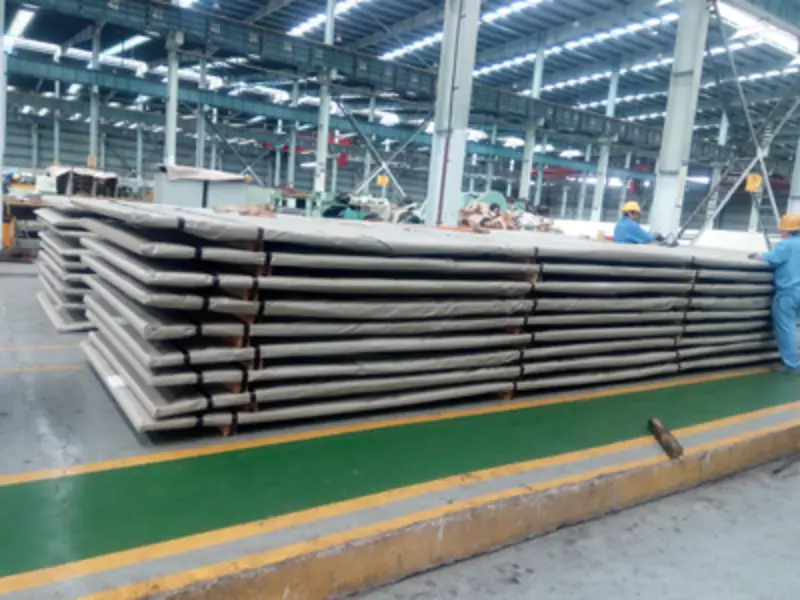
BV Grade D500 Shipbuilding Steel Plate
BV Grade D500 Shipbuilding Steel Plate: High-Strength Hull Structural Steel for Extreme Marine Environments
Comprehensive datasheet for BV Grade D500 (DH51) shipbuilding steel, including chemical composition, mechanical & thermal properties, international equivalents, and application guide for offshore and shipbuilding industries.
Hot rolling, controlled rolling (TMCP), normalizing, or normalizing rolling
- Phone : +8618037372205
- Email : [email protected]
- WhatsApp: Contact via Whtsapp
- WeChat: +8618037372205
BV Grade D500 Shipbuilding Steel Plate Introduction
BV Grade D500 (also designated DH51) is a high-strength structural steel for ship hulls, certified by Bureau Veritas (BV) in accordance with the BV Rules for the Classification of Steel Ships. It belongs to the high-strength shipbuilding steel family with a specified minimum yield strength of 500 MPa. The material is designed for critical structural applications in shipbuilding and offshore engineering, where weight reduction combined with high load-carrying capacity is essential.
- Excellent combination of high strength and good toughness at low temperatures (D-class notch toughness down to -20°C).
- Good weldability when proper preheating and welding consumables are used.
- Available in normalized or thermo-mechanically controlled rolled (TMCP) condition.
- Conforms to IACS UR W11 and BV Chapter 2 requirements for hull structural steels.
BV Grade D500 Shipbuilding Steel Plate Chemical Composition
The chemical composition of BV Grade D500 (DH51) is specified according to IACS UR W11 and BV Rules. The steel is microalloyed with Nb, V, Ti to achieve high strength through grain refinement and precipitation hardening. Carbon equivalent (CEV) is usually limited for good weldability. Typical ladle analysis limits are given below; product analysis tolerances apply according to the relevant standard.
| Chemical Element | Specified Value (max unless range given) | Remarks |
|---|---|---|
| Carbon (C) | ≤ 0.20 | Ladle analysis; for thickness ≤ 50 mm |
| Silicon (Si) | 0.10 - 0.50 | May be adjusted for deoxidation |
| Manganese (Mn) | 0.90 - 1.60 | For thickness ≤ 50 mm; higher thickness may require lower maximum |
| Phosphorus (P) | ≤ 0.025 | Ensures toughness and avoids temper embrittlement |
| Sulfur (S) | ≤ 0.025 | Controls inclusion content |
| Aluminium (Al total) | ≥ 0.015 | Grain refinement; acid-soluble |
| Niobium (Nb) | 0.02 - 0.05 | Microalloying for grain refinement |
| Vanadium (V) | 0.05 - 0.10 | Microalloying for precipitation strengthening |
| Titanium (Ti) | ≤ 0.02 | Grain refinement and inclusion control |
| Chromium (Cr) | ≤ 0.20 | Residual element |
| Nickel (Ni) | ≤ 0.40 | Residual element; improves toughness |
| Molybdenum (Mo) | ≤ 0.08 | Residual element |
| Copper (Cu) | ≤ 0.35 | May influence corrosion resistance; restrict for certain applications |
| Nitrogen (N) | ≤ 0.012 | Controls aging sensitivity |
BV Grade D500 Shipbuilding Steel Plate Thermal, Electrical & Physical Properties
The following physical properties are typical for low-carbon microalloyed structural steel similar to BV D500 (DH51). These values are not mandatory per the standard but are provided as engineering guidance for design, thermal analysis, and welding simulation. Actual values may vary slightly with processing route and chemical composition.
| Physical Property | Typical Value | Unit | Test Conditions / Remarks |
|---|---|---|---|
| Density (ρ) | 7.85 | g/cm³ | At 20°C |
| Modulus of elasticity (E) | 205 - 210 | GPa | At 20°C |
| Shear modulus (G) | ~ 80 | GPa | Calculated from E and ν |
| Poisson's ratio (ν) | 0.30 | - | In elastic range |
| Coefficient of thermal expansion (α) | 11.1 (20-100°C) | 10⁻⁶/K | Average linear expansion; 12.5 at 20-300°C |
| Thermal conductivity (λ) | 45 - 50 | W/(m·K) | At 20°C; decreases with temperature |
| Specific heat capacity (cp) | ~ 460 | J/(kg·K) | At 20-100°C |
| Electrical resistivity (ρ_e) | 0.22 - 0.25 | µΩ·m | At 20°C |
| Melting temperature (solidus) | ~ 1470 | °C | Approximate, depends on composition |
BV Grade D500 Shipbuilding Steel Plate Mechanical Properties
Mechanical properties are guaranteed by the manufacturer through tensile and impact testing according to BV and IACS requirements. Tests are performed on test specimens taken from the plate in the transverse or longitudinal direction as specified. Values listed below are minimum or range requirements for plates up to 50 mm thickness. For thicker plates, strength requirements may be slightly adjusted but toughness remains the same.
| Property | Required Value | Unit | Test Conditions |
|---|---|---|---|
| Upper yield strength (ReH) | ≥ 500 | MPa | Transverse specimen; thickness ≤ 50 mm |
| Tensile strength (Rm) | 610 - 770 | MPa | Transverse specimen; thickness ≤ 50 mm |
| Elongation after fracture (A) | ≥ 16 | % | Gauge length L₀ = 5.65√S₀ (proportional); transverse; thickness ≤ 50 mm |
| Impact energy (KV) at -20°C | ≥ 27 (longitudinal) / ≥ 18 (transverse) | J | Charpy V-notch; D-class toughness |
| Bend test (180° bend) | No cracks | - | Diameter of mandrel = 3 × specimen thickness (3a); for thickness ≤ 50 mm |
BV Grade D500 Shipbuilding Steel Plate Exact Equivalent Material Standards & Substitutable Grades
| Country/Region | Standard/Classification Society | Equivalent Grade | Remarks |
|---|---|---|---|
| International | IACS UR W11 | DH51 | Direct equivalent with D-notch toughness (-20°C) |
| USA / ABS | ABS Rules | DH50 | ABS high-strength hull steel, 500 MPa min. yield |
| China / CCS | CCS Rules | DH500 | China Classification Society equivalent |
| Norway / DNV | DNV Rules | DH500 | DNV classification; identical strength and toughness |
| UK / LR | Lloyd's Register Rules | DH50 | LR high-strength grade |
| South Korea / KR | KR Rules | DH50 | Korean Register equivalent |
| Japan / NK | ClassNK Rules | KDH500 | Nippon Kaiji Kyokai designation |
| Italy / RINA | RINA Rules | DH500 | RINA equivalent |
BV Grade D500 Shipbuilding Steel Plate Application Introduction
BV D500 (DH51) is designed for heavily loaded ship structures where high strength and low-temperature toughness are critical. Key applications include:
- Hull outer shell and main deck plating of large container ships, bulk carriers, and tankers.
- Longitudinal and transverse frames, stringers, and bottom girders.
- Structural components in offshore platforms, jack-up rigs, and offshore wind turbine foundations.
- Construction of high-strength crane booms, heavy lifting equipment, and pressure vessels (with additional certification).
Product Applications: Container ships, VLCC, bulk carriers, Offshore drilling rigs (jack-up legs, cantilevers), Offshore wind turbine transition pieces and foundations, High-pressure gas cylinders and storage tanks (when certified), Heavy-duty lifting and earthmoving equipment
Processed into products: Main deck and side shell plates, Bilge strakes and sheer strakes, Hatch coamings and container guides, Bottom floors and duct keels, Rudder horns and rudder plates, Offshore module support frames, Crane pedestals and brackets, Leg components for self-elevating platforms
Application industries: Shipbuilding, Offshore oil & gas (platforms, FPSOs), Renewable energy (offshore wind substructures), Heavy machinery and transport, Bridge construction (with supplementary approval)
BV Grade D500 Shipbuilding Steel Plate Similar / Alternative Material Grades with Comparable Performance
| Country/Region | Standard | Grade | Remarks |
|---|---|---|---|
| Europe | EN 10025-4 | S500ML | Thermo-mechanically rolled weldable fine-grain structural steel; min. ReH 500 MPa, similar toughness (ML = -50°C), but not specifically certified for shipbuilding unless additional testing performed |
| Europe | EN 10025-6 | S500QL | Quenched and tempered high-strength steel; ReH ≥500 MPa, but different production route and higher carbon equivalent; requires careful welding |
| International / IACS | IACS UR W11 | DH47 | Lower strength variant (460 MPa) with identical D-class toughness; often interchangeable in less demanding designs |
| International / IACS | IACS UR W11 | EH51 | Higher toughness variant (E-class, -40°C impact); same strength, used where more severe low-temperature requirements apply |
| International / IACS | IACS UR W11 | DH36 | Commonly used shipbuilding steel with 355 MPa yield; not a direct substitute for strength but similar weldability and toughness; useful when strength requirements can be met by increasing thickness |
Notes:
All mechanical properties must be verified by the mill test certificate according to BV inspection and certification procedures.
- Welding: For thicknesses above 30 mm, preheating (75–125°C) and low-hydrogen electrodes are recommended. PWHT may not be required if the CEV ≤ 0.43% and strict welding parameters are followed.
- Cold forming: Bend radii should be at least 3t for plate thickness up to 50 mm to avoid strain-age embrittlement.
- Supplementary tests like through-thickness tensile testing (Z-quality) or ultrasonic testing can be ordered if needed for highly restrained joints.
- Share



