
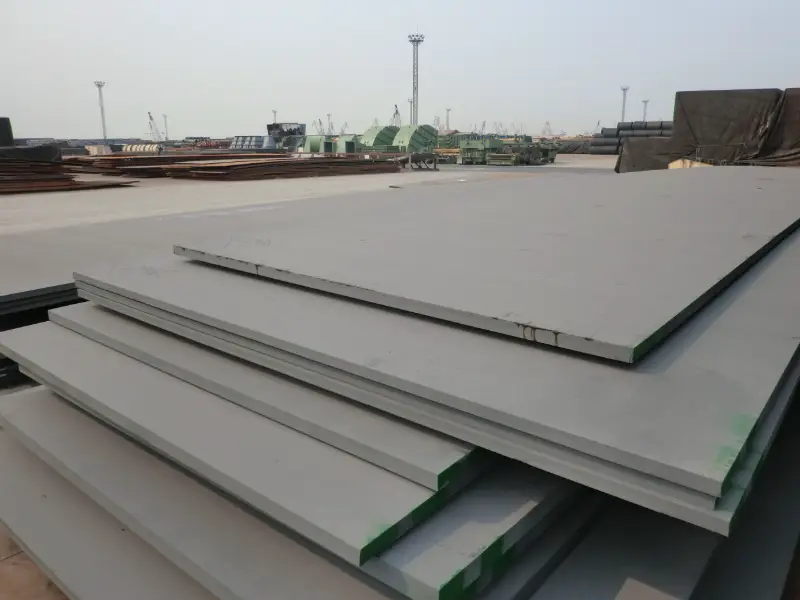
BV Grade E500 Shipbuilding Steel Plate
BV Grade E500 Shipbuilding Steel Plate - High-Strength Marine Structural Steel with Superior Low-Temperature Toughness
BV Grade E500 is a high-strength shipbuilding steel plate certified by Bureau Veritas, offering a minimum yield strength of 500 MPa, excellent weldability, and guaranteed impact toughness at -40°C, ideal for critical ship and offshore structures.
Hot rolling, thermomechanical controlled processing (TMCP), quenching and tempering (Q&T), normalizing rolling; cold forming feasible under controlled conditions; suitable for welding (SAW, SMAW, GMAW), gas cutting, and machining.
- Phone : +8618037372205
- Email : [email protected]
- WhatsApp: Contact via Whtsapp
- WeChat: +8618037372205
BV Grade E500 Shipbuilding Steel Plate Introduction
BV Grade E500 is a premium high-strength structural steel plate specifically developed for shipbuilding and offshore applications under the rules of Bureau Veritas (BV). As an extra-high-strength grade with a minimum yield strength of 500 MPa, it belongs to the EH500 category, indicating excellent notch toughness at extremely low temperatures (E-grade: -40°C impact test). The steel is thermomechanically rolled or quenched and tempered to achieve a fine-grained microstructure, ensuring a superior combination of strength, ductility, and weldability.
- Ultra-high yield strength (≥500 MPa) and tensile strength (670–830 MPa) for weight-saving designs
- Excellent low-temperature impact toughness (Charpy V-notch ≥50 J at -40°C)
- Good formability and excellent weldability with appropriate low-hydrogen procedures
- Fully compliant with BV Rules for Materials and Welding, suitable for critical structural components
BV Grade E500 Shipbuilding Steel Plate Chemical Composition
The chemical composition of BV Grade E500 is carefully balanced to achieve high strength while maintaining excellent weldability and low-temperature toughness. Limits are specified according to BV Rules, with microalloying elements like Nb, V, Ti, and Al used for grain refinement and precipitation strengthening. The carbon equivalent (CEV) is controlled to ensure good weldability without preheating under normal conditions.
| Element | Standard Value (max or range) | Remarks |
|---|---|---|
| Carbon (C) | ≤0.20 | For thickness ≤ 50 mm; may be adjusted for thicker plates |
| Manganese (Mn) | 0.90 – 1.60 | Higher Mn contributes to strength and toughness |
| Silicon (Si) | ≤0.50 | Deoxidation and strength |
| Phosphorus (P) | ≤0.025 | Maximun to avoid temper embrittlement |
| Sulfur (S) | ≤0.025 | Low S for improved toughness and through-thickness properties |
| Aluminum (Al) | ≥0.015 (total) | Grain refining, can be replaced by other grain refiners |
| Niobium (Nb) | 0.02 – 0.05 | Microalloying for grain refinement and precipitation strengthening |
| Vanadium (V) | 0.05 – 0.10 | Optional combination with Nb or Ti |
| Titanium (Ti) | ≤0.02 | Grain refinement and nitrogen fixation |
| Nitrogen (N) | ≤0.009 | Unless sufficient quantity of Ti or Al present |
| Copper (Cu) | ≤0.35 | Residual element, beneficial for corrosion resistance |
| Chromium (Cr) | ≤0.20 | Residual |
| Nickel (Ni) | ≤0.40 | Residual |
| Molybdenum (Mo) | ≤0.08 | Residual |
| Carbon Equivalent (CEV) | ≤0.45 (typical) | Calculated as C + Mn/6 + (Cr+Mo+V)/5 + (Ni+Cu)/15 |
BV Grade E500 Shipbuilding Steel Plate Thermal and Electrical Physical Properties
The following physical properties are representative for thermomechanically rolled or quenched and tempered high-strength low-alloy steels with similar chemical composition and microstructure. These values are not specified in the BV material standard but are essential for design calculations, welding procedure development, and heat transfer analysis.
| Property | Typical Value | Unit | Test Condition / Remarks |
|---|---|---|---|
| Density (ρ) | 7850 | kg/m³ | At room temperature (20°C) |
| Elastic Modulus (E) | 205 | GPa | 20°C; temperature dependent, decreases at elevated temperature |
| Shear Modulus (G) | 80 | GPa | 20°C (approximate) |
| Poisson's Ratio (ν) | 0.3 | — | Elastic range |
| Thermal Expansion Coefficient (α) | 12.0 × 10⁻⁶ | 1/K | Mean value 20–100°C |
| Thermal Conductivity (λ) | 50 | W/(m·K) | 20°C |
| Specific Heat Capacity (cₚ) | 460 | J/(kg·K) | 20°C |
| Electrical Resistivity (ρₑ) | 0.15 | μΩ·m | 20°C |
BV Grade E500 Shipbuilding Steel Plate Mechanical Properties
The mechanical properties are determined in accordance with BV testing procedures on representative specimens (longitudinal or transverse orientation). Strength values apply to plate thicknesses up to and including 100 mm. Impact toughness requirements are mandatory at -40°C to guarantee reliability in cold environments and icy waters. Bending tests confirm sufficient formability for cold-forming operations.
| Property | Required Value | Unit | Test Condition / Remarks |
|---|---|---|---|
| Yield Strength (ReH) | ≥500 | MPa | Thickness ≤ 100 mm; transverse or longitudinal (20°C ambient) |
| Tensile Strength (Rm) | 670 – 830 | MPa | Thickness ≤ 100 mm |
| Elongation (A) | ≥14 | % | Gauge length 5.65√S₀ (proportional test piece); minimum value for thickness ≤ 50 mm |
| Elongation (A) | ≥15 | % | For thickness > 50 mm up to 100 mm, may be reduced by agreement |
| Charpy V-notch Impact Energy (KV2) | ≥50 (longitudinal) | J | At -40°C, average of three tests; single minimum 70% of average |
| Charpy V-notch Impact Energy (KV2) | ≥34 (transverse) | J | At -40°C, for thickness ≤ 50 mm (transverse testing applicable by agreement) |
| Bend Test (Bend Angle 180°) | No cracks or defects | Mandrel diameter 3t for t ≤ 50 mm; 4t for 50 < t ≤ 100 mm (t = specimen thickness) |
BV Grade E500 Shipbuilding Steel Plate Exact Equivalent Material Standards and Replaceable Grades
| Country / Region | Standard / Classification Society | Grade / Designation | Remarks |
|---|---|---|---|
| International (France) | Bureau Veritas (BV) | BV E500 | Original certification standard |
| International (Norway) | DNV (Det Norske Veritas) | DNV E500 | Mutually recognized under IACS UR W13; identical chemical and mechanical requirements |
| International (USA) | American Bureau of Shipping (ABS) | ABS E500 | IACS unified requirement; used for ABS-classed vessels |
| International (UK) | Lloyd's Register (LR) | LR E500 | Identical strength and toughness grade |
| International (China) | China Classification Society (CCS) | CCS E500 | Mirrors IACS W13 specification |
| International (Japan) | Nippon Kaiji Kyokai (ClassNK) | NK E500 | Equivalent hull structural steel grade |
| International (Korea) | Korean Register (KR) | KR E500 | Used for KR-classed ships, same properties |
| International (Italy) | RINA (Registro Italiano Navale) | RINA E500 | Interchangeable per IACS rules |
| International (Russia) | Russian Maritime Register of Shipping (RS) | RS E500 | Recognized equivalent for shipbuilding |
BV Grade E500 Shipbuilding Steel Plate Application Introduction
BV Grade E500 steel is engineered for the most demanding structural applications in shipbuilding and offshore engineering where superior strength and low-temperature toughness are essential. It permits weight reduction without sacrificing safety, making it suitable for critical load-bearing elements in ice-class vessels, large container ships, and harsh-environment offshore structures. The steel's excellent weldability allows efficient fabrication using standard shipyard welding practices.
- Ship hulls, decks, and bottom plates in large vessels
- Icebreakers and Arctic-class ships requiring reliable brittle fracture arrest
- Highly stressed transverse and longitudinal stiffeners
- Offshore platform decks, legs, and jack-up components
- Reinforced bulkheads, web frames, and stringers
Product Applications: Ultra-large container ship hull structures, LNG carrier cargo containment and hull integration, Icebreaker hulls and ice belts, Semi-submersible and jack-up rig primary structural members, Offshore wind monopile transition pieces and bracings, Naval vessel superstructures and blast-resistant components
Processed into products: Shell plates, bottom plates, and deck plates, Longitudinal and transverse stiffeners, girders, and frames, Watertight bulkheads and collision bulkheads, Hatch coamings, brackets, and elaborately shaped reinforcing plates, Foundation plates for heavy machinery and thrust blocks, Pad-eyes, lifting lugs, and other highly loaded attachment points, Welded built-up sections such as T-beams, box columns, and stiffened panels
Application industries: Shipbuilding and ship repair (commercial, naval, and specialized vessels), Offshore oil and gas (fixed platforms, jack-ups, FPSO modules), Renewable energy (offshore wind turbine foundations, substations), Heavy civil engineering (marine bridges, caissons, docks), Arctic and cold-region infrastructure
BV Grade E500 Shipbuilding Steel Plate Similar / Closely Related Substitute Materials
| Country / Region | Standard / Classification Society | Grade / Designation | Remarks |
|---|---|---|---|
| International | IACS UR W13 | EH500 (E500) | Identical to BV E500; ensures universal cross-recognition |
| International | EN 10025-6 | S500Q/QL/QL1 (Quenched & Tempered) | Similar minimum yield strength (500 MPa) but not a ship class grade; may require project-specific approval for marine use |
| International | ASTM A131 / A131M | EH40 | Lower strength (390 MPa min. yield) but same E-grade toughness; not a direct substitute for E500 |
| International | API 2W / 2Y | Grade 50 / 60 | Offshore structural steels with yield up to 415–485 MPa; not fully equivalent; need technical assessment |
Notes:
Welding Recommendations: Pre-heating is generally not required for thicknesses up to 50 mm under normal conditions (CEV ≤ 0.45). Low-hydrogen welding consumables (AWS A5.1 E7018, E7016, or equivalent) and controlled heat inputs (1.5–3.5 kJ/mm) are recommended to maintain toughness in the heat-affected zone. Through-Thickness Properties: When Z-direction loading is critical, additional requirements for sulfur content (≤0.008%) and reduction of area testing can be specified according to BV Rules. Nondestructive Testing: Ultrasonic testing (UT) per BV procedures is typically performed for plates intended for highly stressed or critical areas.
- Share



