
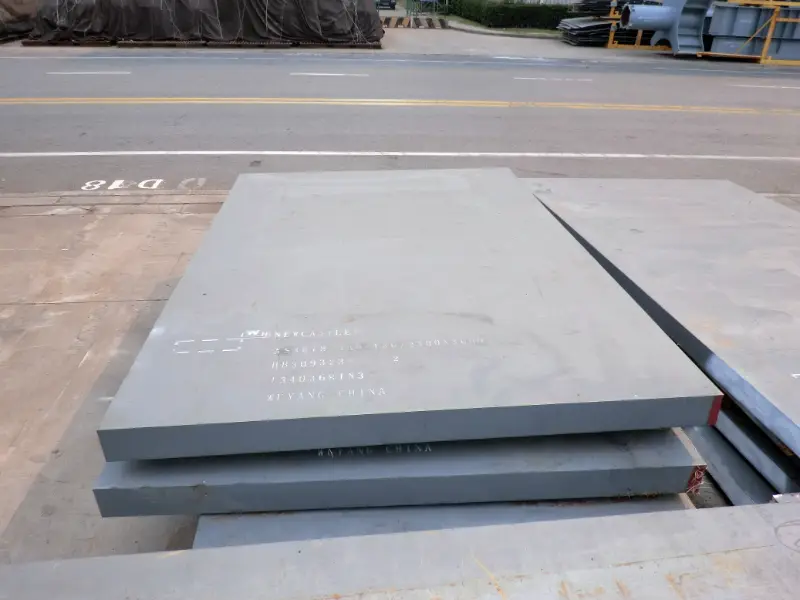
BV Grade F500 Shipbuilding Steel Plate
BV Grade F500 Shipbuilding Steel Plate – Ultra-High Strength Hull Structural Steel
Comprehensive material data for BV Grade F500 shipbuilding steel plate, including chemical composition, mechanical properties, thermal and electrical properties, international equivalents, and application guidelines.
Cutting, cold bending, welding, machining, shot blasting
- Phone : +8618037372205
- Email : [email protected]
- WhatsApp: Contact via Whtsapp
- WeChat: +8618037372205
BV Grade F500 Shipbuilding Steel Plate Introduction
BV Grade F500 is a high-strength shipbuilding steel plate certified by Bureau Veritas (BV) with a minimum yield strength of 500 MPa. It belongs to the fine-grain, high-strength structural steel category designed for critical hull and offshore structures. The 'F' designation indicates guaranteed impact toughness at -60°C, making it suitable for the most severe cold-climate applications. Delivered in normalized, quenched & tempered, or thermo-mechanically controlled processed (TMCP) condition, it offers excellent weldability, superior toughness, and high resistance to brittle fracture. Typical thicknesses range from 6 mm to 150 mm, widely used in icebreakers, Arctic vessels, and heavy offshore platforms.
BV Grade F500 Shipbuilding Steel Plate Chemical Composition
The chemical composition of BV Grade F500 conforms to the limits specified in BV Rules for high-strength hull structural steel with minimum yield strength 500 MPa. Carbon Equivalent (Ceq) and Pcm values are controlled to guarantee weldability. Fine grain practice is mandatory, and nitrogen-binding elements (Al, Nb, V, Ti) are added singly or in combination. Maximum values unless otherwise noted.
| Element | Standard Value (max %) | Remarks |
|---|---|---|
| Carbon (C) | 0.18 | ≤ 0.18% per BV rules |
| Silicon (Si) | 0.10 - 0.55 | Range typical for FH500 |
| Manganese (Mn) | 0.90 - 1.60 | |
| Phosphorus (P) | 0.020 | Controlled for toughness |
| Sulfur (S) | 0.010 | Low sulfur for cleanliness |
| Aluminum (Al) total | 0.020 min | Grain refining element |
| Niobium (Nb) | 0.02 - 0.05 | Microalloying for grain refinement |
| Vanadium (V) | 0.05 - 0.10 | Microalloying |
| Titanium (Ti) | 0.007 - 0.05 | Optional, for toughness |
| Nitrogen (N) | 0.009 | max, if not bound by Ti/Al |
| Copper (Cu) | 0.50 | If specified |
| Chromium (Cr) | 0.50 | max |
| Nickel (Ni) | 0.80 | max |
| Molybdenum (Mo) | 0.50 | max |
| Carbon Equivalent (Ceq) | 0.42 | Typical, based on C + Mn/6 + (Cr+Mo+V)/5 + (Ni+Cu)/15 |
BV Grade F500 Shipbuilding Steel Plate Thermal and Electrical Physical Properties
Physical properties at room temperature (20°C) unless stated otherwise. Values are representative for normalized or Q&T high-strength structural steels of this grade and may vary slightly with processing route. Density assumed 7.85 g/cm³. Elastic modulus (E) and Poisson's ratio are standard for ferritic steels. Thermal expansion coefficient (α) for 20–100°C is 12 × 10-6/K. Thermal conductivity (λ) and electrical resistivity (ρe) are typical for low-alloy carbon-manganese steels.
| Property | Standard Value | Unit | Test Conditions |
|---|---|---|---|
| Density (ρ) | 7.85 | g/cm³ | At 20°C |
| Elastic Modulus (E) | 205 | GPa | At 20°C |
| Shear Modulus (G) | 80 | GPa | At 20°C, estimated from E and ν |
| Poisson's Ratio (ν) | 0.29 | - | At 20°C (typical) |
| Thermal Expansion Coefficient (α) | 12.0 | ×10⁻⁶/K | 20°C to 100°C |
| Thermal Expansion Coefficient (α) | 13.5 | ×10⁻⁶/K | 20°C to 400°C |
| Thermal Conductivity (λ) | 45 | W/(m·K) | At 20°C |
| Specific Heat Capacity (c) | 460 | J/(kg·K) | At 20°C |
| Electrical Resistivity (ρₑ) | 0.25 | µΩ·m | At 20°C |
BV Grade F500 Shipbuilding Steel Plate Mechanical Properties
Mechanical properties as required by BV Rules for F500 steel plates. Yield strength (ReH) and tensile strength (Rm) apply to transverse test pieces. Notch impact energy tested at -60°C on Charpy-V specimens (longitudinal) with minimum energy 50 J. Elongation (A) on gauge length 5.65√S₀. Bend test mandrel diameter is 3t (t ≤ 50 mm) or 4t (t > 50 mm).
| Property | Standard Value | Unit | Test Conditions |
|---|---|---|---|
| Yield Strength (ReH) | 500 | MPa | Thickness ≤ 50 mm |
| Yield Strength (ReH) | 500 | MPa | Thickness > 50 mm ≤ 100 mm |
| Yield Strength (ReH) | 480 | MPa | Thickness > 100 mm ≤ 150 mm |
| Tensile Strength (Rm) | 610 - 770 | MPa | Thickness ≤ 100 mm |
| Tensile Strength (Rm) | 610 - 770 | MPa | Thickness > 100 mm ≤ 150 mm |
| Elongation (A, 5.65√S₀) | 16 | % | Transverse, thickness ≤ 50 mm |
| Elongation (A, 5.65√S₀) | 16 | % | Transverse, thickness > 50 mm |
| Charpy V-notch Impact Energy (KV2) | 50 (min average) | J | At -60°C, Longitudinal |
| Charpy V-notch Impact Energy (KV2) | 34 (min single) | J | At -60°C, Longitudinal |
| Bend Test (Mandrel Diameter) | 3t | - | 180°, t ≤ 50 mm |
| Bend Test (Mandrel Diameter) | 4t | - | 180°, t > 50 mm |
BV Grade F500 Shipbuilding Steel Plate International Equivalent Grades
| Country/Region | Standard | Grade | Remarks |
|---|---|---|---|
| International (ABS) | ABS Rules | FH500 | American Bureau of Shipping -60°C toughness |
| Norway/Germany (DNV) | DNV Rules | FH500 | DNV classification with identical yield and tensile requirements |
| UK (LR) | Lloyd's Register Rules | FH500 | Lloyd's Register FH500 |
| China (CCS) | CCS Rules | FH500 | China Classification Society FH500 |
| Japan (NK) | ClassNK Rules | FH500 | Nippon Kaiji Kyokai |
| Italy (RINA) | RINA Rules | FH500 | Registro Italiano Navale |
| Russia (RS) | Rules of RMRS | FH500 | Russian Maritime Register of Shipping |
| South Korea (KR) | KR Rules | FH500 | Korean Register of Shipping |
BV Grade F500 Shipbuilding Steel Plate Application Introduction
BV Grade F500 is specifically tailored for the most demanding marine and offshore structural applications where high strength and superior low-temperature toughness (-60°C) are mandatory. Its excellent weldability and crack-arrest capability make it ideal for critical safety components in ice-strengthened vessels and Arctic infrastructure. The steel can be processed by laser cutting, plasma cutting, machining, cold forming, and is fully compatible with all common shipyard welding methods.
Product Applications: Ice-strengthened hull plating for polar ships, Upper and lower deck plates of large container ships, Bottom shell and bilge strakes in Arctic shuttle tankers, Legs and spudcans of jack-up drilling rigs, Tubular nodes and chord members of offshore jacket platforms
Processed into products: Hull shell plates (fore peak, ice belt regions), Longitudinal stiffeners and frames for ships, Transverse bulkheads and web frames in tankers, Bracing members and node cans in offshore jackets, Submarine pressure hull sections and reinforcement rings
Application industries: Shipbuilding (Arctic/Antarctic class vessels, icebreakers, LNG carriers), Offshore Oil & Gas (FPSO hulls, jack-up rigs, semi-submersibles), Marine Engineering (crane pedestals, heavy-lift ship structures), Naval Defense (submarine pressure hulls, patrol boats for cold waters)
BV Grade F500 Shipbuilding Steel Plate Similar/Comparable Materials
| Country/Region | Standard | Grade | Remarks |
|---|---|---|---|
| EU | EN 10025-4 | S500ML, S500MLO | Thermo-mechanically rolled structural steel with min. 500 MPa yield; impact -50°C to -60°C depending on ML option |
| China | GB/T 712 | FH500 | Chinese equivalent shipbuilding steel FH500, same strength level and -60°C impact |
| International (ISO) | ISO 630-5 | S500M, S500ML | High-strength structural steel plates, M/ML indicate TMCP delivery condition |
| USA (ASTM) | ASTM A709/A709M | Grade 50 (345 MPa) or HPS 70W (485 MPa) not exact match; closest is A514 Grade Q (min. 690 MPa) but higher strength. | |
| Germany (DIN) | DIN EN 10025-6 | S500QL, S500QL1 | Quenched and tempered structural steel, 500 MPa yield, -40°C or -60°C impact |
| Japan (JIS) | JIS G 3128 | SHY685 (690 MPa) or SHY685N | Higher strength but similar low-temperature toughness; not exact substitute |
Notes:
- Ultrasonic testing in accordance with EN 10160 Class S2/E2 or equivalent is usually required for thicknesses above 15 mm.
- Welding consumables should be selected to match the strength and toughness of FH500; preheat may be needed for thick sections (>40 mm) and low hydrogen process is essential.
- This material is typically certified with BV inspection and stamping; mill certificates include heat analysis, tensile, Charpy-V impact (-60°C), and bend test results.
- Maximum permissible carbon equivalent (Ceq) and Pcm values can be agreed upon at the time of order to guarantee cold cracking resistance.
- Share



