
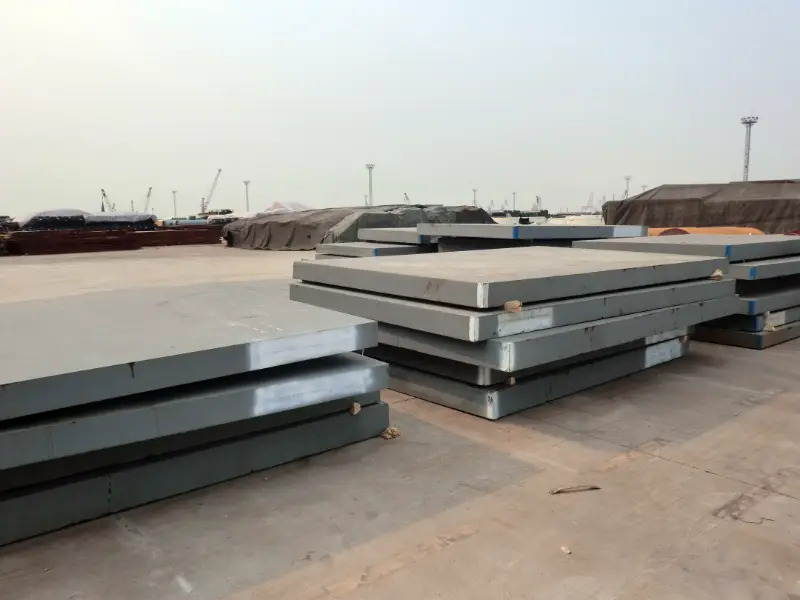
BV Grade A550 Shipbuilding Steel Plate
BV Grade A550 Shipbuilding Steel Plate: High Strength Hull Structural Steel for Marine Engineering
In-depth analysis of BV Grade A550 (AH550) high-strength shipbuilding steel plate under Bureau Veritas rules. Includes chemical composition, mechanical properties, thermal and electrical properties, international equivalents, and application guide for ship and offshore structures.
Hot rolling, thermomechanical controlled rolling (TMCP), normalizing, quenching & tempering, welding, cutting, forming
- Phone : +8618037372205
- Email : [email protected]
- WhatsApp: Contact via Whtsapp
- WeChat: +8618037372205
BV Grade A550 Shipbuilding Steel Plate Introduction
BV Grade A550, officially designated as AH550 under Bureau Veritas Rules for the Classification of Steel Ships (Part D), is a high-strength, normalized or thermomechanically controlled rolled (TMCP) structural steel plate intended for ship and offshore constructions. It offers a minimum yield strength of 550 MPa and excellent weldability and notch toughness at 0°C. This steel is widely used in hulls, decks, and critical structural components subjected to high stress. It complies with IACS Unified Requirement W11 and has equivalent grades across all major classification societies, ensuring global availability and interchangeability. Delivery condition is typically TMCP or quenching and tempering (Q&T), with thicknesses up to 100 mm.
BV Grade A550 Shipbuilding Steel Plate Chemical Composition
The chemical composition limits for BV Grade A550 (AH550) are defined in accordance with IACS UR W11 and BV Rules. Microalloying elements such as Nb, V, and Ti are added to refine grain size and improve strength-toughness balance. Carbon Equivalent (CEV) shall not exceed 0.45% for typical thicknesses to ensure good weldability.
| Element | Standard Value (≤) | Remarks |
|---|---|---|
| Carbon (C) | 0.20 | Max. %; typical aim 0.10–0.18 |
| Silicon (Si) | 0.55 | Max. % |
| Manganese (Mn) | 1.70 | Max. %; often 0.90–1.65 actual |
| Phosphorus (P) | 0.025 | Max. % |
| Sulfur (S) | 0.025 | Max. % |
| Chromium (Cr) | 0.30 | Max. %; may be added for hardenability |
| Nickel (Ni) | 0.40 | Max. % |
| Molybdenum (Mo) | 0.08 | Max. % |
| Copper (Cu) | 0.35 | Max. % |
| Aluminium (Al_s) | 0.015–0.080 | Acid soluble; min. 0.015 for grain refinement |
| Niobium (Nb) | 0.05 | Max. %; grain refiner |
| Vanadium (V) | 0.10 | Max. %; precipitation strengthener |
| Titanium (Ti) | 0.020 | Max. %; grain refiner and sulfide shape control |
| Nitrogen (N) | 0.012 | Max. % |
| CEV (IIW) | 0.45 | Max. typical for t≤50 mm, CEV = C+Mn/6+(Cr+Mo+V)/5+(Ni+Cu)/15 |
BV Grade A550 Shipbuilding Steel Plate Thermal and Electrical Physical Properties
The following data are typical for quenched and tempered high-strength shipbuilding steel and are not mandatory specification values. They are provided for design and simulation purposes. Properties may vary slightly depending on exact heat treatment and composition.
| Property | Typical Value | Unit | Condition / Temperature |
|---|---|---|---|
| Density (ρ) | 7.85 | g/cm³ | Room temperature |
| Elastic Modulus (E) | 205 | GPa | Tensile, 20°C |
| Shear Modulus (G) | 80 | GPa | Calculated from E and ν, 20°C |
| Poisson's Ratio (ν) | 0.3 | – | Elastic range, 20°C |
| Thermal Expansion (α) | 11.5 | 10⁻⁶ /K | 20–100°C |
| Thermal Expansion (α) | 12.5 | 10⁻⁶ /K | 20–200°C |
| Thermal Conductivity (λ) | 45 | W/(m·K) | 20°C |
| Specific Heat Capacity (cp) | 460 | J/(kg·K) | 20°C |
| Electrical Resistivity (ρ_e) | 0.28–0.30 | μΩ·m | 20°C |
BV Grade A550 Shipbuilding Steel Plate Mechanical Properties
Mechanical tests are performed in accordance with BV Rules. Values apply for transverse specimens unless longitudinal is specified by the purchaser. Impact test temperature: 0°C (for grade A). Yield strength reduces gradually for thicknesses above 50 mm as per BV requirements.
| Property | Required Value | Unit | Test Condition |
|---|---|---|---|
| Yield Strength (ReH) | ≥ 550 | MPa | Transverse, t ≤ 50mm |
| Yield Strength (ReH) | ≥ 530 | MPa | Transverse, 50 < t ≤ 100mm (typical reduction) |
| Tensile Strength (Rm) | 670 – 830 | MPa | Transverse, all thicknesses |
| Elongation (A) | ≥ 16 | % | Gauge length Lo=5.65√So, t ≤ 50mm |
| Elongation (A) | ≥ 15 | % | 50 < t ≤ 100mm (typical reduction) |
| Impact Toughness (KV) | ≥ 31 | J | Longitudinal, 0°C, min. average of 3 specimens |
| Impact Toughness (KV) | ≥ 24 | J | Transverse, 0°C, min. average (upon specification) |
| Bend Test (180°) | d = 3a | – | Bend diameter = 3 × plate thickness 'a', no cracks |
BV Grade A550 Shipbuilding Steel Plate Exact Equivalent Material Standards and Substitutable Grades
| Country/Region | Standard | Grade | Remarks |
|---|---|---|---|
| France / International | BV Rules Pt D Ch 3 | BV A550 / AH550 | Original grade; test at 0°C |
| USA | ABS Rules Part 2 | ABS AH550 | Identical chemistry and mechanical requirements |
| Norway / International | DNV Rules Pt 2 Ch 2 | DNV AH550 | Formerly NV A550; fully equivalent |
| UK / International | LR Rules Ch 6 | LR AH550 | Lloyd's Register equivalent |
| China | CCS Rules Pt 1 | CCS AH550 | China Classification Society equivalent |
| Japan | NK Rules Pt K | NK AH550 | Nippon Kaiji Kyokai equivalent |
| Korea | KR Rules Pt 2 | KR AH550 | Korean Register equivalent |
| Italy | RINA Rules Pt C | RINA AH550 | Registro Italiano Navale equivalent |
BV Grade A550 Shipbuilding Steel Plate Application Introduction
BV Grade A550 steel plate is primarily designed for welded structures requiring high strength-to-weight ratio and good low-temperature toughness. It is suitable for both low and ambient temperature service, down to 0°C (grade A). The material can be delivered in as-rolled, normalized, or heat-treated condition, and exhibits excellent formability and weldability when proper preheating and consumables are used. Because of its high yield strength, it enables weight reduction in heavy structures and is increasingly used in modern shipbuilding and offshore engineering.
Product Applications: Bulk carriers and container ships, Jack-up drilling rigs, Semi-submersible platforms, Offshore wind turbine towers and foundations, Heavy-lift ship cranes, Harbor portal cranes, Hydraulic steel structures (lock gates, penstocks)
Processed into products: Longitudinal and transverse stiffeners, Keel plates and garboard strakes, Bracket plates and web frames, Crane boom chords and lattice members, Pin connections and heavy shackles, Transition piece flanges and can sections, Shear-resistant joints and connection plates
Application industries: Shipbuilding: hull structures, decks, bulkheads, hatch covers, crane pedestals, Offshore Oil & Gas: jacket legs, topside modules, flare booms, living quarters, Renewable Energy: offshore wind turbine foundations (monopiles, transition pieces), substations, Heavy Machinery: mobile crane booms, excavator arms, mining dump truck bodies, Bridge Engineering: orthotropic deck plates, stiffening ribs, arch ribs, Pressure Vessels: low-temperature storage tanks (with additional BH certification)
BV Grade A550 Shipbuilding Steel Plate Close or Alternative Material Recommendations
| Country/Region | Standard | Grade | Remarks |
|---|---|---|---|
| International (IACS) | BV/ABS/DNV | AH500 | Yield strength 500 MPa; slightly lower strength; similar welding properties; may be substituted where 550 MPa not critical |
| International (IACS) | BV/ABS/DNV | DH550 | Impact test at -20°C; better toughness; suitable for lower service temperatures |
| Europe | EN 10025-6 | S690QL | Quenched and tempered steel with min. 690 MPa yield; used in heavy lifting equipment; not a direct ship plate, but comparable strength |
| China | GB/T 1591-2018 | Q550D | High-strength low-alloy structural steel; impact at -20°C; may be used in non-marine structures |
| USA | ASTM A514 / A517 | Grade E | Quenched and tempered alloy steel plate with ~690 MPa yield; for structural applications, not specifically certified for ship classification |
Notes:
- A550 is the simplified notation for AH550; the 'A' denotes Charpy V-notch impact testing at 0°C. Orders should specify the full grade and, if required, the impact temperature class (D for -20°C, E for -40°C, etc.).
- For thicknesses above 50 mm, the yield strength may be slightly reduced and the elongation requirement relaxed. Refer to the latest BV Rules for precise thickness-dependent values.
- Welding consumables should match the strength level and toughness; preheating beyond 100°C may be necessary for thick sections. Qualified welding procedures are mandatory under classification rules.
- Ultrasonic testing (UT) is normally required for plates over 20 mm to Class I or II per BV NDT requirements.
- Surface finish and tolerances are in accordance with BV standards or as per EN 10029 for flatness.
- Share



