
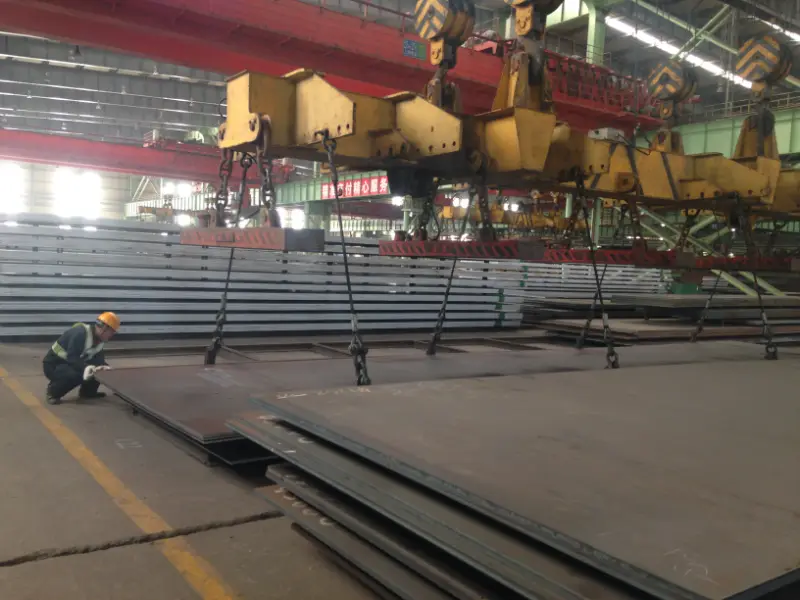
BV Grade D550 Shipbuilding Steel Plate
BV Grade D550 Shipbuilding Steel Plate: High Yield 550 MPa Quenched & Tempered Hull Material
Complete material data for BV Grade D550 offshore and shipbuilding steel plate: chemical composition, mechanical properties, thermal and electrical performance, equivalent grades, and application guidance.
Hot rolling, quenching and tempering; further fabrication by welding, bending, cutting, and forming
- Phone : +8618037372205
- Email : [email protected]
- WhatsApp: Contact via Whtsapp
- WeChat: +8618037372205
BV Grade D550 Shipbuilding Steel Plate Introduction
BV Grade D550 is a high strength quenched and tempered structural steel for shipbuilding and offshore engineering, certified by Bureau Veritas (BV) classification society. It offers a minimum yield strength of 550 MPa with guaranteed impact toughness down to -20°C (D-grade).
Key features:
- High strength-to-weight ratio enabling lighter ship designs
- Good weldability when using proper procedures
- Excellent resistance to brittle fracture at low temperatures
- Compliance with IACS UR W11 for quenched and tempered extra-high strength hull steels
Supplied in the QT (quenched and tempered) condition, it is suitable for critical structural components such as main decks, bottom plates, strength members, and offshore platform frames where stringent safety standards apply.
BV Grade D550 Shipbuilding Steel Plate Chemical Composition
The following chemical composition limits are specified by BV Rules for Grade D550. The steel is micro-alloyed with niobium, vanadium, titanium, and aluminium to achieve grain refinement and the required strength-toughness combination after Q&T treatment.
- Low carbon equivalent (CEV) improves weldability, typically CEV ≤ 0.43% for plate thickness ≤ 50 mm.
- Strict limits on phosphorus and sulphur guarantee cleanliness and toughness.
| Element | Content (wt%) | Remarks |
|---|---|---|
| Carbon (C) | ≤ 0.18 | Max value |
| Silicon (Si) | ≤ 0.55 | Max value |
| Manganese (Mn) | 0.70 – 1.70 | Range |
| Phosphorus (P) | ≤ 0.025 | Max value |
| Sulfur (S) | ≤ 0.025 | Max value |
| Copper (Cu) | ≤ 0.35 | Max value |
| Chromium (Cr) | ≤ 0.20 | Max value |
| Nickel (Ni) | ≤ 0.40 | Max value |
| Molybdenum (Mo) | ≤ 0.08 | Max value |
| Niobium (Nb) | ≤ 0.05 | Max value |
| Vanadium (V) | ≤ 0.10 | Max value |
| Titanium (Ti) | ≤ 0.02 | Max value |
| Aluminium (Al) total | ≥ 0.020 | Minimum acid soluble Al, if grain refinement is required |
| Carbon Equivalent (CEV) | ≤ 0.43 (t ≤ 50 mm) | As per IACS formula, for typical thickness |
BV Grade D550 Shipbuilding Steel Plate Thermal and Electrical Physical Properties
The BV Rules do not mandate thermal or electrical physical properties; however, the following typical values for quenched and tempered low-carbon structural steel are given for engineering reference. Actual values may vary slightly with chemical composition and heat treatment.
| Property | Typical Value | Unit | Test Condition / Remarks |
|---|---|---|---|
| Density (ρ) | 7850 | kg/m³ | At 20 °C |
| Elastic modulus (E) | 210 | GPa | At 20 °C |
| Shear modulus (G) | 80 | GPa | Calculated |
| Poisson's ratio (ν) | 0.3 | – | Within elastic range |
| Thermal expansion coefficient (α) | 11.7 × 10⁻⁶ | K⁻¹ | Range 20 – 100 °C |
| Thermal expansion coefficient (α) | 12.5 × 10⁻⁶ | K⁻¹ | Range 20 – 200 °C |
| Thermal expansion coefficient (α) | 13.6 × 10⁻⁶ | K⁻¹ | Range 20 – 400 °C |
| Thermal conductivity (λ) | 36 | W/(m·K) | At 20 °C |
| Specific heat capacity | 480 | J/(kg·K) | At 20 – 100 °C |
| Electrical resistivity (ρₑ) | 0.25 × 10⁻⁶ | Ω·m | At 20 °C |
BV Grade D550 Shipbuilding Steel Plate Mechanical Properties
Tensile testing is performed on transverse or longitudinal specimens depending on purchaser's request. Impact test temperatures and minimum absorbed energy distinguish the D-grade notch toughness (-20°C). All tests are carried out in the Q&T delivery condition. Values depend on plate thickness; multiple thickness ranges are listed below.
| Property | Required Value | Unit | Test Condition / Plate Thickness |
|---|---|---|---|
| Yield strength (ReH) | ≥ 550 | MPa | Thickness ≤ 50 mm, transverse or longitudinal |
| Yield strength (ReH) | ≥ 530 | MPa | Thickness 50 < t ≤ 80 mm |
| Yield strength (ReH) | ≥ 510 | MPa | Thickness 80 < t ≤ 100 mm |
| Tensile strength (Rm) | 670 – 830 | MPa | Thickness ≤ 50 mm |
| Tensile strength (Rm) | 620 – 780 | MPa | Thickness 50 < t ≤ 80 mm |
| Tensile strength (Rm) | 610 – 770 | MPa | Thickness 80 < t ≤ 100 mm |
| Elongation (A, L₀ = 5.65√S₀) | ≥ 14 | % | All thicknesses ≤ 100 mm, longitudinal specimen |
| Bend test (180°) | d = 3t | – | Bend axis: transverse, mandrel diameter = 3 × thickness |
| Charpy V-notch impact energy (KV) longitudinal | ≥ 31 (average) / ≥ 22 (single) | J | -20°C, thickness ≤ 50 mm |
| Charpy V-notch impact energy (KV) transverse | ≥ 20 (average) / ≥ 16 (single) | J | -20°C, thickness ≤ 50 mm |
| Charpy V-notch impact energy (KV) longitudinal | ≥ 27 (average) / ≥ 19 (single) | J | -20°C, thickness 50 < t ≤ 70 mm |
| Charpy V-notch impact energy (KV) transverse | ≥ 18 (average) / ≥ 13 (single) | J | -20°C, thickness 50 < t ≤ 70 mm |
| Charpy V-notch impact energy (KV) longitudinal | ≥ 24 (average) / ≥ 17 (single) | J | -20°C, thickness 70 < t ≤ 100 mm |
| Charpy V-notch impact energy (KV) transverse | ≥ 16 (average) / ≥ 11 (single) | J | -20°C, thickness 70 < t ≤ 100 mm |
BV Grade D550 Shipbuilding Steel Plate Completely Equivalent Material Standards & Grades
The following classification society grades are directly equivalent to BV Grade D550 (yield 550 MPa, -20°C impact), governed by IACS Unified Requirement W11 for ship hull structural steels.
| Country / Region | Standard / Classification Society | Grade | Remarks |
|---|---|---|---|
| International (USA) | ABS Rules | DH550 | American Bureau of Shipping, fully equivalent |
| International (Norway/Germany) | DNV Rules | DH550 | Det Norske Veritas, same strength and low-temperature toughness |
| International (UK) | Lloyd's Register Rules | DH550 | Lloyd's Register, identical requirements |
| China | CCS Rules | DH550 | China Classification Society, conforms to IACS UR W11 |
| Japan | ClassNK Rules | DH550 | Nippon Kaiji Kyokai, equivalent grade |
| Italy | RINA Rules | DH550 | Registro Italiano Navale, based on IACS UR W11 |
| Korea | KR Rules | DH550 | Korean Register, same specification |
BV Grade D550 Shipbuilding Steel Plate Application Introduction
BV Grade D550 is primarily used in the construction of large ships and offshore installations where high strength, weldability, and low-temperature toughness are essential.
Typical application fields include:
Product Applications: Hull structures: deck plates, bottom shells, side plates, stringers, floor plates, Longitudinal stiffeners, transverse webs, girders, deep frames, Deckhouses and superstructures on ice-class vessels, Offshore module support beams, blast walls, helicopter decks
Processed into products: Large formed or welded box girders, Skewed plates in bow regions, Knot plates for mooring equipment, Deep penetration welded T-joints and cruciform joints, Bearing support structures for cranes and winches, Integrally stiffened panels
Application industries: Shipbuilding – large container ships, bulk carriers, tankers, LNG carriers, FPSO vessels, naval vessels, Offshore engineering – fixed platforms, jack-up rigs, semi-submersibles, offshore wind turbine foundations, Heavy steel construction – bridges, pressure vessels (if dual-certified), harbour cranes, and port facilities
BV Grade D550 Shipbuilding Steel Plate Similar Alternative Materials
These grades offer similar strength levels but differ in low-temperature toughness or alloy design. They can be considered for replacement with engineering assessment, especially when service temperature permits.
| Country / Region | Standard | Grade | Remarks |
|---|---|---|---|
| International | BV Rules / IACS UR W11 | EH550 | Toughness down to -40°C, otherwise same strength; can substitute D550 in lower service temperatures |
| International | BV Rules / IACS UR W11 | FH550 | Toughness down to -60°C, excellent cryogenic properties; overmatch for D550 but acceptable |
| International | BV Rules / IACS UR W11 | DH470 | Lower yield strength (≥460 MPa); may be used if 550 MPa is not mandatory, easier to weld |
| Europe | EN 10025-6 | S550Q / S550QL | Quenched and tempered structural steel with minimum 550 MPa yield, not ship-specific but similar mechanical properties; verify Bureau Veritas acceptance for marine use |
| International | ABS / IACS | DH36 | Lower strength (355 MPa yield); used in less demanding structural parts, but not a direct substitute |
Notes:
Welding recommendations: Preheat up to 100–150°C depending on plate thickness and carbon equivalent; low-hydrogen processes such as SAW, FCAW, and GMAW are preferred. Heat input control is required to avoid grain coarsening in the heat-affected zone.
Tolerances: Dimensional and flatness tolerances are according to BV Rules or by agreement. Usually plates are supplied with EN 10029 Class A flatness.
Certification: Products are delivered with BV material certificate and third-party inspection, meeting the IACS UR W11 extra-high strength steel requirements for shipbuilding.
- Share



