
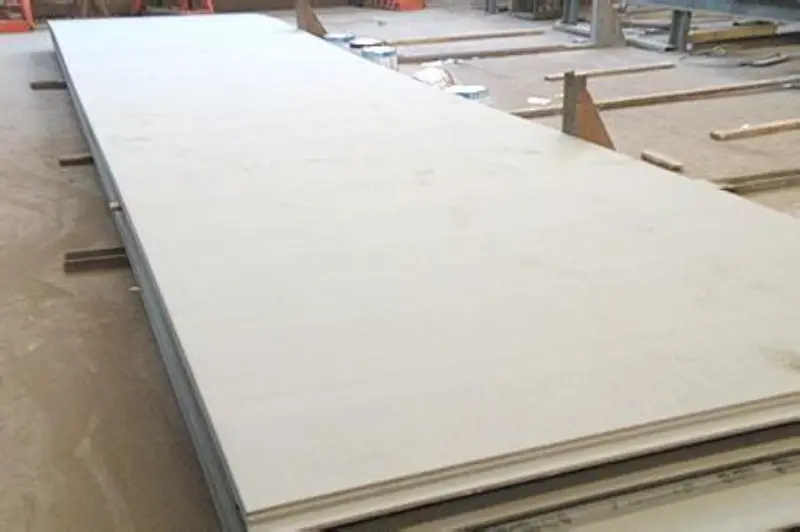
BV Grade E550 Shipbuilding Steel Plate
BV Grade E550 Shipbuilding Steel Plate | 550 MPa High Strength Marine Steel
Explore data for BV Grade E550 shipbuilding steel plate: chemical composition, mechanical properties, thermal and electrical properties, international equivalents, and applications in marine engineering.
Thermo-mechanically controlled rolling (TMCP), Normalizing, Normalizing rolling, Quenching and tempering (optional), Hot rolling
- Phone : +8618037372205
- Email : [email protected]
- WhatsApp: Contact via Whtsapp
- WeChat: +8618037372205
BV Grade E550 Shipbuilding Steel Plate Introduction
BV Grade E550 is a high-strength, fine-grained structural steel plate primarily used in shipbuilding and offshore constructions. It is certified by Bureau Veritas and offers a minimum yield strength of 550 MPa under the E-grade toughness requirements for service temperatures down to -40 °C. The steel is typically supplied in thermo-mechanically controlled rolled (TMCP) or normalized condition, guaranteeing excellent weldability, notch toughness, and strength-to-weight ratio. Its balanced microalloy element design (Nb, V, Ti) ensures enhanced grain refinement and precipitation strengthening, making it suitable for critical load-bearing components such as hull girders, deck plates, and offshore platform legs.
BV Grade E550 Shipbuilding Steel Plate Chemical Composition
The chemical composition of BV Grade E550 must comply with the requirements of IACS UR W11 and BV Rules. Values shown are ladle analysis maximum or range, as applicable. Microalloying elements such as Nb, V, Ti are added for grain refinement and strengthening.
- Carbon equivalent (CEV) is typically controlled ≤0.43% for improved weldability.
- All total aluminum (Al) refers to acid-soluble aluminum.
| Element | Content (%) | Remarks |
|---|---|---|
| C | ≤ 0.20 | |
| Si | ≤ 0.55 | |
| Mn | 0.90 – 1.70 | |
| P | ≤ 0.025 | |
| S | ≤ 0.025 | |
| Cr | ≤ 0.25 | Optional, if added |
| Ni | ≤ 0.80 | |
| Mo | ≤ 0.10 | |
| Cu | ≤ 0.35 | |
| Nb | ≤ 0.05 | |
| V | ≤ 0.10 | |
| Ti | ≤ 0.02 | |
| Al (total) | ≥ 0.015 | Acid soluble Al minimum |
BV Grade E550 Shipbuilding Steel Plate Thermal and Electrical Properties
The following physical properties are typical for BV Grade E550 steel at room temperature and atmospheric pressure. Actual values may vary slightly depending on exact composition and heat treatment condition. These data are based on high-strength low-alloy structural steel characteristics.
- Thermal conductivity and heat capacity are temperature dependent, values given for 20 °C.
- Linear thermal expansion coefficient is average between 20 °C and 100 °C.
| Property | Typical Value | Unit | Test Condition |
|---|---|---|---|
| Density (ρ) | 7.85 | g/cm³ | 20 °C |
| Modulus of elasticity (E) | 210 | GPa | Room temperature |
| Shear modulus (G) | 80 | GPa | Room temperature |
| Poisson's ratio (ν) | 0.30 | – | |
| Thermal expansion coefficient (α) | 12.0 × 10⁻⁶ | K⁻¹ | 20–100 °C |
| Thermal conductivity (λ) | 51.9 | W/(m·K) | 20 °C |
| Specific heat capacity (c) | 486 | J/(kg·K) | 20 °C |
| Electrical resistivity (ρ_e) | 0.20 | µΩ·m | 20 °C |
BV Grade E550 Shipbuilding Steel Plate Mechanical Properties
Mechanical properties are guaranteed at delivery condition and tested on transverse or longitudinal specimens in accordance with BV Rules. The values depend on plate thickness (t). Impact tests are performed at -40 °C (E-grade). Bending test requires no cracks on outer surface.
- Elongation values are for gauge length L₀ = 5.65√S₀ (proportional specimens).
- Impact energy is the minimum average of three Charpy V-notch specimens; one individual value may be lower but not below 70% of the average requirement.
| Property | Specified Value | Unit | Test Condition |
|---|---|---|---|
| Yield strength (ReH) | ≥ 550 | MPa | Thickness ≤ 50 mm, transverse |
| Yield strength (ReH) | ≥ 530 | MPa | 50 < thickness ≤ 70 mm, transverse |
| Yield strength (ReH) | ≥ 510 | MPa | 70 < thickness ≤ 100 mm, transverse |
| Tensile strength (Rm) | 670 – 830 | MPa | Thickness ≤ 100 mm |
| Elongation (A) | ≥ 16 | % | l₀ = 5.65√S₀; thickness ≤ 50 mm, longitudinal |
| Elongation (A) | ≥ 15 | % | 50 < thickness ≤ 70 mm, longitudinal |
| Elongation (A) | ≥ 14 | % | 70 < thickness ≤ 100 mm, longitudinal |
| Bending test | d = 3a | – | Thickness ≤ 35 mm, 180° |
| Bending test | d = 4a | – | 35 < thickness ≤ 50 mm, 180° |
| Bending test | d = 5a | – | 50 < thickness ≤ 100 mm, 180° |
| Charpy V-notch impact energy (KV₂ / -40 °C) | ≥ 34 | J | Thickness ≤ 50 mm, longitudinal |
| Charpy V-notch impact energy (KV₂ / -40 °C) | ≥ 27 | J | 50 < thickness ≤ 70 mm, longitudinal |
| Charpy V-notch impact energy (KV₂ / -40 °C) | ≥ 20 | J | 70 < thickness ≤ 100 mm, longitudinal |
| Charpy V-notch impact energy (KV₂ / -40 °C) | ≥ 24 | J | Thickness ≤ 50 mm, transverse |
| Charpy V-notch impact energy (KV₂ / -40 °C) | ≥ 20 | J | 50 < thickness ≤ 70 mm, transverse |
| Charpy V-notch impact energy (KV₂ / -40 °C) | ≥ 16 | J | 70 < thickness ≤ 100 mm, transverse |
BV Grade E550 Shipbuilding Steel Plate Fully Equivalent Material Standards and Replaceable Grades
| Country/Region | Standard | Grade | Remarks |
|---|---|---|---|
| American Bureau of Shipping (ABS) | ABS Rules | ABS EH550 | Identical strength and -40 °C notch toughness; fully interchangeable |
| DNV (Norway/Germany) | DNV Rules | DNV E550 | DNV E550 matches BV E550 in all respects |
| Lloyd's Register (UK) | LR Rules | LR EH550 | EH550 under LR, equivalent technical requirements |
| China Classification Society (CCS) | CCS Rules | CCS E550 | CCS E550 fully equivalent to BV E550 |
| ClassNK (Japan) | NK Rules | NK KE550 | KE550 is the E-grade 550 MPa class steel |
| Korean Register (KR) | KR Rules | KR RE550 | RE550 corresponds to E550 |
| RINA (Italy) | RINA Rules | RINA E550 | RINA E550 same as BV E550 |
| Russian Maritime Register of Shipping (RS) | RS Rules | RS E550 | E550 in RS classification |
| Indian Register of Shipping (IRS) | IRS Rules | IRS E550 | Equivalent to BV E550 |
| European Standard | EN 10225:2000 | F550 | Suitable for offshore structures; similar chemical and mechanical requirements but may have slight CEV differences; verification recommended |
BV Grade E550 Shipbuilding Steel Plate Application Introduction
BV Grade E550 is optimized for severe operating conditions in marine and offshore environments. Thanks to its high strength and outstanding toughness at low temperatures, it allows weight reduction and enhanced safety margins. Typical applications include:
Product Applications: Hull plates (bottom, side, deck, bulkhead), Offshore structural tubulars and cones, Reinforced deck panels for helicopter decks, Heavy-duty lifting appliances (A-frames, booms)
Processed into products: Hatch coamings and covers, Container ship lashing bridges, Crane pedestal and slew rings, Leg structures for self-elevating platforms, Stiffeners and brackets in ice-reinforced hulls, Transition pieces and tower flanges in wind turbines
Application industries: Shipbuilding (naval and commercial vessels), Offshore oil & gas platforms (jack-ups, semi-submersibles), Renewable energy (offshore wind turbine foundations), Bridge construction (large span and movable bridges), Heavy machinery and crane structures (offshore pedestal cranes)
BV Grade E550 Shipbuilding Steel Plate Similar/Alternative Material Recommendations
| Country/Region | Standard | Grade | Remarks |
|---|---|---|---|
| ABS | ABS Rules | ABS FH550 | Higher toughness grade (-60 °C), same strength; appropriate where lower service temperature needed |
| DNV | DNV Rules | DNV E550W | Weathering steel variant of E550, improved atmospheric corrosion resistance |
| BV | BV Rules | BV EH550Z35 | E550 with guaranteed through-thickness properties (Z35), for welded joints under high restraint |
| CCS | CCS Rules | CCS EH550 | EH550 is the standard ocean engineering steel with -40 °C impact, similar to E550; may have tighter chemical limits |
| ISO | ISO 630-6:2014 | S550Q | Quenched and tempered 550 MPa yield steel; strength equivalent but different delivery condition, suitable for heavy machinery structures |
| EN | EN 10025-6:2019 | S690Q | 690 MPa yield strength class; suitable for higher load applications but requires careful welding procedure qualification compared to E550 |
Notes:
Additional options available upon request:
- Through-thickness tensile properties (Z15, Z25, Z35) for improved lamellar tearing resistance.
- Ultrasonic testing according to EN 10160 or ASTM A578 for internal defects.
- Normalizing or normalizing rolling as an alternative to TMCP, if specified by the purchaser.
- Stricter Charpy impact requirements (e.g., at -60 °C for FH550-like performance) may be agreed.
- Supplementary notch toughness at higher plate thicknesses may require specific chemical adjustments; confirm with the mill.
- Share



