
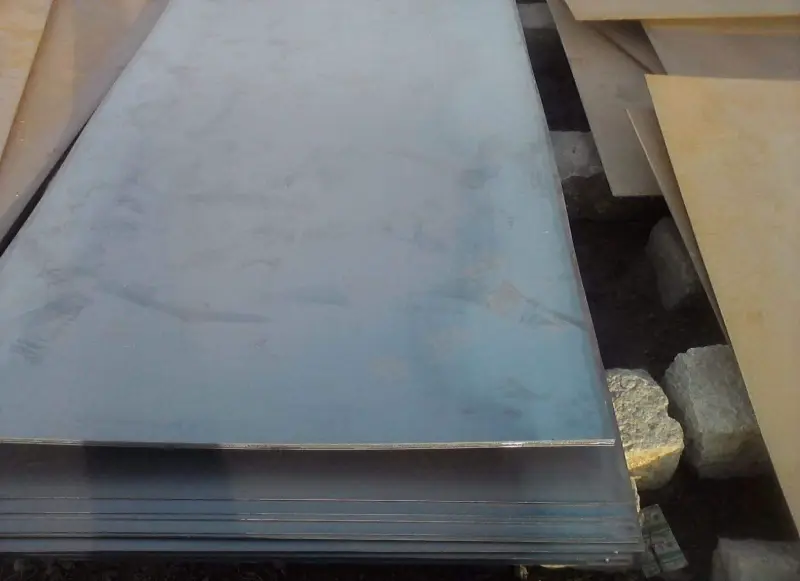
BV Grade F550 Shipbuilding Steel Plate
BV Grade F550 Shipbuilding Steel Plate: High Strength & Low Temperature Toughness
Comprehensive material data for BV Grade F550 shipbuilding steel, covering chemical composition, mechanical and physical properties, international equivalents, similar alternatives, and application guidelines for marine and offshore structures.
Hot rolling, normalised rolling, TMCP, quenching and tempering (optional), cutting, welding, forming
- Phone : +8618037372205
- Email : [email protected]
- WhatsApp: Contact via Whtsapp
- WeChat: +8618037372205
BV Grade F550 Shipbuilding Steel Plate Introduction
BV Grade F550 is a high-strength structural steel plate for shipbuilding, classified under Bureau Veritas rules. It is supplied in normalised (N), normalised rolled (NR), thermo-mechanically controlled processed (TMCP), or quenched and tempered (QT) condition. The grade guarantees a minimum yield strength of 550 MPa and excellent impact toughness at -60°C (F-grade), making it suitable for critical welded structures in Arctic and harsh marine environments. Designed according to BV NR216 and IACS UR W11, it offers good weldability when appropriate procedures are followed. Typical applications include hull plates, decks, and offshore platform components where high strength and low-temperature toughness are mandatory.
BV Grade F550 Shipbuilding Steel Plate Chemical Composition
Chemical requirements according to BV NR216 for grade F550. Values are maximum unless a range is indicated. Nb, V, Ti are optional microalloying elements for grain refinement and strengthening. Als (acid soluble aluminium) is mandatory for fine grain practice. Carbon equivalent (CEV) is controlled to ensure weldability, typically ≤0.45 for thicknesses ≤50 mm.
| Element | Standard Value (wt%) | Notes |
|---|---|---|
| C | ≤0.18 | Low carbon for weldability |
| Mn | 0.90 - 1.60 | Contributes to strength and hardenability |
| Si | ≤0.50 | Deoxidiser, improves strength |
| P | ≤0.025 | Strict control for low-temperature toughness |
| S | ≤0.025 | Strict control for low-temperature toughness |
| Al (acid soluble) | ≥0.020 | Ensures fine austenite grain size |
| Nb | ≤0.05 | Optional; grain refiner and precipitation strengthener |
| V | ≤0.10 | Optional; may be added for strength |
| Ti | ≤0.02 | Optional; grain growth inhibitor, improves toughness |
| Cu | ≤0.35 | If specified for enhanced corrosion resistance |
| Cr | ≤0.20 | Residual; may be increased by agreement |
| Ni | ≤0.40 | Optional; enhances low-temperature toughness |
| Mo | ≤0.08 | Residual; can improve hardenability |
| N | ≤0.009 | Restricted to avoid strain ageing; normally bound by Ti or Al |
BV Grade F550 Shipbuilding Steel Plate Thermal and Electrical Physical Properties
The following values are typical for low-alloy carbon-manganese structural steels and are not mandatory in the material specification. They serve as a general guide for design and engineering calculations. Actual values may vary slightly depending on specific composition, heat treatment, and temperature.
| Property | Typical Value | Unit | Test Condition / Notes |
|---|---|---|---|
| Density (ρ) | 7.85 | g/cm³ | At 20°C |
| Elastic modulus (E) | 210 | GPa | At room temperature |
| Shear modulus (G) | approx. 80 | GPa | Calculated from E and ν |
| Poisson's ratio (ν) | 0.3 | - | Within elastic range |
| Coefficient of thermal expansion (α) | 11.7 | 10⁻⁶/K | 20°C to 100°C (average) |
| Coefficient of thermal expansion (α) | 12.2 | 10⁻⁶/K | 20°C to 200°C (average) |
| Coefficient of thermal expansion (α) | 14.0 | 10⁻⁶/K | 20°C to 500°C (average) |
| Thermal conductivity (λ) | approx. 50 | W/(m·K) | At 20°C; range typically 45–55 |
| Specific heat capacity (Cp) | 460 - 480 | J/(kg·K) | At 20°C |
| Electrical resistivity (ρ_e) | 0.18 - 0.25 | µΩ·m | At 20°C; typical for low-alloy steel |
BV Grade F550 Shipbuilding Steel Plate Mechanical Properties
Transverse tensile test specimens, longitudinal Charpy V-notch specimens. Properties apply in delivery condition for plate thicknesses up to 100 mm. Bend test requires no cracks on the outer surface. Impact energy values are minimum average of three specimens; one individual minimum may be 70% of the average (e.g., 22 J). Thickness ranges may affect yield strength and elongation, as detailed.
| Property | Specified Value | Unit | Test Condition / Remark |
|---|---|---|---|
| Yield Strength (ReH) | ≥550 | MPa | Plate thickness ≤50 mm, transverse |
| Yield Strength (ReH) | ≥530 | MPa | 50 mm < thickness ≤70 mm, transverse |
| Yield Strength (ReH) | ≥510 | MPa | 70 mm < thickness ≤100 mm, transverse |
| Tensile Strength (Rm) | 670 - 830 | MPa | All thicknesses, transverse |
| Elongation after fracture (A5) | ≥16 | % | Thickness ≤50 mm, gauge length 5.65√So |
| Elongation after fracture (A5) | ≥16 | % | 50 mm < thickness ≤70 mm, gauge length 5.65√So |
| Elongation after fracture (A5) | ≥15 | % | 70 mm < thickness ≤100 mm, gauge length 5.65√So |
| Charpy V-notch impact energy (KV2) | ≥31 (average) | J | -60°C, longitudinal direction; applicable for thickness ≥5 mm |
| Bend test (180°) | No visible cracks | - | d = 3a (t≤25 mm), d = 4a (t>25 mm). d: mandrel diameter, a: specimen thickness |
BV Grade F550 Shipbuilding Steel Plate Completely Equivalent Standards and Grades
| Country / Region | Standard | Grade | Remarks |
|---|---|---|---|
| International | IACS UR W11 | FH550 | Unified requirement for extra-high strength hull structural steel with -60°C impact class |
| USA | ABS | FH550 | American Bureau of Shipping equivalent |
| Norway/Germany | DNV (formerly DNV GL) | FH550 | Det Norske Veritas equivalent |
| UK | LR | FH550 | Lloyd's Register equivalent |
| China | CCS | FH550 | China Classification Society equivalent |
| Korea | KR | FH550 | Korean Register equivalent |
| Japan | NK (ClassNK) | FH550 | Nippon Kaiji Kyokai equivalent |
| Italy | RINA | FH550 | Registro Italiano Navale equivalent |
| Russia | RS | FH550 | Russian Maritime Register of Shipping equivalent |
BV Grade F550 Shipbuilding Steel Plate Application Introduction
BV F550 steel plates are primarily used in welded structures that require a combination of high strength, excellent low-temperature toughness, and good weldability. They are specifically designed for critical load-bearing members in ships and offshore installations exposed to harsh environments, including Arctic conditions. Typical end-use sectors and products are listed below:
Product Applications: Container ships, Bulk carriers, Tankers (oil/chemical/gas), Icebreakers and ice-strengthened vessels, Offshore jackets, decks and topsides, Heavy lift crane barges, Wind turbine installation vessels (WTIV), Semi-submersible platforms
Processed into products: Main hull side shell and bottom plating, Strength deck and hatch coaming plates, Bilge strakes and sheer strakes, Longitudinal and transverse stiffeners, Ice belt region (strengthened shell), Web frames and stringers, Bulkhead plates and stiffeners, Offshore structural nodes and can sections, Jack-up leg chords and bracing members, Topside module support structures
Application industries: Shipbuilding, Offshore oil & gas, Marine engineering, Heavy steel construction, Arctic and polar engineering
BV Grade F550 Shipbuilding Steel Plate Similar or Near-Equivalent Materials
| Country / Region | Standard | Grade | Remarks |
|---|---|---|---|
| International | IACS UR W11 | EH550 | Same strength level but -40°C impact toughness; suitable where -60°C is not required |
| International | IACS UR W11 | FH500 | Yield strength 500 MPa with -60°C toughness; may be considered for less demanding strength requirements |
| Europe | EN 10025-6 | S690QL | Quenched and tempered steel; 690 MPa yield, but requires evaluation for marine applications and notch toughness at low temperatures |
| International | API 2Y | Grade 60 | Offshore structural steel; yield 415 MPa, not a direct substitute but used in similar offshore environments |
| International | ASTM A514 / A517 | Grade Q / Grade Q | Quenched and tempered high strength plate; yield ≥690 MPa, applicable for non-marine or specialised marine construction with additional toughness qualification |
Notes:
Welding must follow low-hydrogen procedures; preheating may be needed depending on plate thickness and CEV. Post-weld heat treatment is typically not required for TMCP or normalised grades. Through-thickness ductility (Z-grade) can be specified according to EN 10164 or equivalent. Ultrasonic testing is usually performed per BV rules. Certificates: mill test certificate (3.1 or 3.2 according to EN 10204) issued by the classification society. Dimensional tolerances comply with BV requirements or ASTM A6 equivalent.
- Share



