
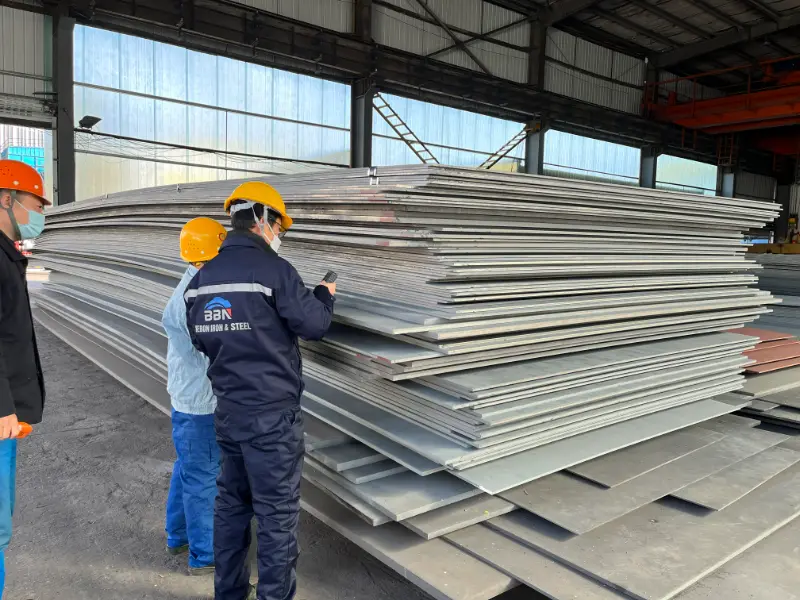
BV Grade A620 Marine Steel Plate
BV Grade A620 Marine Steel Plate: High-Strength Quenched & Tempered for Shipbuilding
Comprehensive technical data for BV Grade A620 shipbuilding steel including chemical composition, mechanical and physical properties, equivalent standards, and application guidance.
Cutting (flame, plasma, laser), welding (all conventional methods), cold and hot forming, machining
- Phone : +8618037372205
- Email : [email protected]
- WhatsApp: Contact via Whtsapp
- WeChat: +8618037372205
BV Grade A620 Marine Steel Plate Introduction
BV Grade A620 is a high-strength quenched and tempered shipbuilding steel plate certified by Bureau Veritas (BV). With a minimum yield strength of 620 MPa, it is intended for critical structural components in advanced marine and offshore applications.
This steel offers an excellent combination of high strength, good toughness, and reliable weldability due to its low carbon equivalent and fine-grain practice. It is typically supplied in grades A, D, E, and F, corresponding to different impact toughness levels at 0°C, -20°C, -40°C, and -60°C. The material is frequently applied in decks, hulls, and heavy lift structures of large container ships, naval vessels, and offshore platforms where weight saving and structural integrity are essential.
The plate is delivered in quenched and tempered condition, guaranteeing uniform mechanical properties throughout the thickness. Tight control of residual elements (P, S) ensures high resistance to lamellar tearing in welded joints.
BV Grade A620 Marine Steel Plate Chemical Composition
The chemical composition conforms to BV Rules Pt.2 Ch.1 for Grade A620. All values are maximum unless a range is specified. Fine grain practice is achieved by addition of grain-refining elements such as Al, Nb, V, and Ti. A low carbon equivalent (CEV) is controlled to ensure excellent weldability even at high strength levels.
- CEV = C + Mn/6 + (Cr+Mo+V)/5 + (Ni+Cu)/15 not exceeding the agreed limits (typically 0.56–0.58%).
- Additional restrictions on phosphorus and sulphur guarantee high resistance to brittle fracture and lamellar tearing.
| Element | Standard Value (wt%) | Remarks |
|---|---|---|
| C (Carbon) | ≤0.20 | Key for strength and hardenability |
| Si (Silicon) | 0.10–0.55 | Deoxidizer and strength contributor |
| Mn (Manganese) | 0.90–1.65 | Hardenability and toughness balance |
| P (Phosphorus) | ≤0.035 | Strict limit for toughness |
| S (Sulphur) | ≤0.035 | Strict limit for cleanliness |
| Cr (Chromium) | ≤0.20 | Weldability control |
| Ni (Nickel) | ≤0.40 | Toughness enhancement |
| Mo (Molybdenum) | ≤0.08 | Hardenability |
| Cu (Copper) | ≤0.35 | Weathering resistance (optional) |
| Nb (Niobium) | ≤0.05 | Grain refiner |
| V (Vanadium) | ≤0.10 | Precipitation strengthening |
| Ti (Titanium) | ≤0.02 | Grain refiner and inclusion control |
| Al (Aluminium, total) | ≥0.015 | Grain refinement, deoxidation |
BV Grade A620 Marine Steel Plate Physical Properties
The physical properties listed below are typical for a high-strength low-alloy quenched and tempered steel. Actual values may vary slightly depending on the exact heat treatment and chemical composition. These properties are essential for design calculations involving thermal and electrical loads.
- The density is standard for steel.
- Thermal expansion and conductivity values are comparable with those of structural steels.
- Electrical resistivity is given for completeness in electrical contact or corrosion assessments.
| Property | Typical Value | Unit | Remarks |
|---|---|---|---|
| Density (ρ) | 7.85 | g/cm³ | Typical for carbon-manganese steels |
| Elastic Modulus (E) | 205 | GPa | At 20°C |
| Shear Modulus (G) | 80 | GPa | Calculated, G ≈ E/2(1+ν) |
| Poisson's Ratio (ν) | 0.30 | — | In elastic range |
| Thermal Expansion Coefficient (α) | 12.0 | 10⁻⁶/K | 20–100°C |
| Thermal Conductivity (λ) | 45 | W/(m·K) | At 100°C |
| Specific Heat Capacity (c) | 480 | J/(kg·K) | At 20°C |
| Electrical Resistivity (ρₑ) | 0.22 | 10⁻⁶ Ω·m | At 20°C |
BV Grade A620 Marine Steel Plate Mechanical Properties
Tensile testing performed on transverse specimens in accordance with BV Rules. The values apply to plates up to 50 mm thickness in quenched and tempered condition. Charpy impact energy requirements depend on the specific grade (A, D, E, F).
- Yield strength is specified as minimum upper yield (ReH) or 0.2% proof (Rp0.2).
- Bend test: 180° bending over a mandrel of 4 times the thickness (4t) without cracking.
- Impact test: indicates the steel's resistance to brittle fracture at low temperatures.
| Property | Specified Value | Unit | Test Condition |
|---|---|---|---|
| Yield Strength (ReH) | ≥620 | MPa | Plate thickness ≤50 mm, transverse |
| Tensile Strength (Rm) | 720–890 | MPa | Plate thickness ≤50 mm, transverse |
| Elongation (A5) | ≥15 | % | Gauge length 5.65√S0, transverse |
| Bend Test | 180°; d=4t | — | No cracks, plate thickness applicable |
| Charpy Impact Energy (KV) | ≥41 | J | Grade A (0°C), transverse, min. average |
| Charpy Impact Energy (KV) | ≥41 | J | Grade D (-20°C), transverse, min. average |
| Charpy Impact Energy (KV) | ≥41 | J | Grade E (-40°C), transverse, min. average |
| Charpy Impact Energy (KV) | ≥41 | J | Grade F (-60°C), transverse, min. average |
BV Grade A620 Marine Steel Plate Completely Equivalent Grades by International Classification Societies
| Country / Society | Standard / Rule | Grade Designation | Remarks |
|---|---|---|---|
| ABS (American Bureau of Shipping) | ABS Rules | AQ620 (AH620, DH620, EH620, FH620) | Identical strength and toughness grades |
| DNV (Det Norske Veritas) | DNV Rules | S620 (NV S620) | Equivalent high-strength structural steel |
| LR (Lloyd's Register) | LR Rules | AH620, DH620, EH620, FH620 | Same minimum yield 620 MPa |
| CCS (China Classification Society) | CCS Rules | AH620, DH620, EH620, FH620 | Aligned with IACS UR W11 |
| NK (ClassNK) | NK Rules | KA620 (KA620, KD620, KE620, KF620) | Japanese equivalent |
| RINA (Registro Italiano Navale) | RINA Rules | A/D/E/F620 | European classification society |
| RS (Russian Maritime Register) | RS Rules | A620, D620, E620, F620 | Russian maritime register |
| KR (Korean Register) | KR Rules | AH620 | South Korean equivalent |
| GL (Germanischer Lloyd) | GL Rules | A620 | Now DNV GL (DNV) |
BV Grade A620 Marine Steel Plate Application Introduction
BV Grade A620 is extensively applied in modern shipbuilding and marine engineering due to its outstanding strength-to-weight ratio. It allows design of lighter structures without sacrificing safety, leading to higher payload capacity and fuel efficiency. This steel is particularly suitable for large container ships, naval vessels, offshore platforms, and other heavy marine constructions where traditional lower-strength steel would require excessive thickness.
Product Applications: Container ship hulls and decks, Very large crude carriers (VLCC) and bulk carriers, Naval destroyers and frigates, Semi-submersible and jack-up offshore platforms, Heavy-lift crane barges, Submarine pressure hulls (as part of qualified steel families)
Processed into products: Main deck and bottom shell plates, Web frames and longitudinal stiffeners, Bulkhead plating, Helideck structures, Boom and crane pedestal stiffening, Heavy lifting pad-eyes and brackets, Mooring foundations
Application industries: Shipbuilding (commercial and naval), Offshore and coastal engineering, Marine heavy lifting equipment, Port and quay structures, Renewable energy (floating wind turbine foundations)
BV Grade A620 Marine Steel Plate Similar High-Strength Steel Grades
| Standard / Grade | Country / Region | Description | Remarks |
|---|---|---|---|
| ASTM A514 Grade Q | USA | Quenched and tempered alloy steel plate, min YS 690 MPa | Higher strength, somewhat similar weldability; used in structural and heavy equipment |
| EN 10025-6 S690QL | Europe | Hot-rolled structural steel, quenched and tempered, min YS 690 MPa | Popular for cranes, bridges; higher CEV than BV A620 |
| JIS G 3128 SHY685 | Japan | High yield strength steel for welded structures, min YS 685 MPa | Used in construction and shipbuilding; requires preheat similar to A620 |
| API 2W Grade 60 | USA | Steel for offshore structures, YS 414–621 MPa depending on thickness | Grade 60 has lower strength; API specification covers toughness |
| ASTM A709 Grade 690W | USA | Structural steel for bridges, YS 690 MPa | Not intended for marine service but comparable mechanical properties |
Notes:
- Plates are usually supplied with inspection certificate type 3.1 or 3.2 per EN 10204.
- Weldability: Low hydrogen welding processes recommended. Preheat and interpass temperatures should be based on CEV and plate thickness; post-weld heat treatment is generally not required for thicknesses below 50 mm.
- Z‑direction properties (through‑thickness ductility): Can be supplied in accordance with BV Rules upon request, meeting Z25 or Z35 levels for lamellar tearing resistance.
- Ultrasonic testing to EN 10160 class S2/E2 or stricter is commonly ordered.
- Share



