
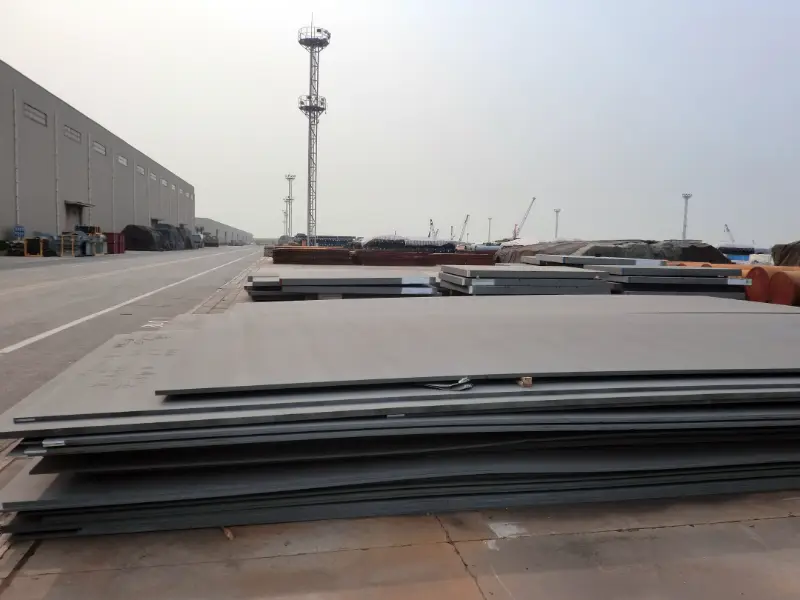
BV Grade D620 Shipbuilding Steel Plate
BV Grade D620 Shipbuilding Steel Plate: High-Strength Quenched & Tempered Marine Steel
BV D620 is a high-strength shipbuilding steel grade with minimum yield strength of 620 MPa, suitable for offshore and marine structures requiring excellent toughness at -20°C.
Quenching & Tempering (Q&T), Thermo-Mechanical Controlled Processing (TMCP)
- Phone : +8618037372205
- Email : [email protected]
- WhatsApp: Contact via Whtsapp
- WeChat: +8618037372205
BV Grade D620 Shipbuilding Steel Plate Introduction
BV Grade D620 (often designated DH620 under GB/T 712) is a high-strength shipbuilding structural steel plate certified by Bureau Veritas. It belongs to the high-strength hull structural steel group with a minimum yield strength of 620 MPa. Manufactured via quenching and tempering (Q&T) or thermo-mechanical controlled processing (TMCP), it offers an excellent combination of high strength, good weldability, and notch toughness down to -20°C.
- High yield strength (≥620 MPa) and tensile strength (720–890 MPa) enable lightweight design.
- Reliable low-temperature impact energy (≥37 J at -20°C) ensures safe service in cold marine environments.
- Good formability and weldability with appropriate consumables and procedures.
BV Grade D620 Shipbuilding Steel Plate Chemical Composition
The chemical composition of DH620 steel is designed to achieve high strength and excellent weldability while maintaining good toughness. Microalloying elements such as niobium, vanadium, and titanium are often added for grain refinement and precipitation strengthening. Carbon equivalent (Ceq) is typically controlled to ≤0.50% to ensure good weldability.
| Element | Standard Value (max, unless range) | Remarks |
|---|---|---|
| Carbon, C | ≤0.20% | Lower carbon helps weldability and toughness |
| Silicon, Si | ≤0.55% | Deoxidizer and strength contributor |
| Manganese, Mn | 0.50–1.60% | Essential for strength and hardenability |
| Phosphorus, P | ≤0.025% | Strictly controlled to avoid embrittlement |
| Sulfur, S | ≤0.025% | For improved ductility and impact properties |
| Chromium, Cr | ≤0.25% (optional) | Minor element, may be specified |
| Nickel, Ni | ≤0.40% (optional) | Improves toughness |
| Molybdenum, Mo | ≤0.08% (optional) | Enhances hardenability |
| Copper, Cu | ≤0.35% (optional) | Weathering resistance |
| Niobium, Nb | 0.02–0.05% (typical) | Grain refinement |
| Vanadium, V | 0.05–0.10% (typical) | Precipitation strengthening |
| Titanium, Ti | 0.005–0.02% (typical) | Micro-alloy for grain control |
| Aluminum, Al | ≥0.020% (total) | Grain refinement and deoxidation |
| Nitrogen, N | ≤0.012% | Controlled to avoid brittleness |
| Carbon Equivalent, Ceq | ≤0.50% (typical for ≤50 mm) | Depending on thickness |
BV Grade D620 Shipbuilding Steel Plate Thermal and Electrical Physical Properties
Physical properties are representative of quenched and tempered high-strength low-alloy steels. Actual values may slightly differ based on exact chemical composition and heat treatment. Data provided as typical guidance for engineering calculations.
| Property | Typical Value | Unit | Test Condition |
|---|---|---|---|
| Density (ρ) | 7.85 | g/cm³ | At 20°C |
| Young's Modulus (E) | 210 | GPa | At room temperature |
| Shear Modulus (G) | 81 | GPa | Calculated |
| Poisson's Ratio (ν) | 0.3 | — | In elastic range |
| Thermal Expansion Coefficient (α) | 12.0 | 10⁻⁶/K | 20–100°C |
| Thermal Conductivity (λ) | 45 | W/(m·K) | At 100°C |
| Specific Heat Capacity | 460 | J/(kg·K) | At 100°C |
| Electrical Resistivity (ρₑ) | 0.25 | Ω·mm²/m | At 20°C |
BV Grade D620 Shipbuilding Steel Plate Mechanical Properties
Minimum mechanical properties are specified according to GB/T 712 and BV rules. Values may vary with plate thickness and product form. Impact testing is performed at -20°C (D grade). Transverse specimens are usually tested. Bend test requirements ensure adequate formability.
| Property | Standard Requirement | Unit | Test Condition |
|---|---|---|---|
| Yield Strength (ReH) | ≥620 | MPa | Transverse, t≤100 mm |
| Tensile Strength (Rm) | 720–890 | MPa | Transverse, t≤100 mm |
| Elongation (A5) | ≥15 | % | Gauge length 5.65√S₀ |
| Impact Energy (KV₂) | ≥37 | J | -20°C, longitudinal; ≥27 J transverse |
| Bend Test (180°) | D=4a | — | Bend diameter = 4 times sample thickness, t≤50 mm |
| Through-thickness Reduction of Area (Z) | ≥35 (optional) | % | Z35 quality, if specified |
BV Grade D620 Shipbuilding Steel Plate Fully Equivalent Material Standards and Substitutable Grades
| Country/Region | Standard | Grade | Remarks |
|---|---|---|---|
| International | BV Rules Part 2 | DH620 | Bureau Veritas original grade |
| China | GB/T 712 | DH620 | Chinese ship steel standard |
| International | ABS Rules | DH620 | American Bureau of Shipping |
| International | DNV GL Rules | DH620 | DNV classification |
| International | LR Rules | DH620 | Lloyd's Register |
| International | CCS Rules | DH620 | China Classification Society |
| International | NK Rules | DH620 | Nippon Kaiji Kyokai |
| International | KR Rules | DH620 | Korean Register |
| International | RINA Rules | DH620 | Registro Italiano Navale |
BV Grade D620 Shipbuilding Steel Plate Application Introduction
DH620 (BV Grade D620) is engineered for critical marine and offshore structural applications where high strength-to-weight ratio and reliable low-temperature toughness are essential. Its use significantly reduces structural weight while maintaining safety margins. Proper welding procedures and filler metals must be used to avoid cold cracking.
Product Applications: Deck plates and shell plates of ship hulls, Stiffeners and longitudinal frames, Offshore platform legs and bracing members, Padeyes and lifting attachments, Heavy crane booms and booms rest plates
Processed into products: Welded structural panels and box girders, Bulkhead and deck stiffeners, Transverse frames and brackets, Foundation plates for heavy machinery, Offshore subsea structural nodes
Application industries: Shipbuilding (container ships, bulk carriers, naval vessels), Offshore oil & gas (jack-up rigs, semi-submersibles, platform structures), Marine engineering (lock gates, harbour equipment, ice-going vessels), Bridge construction (heavy-duty structural components), Wind turbine support structures (offshore monopiles, transition pieces)
BV Grade D620 Shipbuilding Steel Plate Similar or Alternative Material Recommendations
| Country/Region | Standard | Grade | Description |
|---|---|---|---|
| China/International | GB/T 712 / IACS | EH620 | Higher toughness at -40°C, otherwise comparable strength |
| China/International | GB/T 712 / IACS | FH620 | Even higher toughness at -60°C, for severe cold conditions |
| China/International | GB/T 712 / IACS | DH550 | Lower strength (≥550 MPa yield), but similar weldability |
| International | EN 10025-6 | S620QL | High-strength quenched & tempered structural steel (EN standard), comparable strength, but different certification |
| International | ASTM | A514 Grade B (690 MPa) | Higher strength quenched & tempered steel, often used in heavy machinery; welding preheat may differ |
Notes:
Welding considerations: Low-hydrogen welding processes (SMAW, SAW, FCAW, GMAW) are recommended with suitable preheat (typically 100–150°C depending on thickness) and controlled interpass temperature. Post-weld heat treatment is generally not required but may be applied. Supplementary testing (Z-grade through-thickness properties) may be ordered for components subjected to high lamellar tearing risk. This grade is produced under classification society survey and stamped with the relevant society's mark.
- Share



