
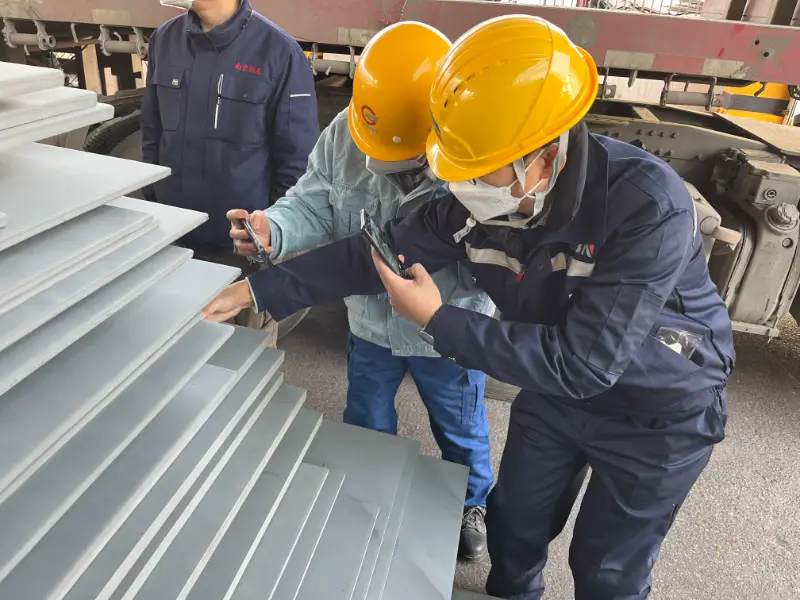
BV Grade E620 Shipbuilding Steel Plate
BV Grade E620 Shipbuilding Steel Plate – High Strength Quenched & Tempered Grade for Marine Structures
BV Grade E620 is a high-strength quenched and tempered shipbuilding steel with minimum yield strength of 620 MPa. Designed for critical structural parts of ships and offshore platforms, it offers excellent toughness at -40°C.
Hot rolling, quenching and tempering (Q&T); suitable for welding, bending, forming, and machining in shipyards and offshore fabrication
- Phone : +8618037372205
- Email : [email protected]
- WhatsApp: Contact via Whtsapp
- WeChat: +8618037372205
BV Grade E620 Shipbuilding Steel Plate Introduction
BV Grade E620 is a high-strength structural steel grade regulated by Bureau Veritas (BV) Rules for the Classification of Steel Ships. It belongs to the quenched and tempered (Q&T) category, delivering a minimum yield strength of 620 MPa and excellent low‑temperature impact toughness down to –40°C (E‑grade).
Key characteristics:
- Excellent strength‑to‑weight ratio for weight‑sensitive ship designs.
- Good weldability using recommended preheating and low‑hydrogen consumables.
- Stringent toughness requirements ensure reliable performance in cold‑climate marine environments.
- Available in quenched and tempered condition, typically in plate form up to 150 mm thickness.
The grade is mainly employed in highly stressed hull members, offshore structures, and equipment subject to extreme operational loads.
BV Grade E620 Shipbuilding Steel Plate Chemical Composition
The table below lists the ladle analysis limits specified in BV Rules for Grade E620. Besides the mandatory elements, microalloying additions (Cr, Mo, Ni, Cu, Nb, V, Ti, B) are typically employed to obtain the required mechanical properties, but their amounts are agreed upon between the steelmaker and the classification society. The carbon equivalent Ceq is controlled to ensure weldability.
| Element | Standard Requirement (max, wt%) | Remarks |
|---|---|---|
| Carbon (C) | ≤ 0.20 | Ladle analysis |
| Silicon (Si) | ≤ 0.50 | Ladle analysis |
| Manganese (Mn) | ≤ 1.70 | Ladle analysis |
| Phosphorus (P) | ≤ 0.025 | Ladle analysis |
| Sulphur (S) | ≤ 0.025 | Ladle analysis |
| Aluminium (total Al) | ≥ 0.020 | Ladle analysis, acid‑soluble Al |
| Nitrogen (N) | ≤ 0.020 | Ladle analysis |
| Others (Cr, Mo, Ni, Cu, Nb, V, Ti, B) | As per steelmaker's approved formula | Microalloying to achieve strength/toughness; Ceq ≤ 0.50 typically |
BV Grade E620 Shipbuilding Steel Plate Physical and Electrical Properties
The data below are typical for quenched and tempered steel plates of this strength class and are not mandatory per BV Rules. They serve as engineering references for design and simulation.
| Property | Typical Value | Unit | Test Condition / Remarks |
|---|---|---|---|
| Density (ρ) | 7850 | kg/m³ | Room temperature |
| Young's modulus (E) | 205 | GPa | Room temperature |
| Shear modulus (G) | 80 | GPa | Room temperature |
| Poisson's ratio (ν) | 0.3 | — | Room temperature |
| Thermal expansion coefficient (α) | 12 × 10⁻⁶ | K⁻¹ | 20 – 100 °C |
| Thermal conductivity (λ) | 40 – 45 | W/(m·K) | Room temperature |
| Specific heat capacity | 460 – 500 | J/(kg·K) | Room temperature |
| Electrical resistivity (ρ_e) | 0.18 – 0.25 × 10⁻⁶ | Ω·m | Room temperature |
BV Grade E620 Shipbuilding Steel Plate Mechanical Properties
The mechanical properties are required by BV Rules and are verified by tensile and impact tests. The values depend on plate thickness. Transverse specimens are tested when possible; specified impact energy corresponds to longitudinal specimens. The values below represent the minimum standard requirements for quenched and tempered plates.
| Property | Standard Requirement | Unit | Test Conditions / Thickness |
|---|---|---|---|
| Yield strength (ReH) | ≥ 620 | MPa | t ≤ 50 mm |
| Yield strength (ReH) | ≥ 600 | MPa | 50 < t ≤ 100 mm |
| Yield strength (ReH) | ≥ 580 | MPa | 100 < t ≤ 150 mm |
| Tensile strength (Rm) | 720 – 890 | MPa | t ≤ 50 mm |
| Tensile strength (Rm) | 700 – 870 | MPa | 50 < t ≤ 100 mm |
| Tensile strength (Rm) | 680 – 850 | MPa | 100 < t ≤ 150 mm |
| Elongation (A, longitudinal) | ≥ 15 | % | L₀ = 5.65√S₀, t ≤ 50 mm |
| Elongation (A, longitudinal) | ≥ 13 | % | L₀ = 5.65√S₀, 50 < t ≤ 150 mm |
| Charpy‑V impact energy (KV, longitudinal) | ≥ 36 (average of 3) | J | –40 °C, 10×10 mm specimen, t ≤ 50 mm |
| Charpy‑V impact energy (KV, longitudinal) | ≥ 30 (average of 3) | J | –40 °C, 10×10 mm specimen, 50 < t ≤ 150 mm |
| Bend test (transverse) | No cracks; D = 3a (t ≤ 50 mm) | — | 180° bending, mandrel diameter 3×thickness |
| Bend test (transverse) | No cracks; D = 4a (t > 50 mm) | — | 180° bending, mandrel diameter 4×thickness |
BV Grade E620 Shipbuilding Steel Plate Fully Equivalent Material Standards and Recommended Substitute Grades
| Country/Region | Standard / Classification Society | Grade | Remarks |
|---|---|---|---|
| International | Bureau Veritas | BV E620 | Baseline grade; E – impact at –40 °C |
| USA | American Bureau of Shipping | ABS EQ70 (previously EQ70) | Yield 620 MPa class, Q&T, –40°C |
| Norway | DNV | DNV E620 | Equivalent Q&T strength class |
| United Kingdom | Lloyd's Register | LR EH620 | EH for impact at –40°C, 620 MPa yield |
| China | China Classification Society | CCS E620 | Same base specification |
| Japan | Nippon Kaiji Kyokai | NK KE620 | Ice‑class steel equivalent |
| Korea | Korean Register | KR RE620 | Identical strength and toughness |
| Italy | RINA | RINA E620 | Same designation |
BV Grade E620 Shipbuilding Steel Plate Application Introduction
BV Grade E620 is purpose‑designed for the most demanding marine structural applications where a high strength‑to‑weight ratio significantly reduces hull weight or platform topside mass. It is especially suited for cold‑water operations because of its guaranteed low‑temperature toughness. Common application areas include:
Product Applications: Main deck and bottom shell plates, Side shell and inner bottom panels, Hatch coamings and container ship cell guides, Crane pedestals and A‑frames, Legs and spudcans of jack‑up rigs, Transition pieces and nodes of fixed offshore platforms, Heavy‑duty sea‑fastening components
Processed into products: Stiffeners, girders, and web frames, Mast houses and king posts, Deck crane structural supports, Winch and towing gear bases, Heavy‑duty lifting lugs and padeyes, Buckling‑critical panels subjected to combined loading
Application industries: Shipbuilding (oceangoing vessels, ice‑class ships, naval vessels), Offshore oil & gas (jack‑up rigs, semi‑submersibles, production platforms), Marine heavy lifting equipment, Renewable energy offshore (wind turbine substructures)
BV Grade E620 Shipbuilding Steel Plate Similar or Nearby Substitute Materials
| Country/Region | Standard / Classification Society | Grade | Remarks |
|---|---|---|---|
| International | BV | BV FH620 | Improved low‑temperature toughness (–60°C) compared to E620; otherwise similar strength. |
| International | BV | BV E550 | Lower minimum yield (550 MPa) but easier to weld; may replace E620 where full 620 MPa is not essential. |
| USA | ASTM | A514 Grade Q (Type A, B, etc.) | Quenched & tempered steel, min yield 690 MPa; requires re‑certification for marine use. |
| Europe | EN | S690QL (EN 10025‑6) | Structural steel for offshore and heavy fabrication; similar strength class but not directly certified under BV ship rules. |
Notes:
- Welding procedures must comply with BV Rules; low‑hydrogen processes and preheat/interpass temperature control are essential to avoid cold cracking.
- Post‑weld heat treatment (PWHT) is not normally performed on this Q&T grade unless explicitly approved, as it may degrade strength.
- Surface protection (shop primer or full coating) is strongly recommended for marine environments.
- For thicknesses beyond 150 mm, special agreement with the classification society is required.
- Share



