
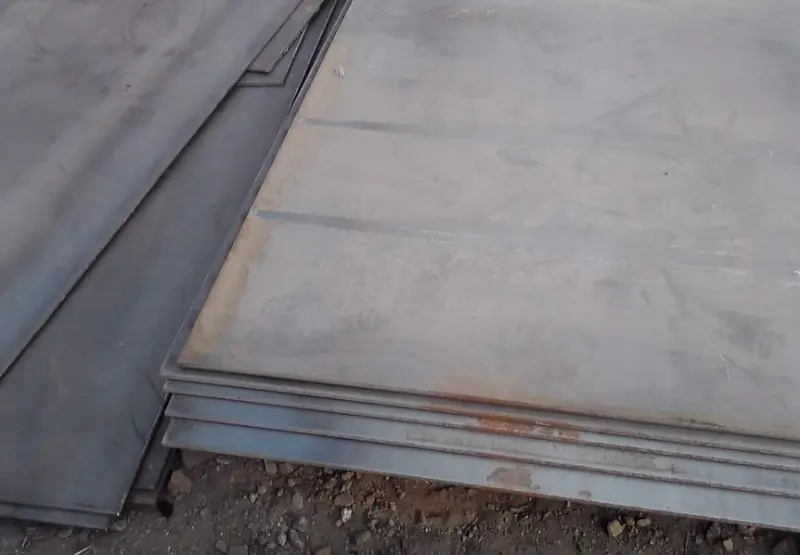
BV Grade F620 Shipbuilding Steel Plate
BV Grade F620 Shipbuilding Steel Plate: High-Strength Marine Structural Solution
In-depth analysis of BV Grade F620 shipbuilding steel plate, including chemical composition, mechanical and physical properties, international equivalents, and application guide.
Welding, Cutting, Forming, Bending, Quenching and Tempering
- Phone : +8618037372205
- Email : [email protected]
- WhatsApp: Contact via Whtsapp
- WeChat: +8618037372205
BV Grade F620 Shipbuilding Steel Plate Introduction
BV Grade F620 is a high-strength, quenched and tempered steel plate specifically designed for marine and offshore structural applications. Certified by Bureau Veritas, it offers a minimum yield strength of 620 MPa, enabling the construction of lighter yet stronger vessels and offshore units. This grade belongs to the extra high-strength category and is characterized by excellent weldability, good toughness at low temperatures, and superior resistance to brittle fracture. Typical applications include critical structural parts of large container ships, jack-up rig legs, and heavy-lift crane pedestals, where weight reduction without compromising safety and durability is paramount. Its properties are achieved through a precisely controlled chemical composition and a specialized heat treatment process.
BV Grade F620 Shipbuilding Steel Plate Chemical Composition of BV Grade F620
The chemical composition of BV F620 is meticulously balanced to achieve its ultra-high strength and excellent toughness after quenching and tempering. Elements like Carbon (C) are kept low to ensure good weldability, while Manganese (Mn), Nickel (Ni), Chromium (Cr), and Molybdenum (Mo) are added in controlled amounts for hardenability and strength. Micro-alloying elements such as Niobium (Nb), Vanadium (V), and Titanium (Ti) provide grain refinement and precipitation strengthening, contributing to both strength and low-temperature toughness.
| Element | Standard Value (Max, unless range is given) | Remarks |
|---|---|---|
| Carbon (C) | 0.20 | Improves strength and hardenability |
| Silicon (Si) | 0.10 - 0.55 | Deoxidizer; contributes to strength |
| Manganese (Mn) | 0.70 - 1.70 | Crucial for strength and hardenability, offsets sulfur |
| Phosphorus (P) | 0.025 | Impurity; kept low for toughness |
| Sulfur (S) | 0.015 | Impurity; kept low to prevent hot cracking |
| Chromium (Cr) | 1.00 | Increases hardenability and corrosion resistance |
| Nickel (Ni) | 2.00 | Crucial for low-temperature toughness |
| Molybdenum (Mo) | 0.70 | Increases hardenability and high-temperature strength |
| Copper (Cu) | 0.50 | Provides some atmospheric corrosion resistance |
| Aluminum (Al) total | 0.020 min | Grain refining element; ensures fine grain structure |
| Nitrogen (N) | 0.015 | Controlled for optimal mechanical properties |
| Niobium (Nb) | 0.05 | Grain refiner and precipitation strengthener |
| Vanadium (V) | 0.10 | Precipitation strengthener; improves toughness |
| Titanium (Ti) | 0.05 | Grain refiner; binds nitrogen |
| Boron (B) | 0.005 | Significantly increases hardenability |
BV Grade F620 Shipbuilding Steel Plate Physical Properties of BV Grade F620
Physical properties are essential for engineering calculations, such as thermal stress analysis and heat transfer. These values are typical for high-strength quenched and tempered steels and are influenced by the specific chemical composition and microstructure. The Density (ρ) is standard for steel. The Young's Modulus (E) and Shear Modulus (G) are fundamental for stiffness calculations, while the Thermal Expansion Coefficient (α), Thermal Conductivity (λ), and Specific Heat Capacity (Cp) are critical for weld pre-heating and service condition assessments.
| Property | Typical Value | Unit | Test Condition / Notes |
|---|---|---|---|
| Density (ρ) | 7850 | kg/m³ | At 20°C |
| Young's Modulus (E) | 205 | GPa | At 20°C |
| Shear Modulus (G) | 80 | GPa | At 20°C |
| Poisson's Ratio (ν) | 0.3 | - | At 20°C |
| Thermal Expansion Coefficient (α) | 11.5 | 10⁻⁶/K | Between 20°C and 100°C |
| Thermal Expansion Coefficient (α) | 12.5 | 10⁻⁶/K | Between 20°C and 200°C |
| Thermal Expansion Coefficient (α) | 13.0 | 10⁻⁶/K | Between 20°C and 300°C |
| Thermal Conductivity (λ) | 28 | W/(m·K) | At 20°C, typical for high-strength steel |
| Thermal Conductivity (λ) | 35 | W/(m·K) | At 200°C, typical for high-strength steel |
| Specific Heat Capacity (Cp) | 460 | J/(kg·K) | At 20°C to 100°C |
| Electrical Resistivity (ρ_e) | 0.25 | Ω·mm²/m | At 20°C |
BV Grade F620 Shipbuilding Steel Plate Mechanical Properties of BV Grade F620
The following mechanical properties are guaranteed for BV F620 plates in the quenched and tempered condition. The Yield Strength of ≥ 620 MPa and Tensile Strength range of 720-890 MPa represent the minimum requirements. Crucially, Charpy V-notch impact tests (KV) are performed at designated test temperatures to ensure sufficient toughness against brittle fracture, a non-negotiable requirement for marine-classed materials.
| Property | Standard Value | Unit | Test Condition / Notes |
|---|---|---|---|
| Yield Strength (ReH) | ≥ 620 | MPa | Ambient, 20°C |
| Tensile Strength (Rm) | 720 - 890 | MPa | Ambient, 20°C |
| Elongation after fracture (A) | ≥ 15 | % | Gauge length 5.65√So (L0=5d) |
| Charpy Impact Toughness (KV) - Longitudinal | ≥ 69 | J | At -60°C / Average on 3 specimens |
| Charpy Impact Toughness (KV) - Longitudinal | ≥ 52 | J | At -60°C / Minimum single value |
| Charpy Impact Toughness (KV) - Transverse | ≥ 46 | J | At -60°C / Average on 3 specimens |
| Charpy Impact Toughness (KV) - Transverse | ≥ 35 | J | At -60°C / Minimum single value |
| Bend Test (Diameter 'd', Thickness 'a') | d = 4a, 180° | - | No cracks or defects acceptable |
BV Grade F620 Shipbuilding Steel Plate Completely Equivalent Material Standards & Replaceable Grades
| Country/Region | Standard | Grade | Remarks |
|---|---|---|---|
| International | BV Rules | F620 | The base standard and grade. Delivery condition: Q+T. |
| Europe | EN 10225 | S620Q / S620QL1 | S620Q is the basic grade; S620QL1 guarantees low-temperature impact properties (down to -60°C), making it the closest potential equivalent. Always verify property parity with BV F620 specific mill certificate. |
BV Grade F620 Shipbuilding Steel Plate Application Introduction
BV F620 is engineered for high-stress, fatigue-critical applications in severe environments. Its exceptional strength-to-weight ratio allows designers to reduce structural weight, which increases payload capacity for transport vessels or reduces wave loading on offshore platforms. Its reliable low-temperature toughness ensures structural integrity in cold climates and Arctic waters.
Product Applications: Large Container Ships (upper deck, hatch coaming), Jack-up Drilling Rigs (legs, spudcans), Semi-submersible Production Platforms (deck box, column connections), FPSO (Floating, Production, Storage, and Offloading) Vessels, Heavy-lift Crane Vessels (pedestal, boom), Arctic-class Icebreaker Hulls
Processed into products: Main deck plating and stiffeners, Bottom shell plating and longitudinals, Bilge strakes and sheer strakes, Watertight bulkheads and box girder flanges, Tubular joints and node cans for offshore jackets, Crane pedestal flanges and diaphragms, Lock gates and other heavy hydraulic structures, Armor plate systems (specialty application)
Application industries: Marine & Shipbuilding, Offshore Oil & Gas Exploration, Heavy Lifting & Transport, Civil Engineering (specialized applications like bridges under high dynamic loads), Renewable Energy (offshore wind turbine foundations and structures)
BV Grade F620 Shipbuilding Steel Plate Similar/Alternative High-Strength Quenched & Tempered Steels
| Country/Region | Standard | Grade | Remarks |
|---|---|---|---|
| United States | ASTM A514 / A517 | Grade Q / Grade S | Yield strength of 690 MPa (100 ksi) is higher, but tensile strength overlaps with BV F620. Requires careful review of Charpy impact test temperature and values, which often need separate specification. |
| United Kingdom | BS 7191 | 550EMZ | Comparable yield strength class (550 MPa design, 620 MPa minimum yield). Primarily intended for offshore structures. Verification of specific tensile and toughness requirements is essential. |
| Japan | JIS G 3128 | SHY 685 / SHY 685N | High yield strength plate for welded structures. The 'N' designation typically indicates a specified low-temperature toughness, making it functionally similar for some applications. |
| China | GB/T 31905 | F620 | Chinese classification society standard for ship and ocean engineering structural steel. Often designed to be technically equivalent to international ship class requirements like BV F620. |
Notes:
Processing and Certification: Delivery is exclusively in the Quenched and Tempered (Q+T) condition. Any subsequent hot forming or excessive heat input during welding can degrade the carefully designed mechanical properties. Welding procedures must be qualified in accordance with BV rules using low-hydrogen practices. Mill Test Certificate: Material must be supplied with a BV-certified 3.2 inspection certificate, detailing ladle analysis, product analysis, tensile test results, and all impact test results traceable to plate heat treatment batch.
- Share



