
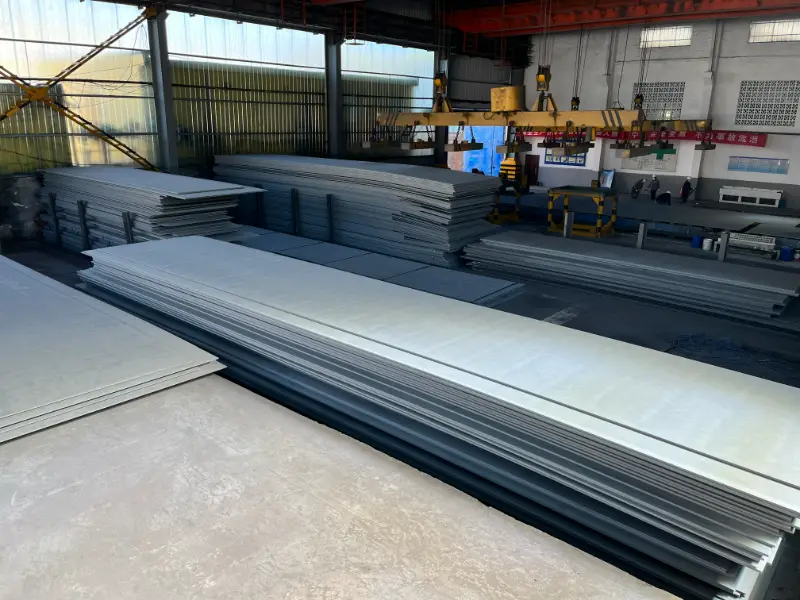
BV Grade A690 Shipbuilding Steel Plate
BV Grade A690 Shipbuilding Steel Plate: Properties, Chemistry & International Equivalents
Comprehensive material data for BV Grade A690 high-strength quenched and tempered shipbuilding steel plate, including chemical composition, mechanical and physical properties, international equivalents, similar grades, and application guidelines.
Hot rolling, quenching and tempering; subsequent cutting, cold forming, and welding (with preheat and interpass temperature control)
- Phone : +8618037372205
- Email : [email protected]
- WhatsApp: Contact via Whtsapp
- WeChat: +8618037372205
BV Grade A690 Shipbuilding Steel Plate Introduction
BV Grade A690 is a high-strength quenched and tempered (Q&T) structural steel plate specifically designed for marine and offshore applications, classified by Bureau Veritas (BV). It offers a minimum yield strength of 690 MPa, combining exceptional strength with good toughness at low temperatures. This steel is intended for critical structural components where weight reduction and high load-bearing capacity are paramount.
Key characteristics:
- Minimum yield strength of 690 MPa in thinner sections.
- Excellent weldability when proper procedures are followed, due to controlled carbon equivalent.
- Guaranteed impact toughness at 0 °C (longitudinal and transverse).
- Supplied in the quenched and tempered condition to achieve uniform mechanical properties.
- Conforms to IACS Unified Requirement W11, ensuring global acceptance across major classification societies.
BV Grade A690 Shipbuilding Steel Plate Chemical Composition
The chemical composition of BV A690 is strictly controlled to ensure deep hardenability, adequate toughness, and good weldability. The following table gives the maximum allowable limits (unless a range is specified) according to BV Rules and IACS UR W11 for quenched and tempered steels with minimum yield strength ≥ 690 MPa.
| Element | Content (%) | Remarks |
|---|---|---|
| Carbon (C) | ≤ 0.20 | Max. value |
| Silicon (Si) | ≤ 0.55 | Max. value |
| Manganese (Mn) | ≤ 1.70 | Max. value |
| Phosphorus (P) | ≤ 0.025 | Max. value |
| Sulfur (S) | ≤ 0.025 | Max. value |
| Chromium (Cr) | ≤ 1.50 | Max. value |
| Nickel (Ni) | ≤ 2.00 | Max. value |
| Molybdenum (Mo) | ≤ 0.70 | Max. value |
| Copper (Cu) | ≤ 0.50 | Max. value |
| Vanadium (V) | ≤ 0.10 | Max. value |
| Niobium (Nb) | ≤ 0.06 | Max. value |
| Titanium (Ti) | ≤ 0.05 | Max. value |
| Aluminum (Al, total) | ≥ 0.015 | Min. value, for grain refinement |
| Nitrogen (N) | ≤ 0.015 | Max. value |
| Boron (B) | ≤ 0.005 | If added, max. value |
BV Grade A690 Shipbuilding Steel Plate Thermal and Electrical Physical Properties
The following data are typical for low-alloy quenched and tempered steels with yield strength around 690 MPa. Values may vary slightly depending on exact composition and heat treatment condition. They are provided for information and design estimation.
| Property | Typical Value | Unit | Test Conditions |
|---|---|---|---|
| Density (ρ) | 7.85 | g/cm³ | 20 °C |
| Modulus of Elasticity (E) | 205 | GPa | 20 °C |
| Shear Modulus (G) | 80 | GPa | 20 °C |
| Poisson's Ratio (ν) | 0.3 | - | 20 °C |
| Thermal Expansion Coefficient (α) | 12 | 10⁻⁶/K | 20 - 100 °C |
| Thermal Conductivity (λ) | 50 | W/(m·K) | 20 °C |
| Specific Heat Capacity (c) | 460 | J/(kg·K) | 20 °C |
| Electrical Resistivity (ρ_e) | 0.25 | μΩ·m | 20 °C |
BV Grade A690 Shipbuilding Steel Plate Mechanical Properties
Mechanical properties are determined on test pieces taken in the transverse direction (unless otherwise specified) and in accordance with BV Rules. Values are valid for plate thicknesses as indicated. Impact test temperature is 0 °C for grade A690.
| Property | Required Value | Unit | Test Conditions |
|---|---|---|---|
| Yield Strength (ReH) | ≥ 690 | MPa | t ≤ 50 mm, transverse |
| Yield Strength (ReH) | ≥ 670 | MPa | 50 < t ≤ 100 mm, transverse |
| Tensile Strength (Rm) | 770 - 940 | MPa | t ≤ 50 mm, transverse |
| Tensile Strength (Rm) | 670 - 830 | MPa | 50 < t ≤ 100 mm, transverse |
| Elongation (A) | ≥ 14 | % | L₀ = 5.65√So, longitudinal |
| Bend Test (Bend Diameter) | 3t | - | 180° bend, t ≤ 50 mm, no cracks |
| Bend Test (Bend Diameter) | 4t | - | 180° bend, 50 < t ≤ 100 mm, no cracks |
| Impact Energy KV (0 °C) | ≥ 50 (avg.) / ≥ 35 (single) | J | Longitudinal, t ≤ 50 mm |
| Impact Energy KV (0 °C) | ≥ 34 (avg.) / ≥ 24 (single) | J | Transverse, t ≤ 50 mm |
BV Grade A690 Shipbuilding Steel Plate Fully Equivalent Materials
| Country / Region | Standard / Classification Society | Grade | Remarks |
|---|---|---|---|
| China | CCS (China Classification Society) | A690 | Identical under IACS UR W11 |
| USA | ABS (American Bureau of Shipping) | A690 | Identical under IACS UR W11 |
| Norway / Germany | DNV (Det Norske Veritas) | A690 | Identical under IACS UR W11 |
| UK | LR (Lloyd's Register) | A690 | Identical under IACS UR W11 |
| South Korea | KR (Korean Register) | A690 | Identical under IACS UR W11 |
| Japan | NK (Nippon Kaiji Kyokai) | A690 | Identical under IACS UR W11 |
| Italy | RINA (Registro Italiano Navale) | A690 | Identical under IACS UR W11 |
| India | IRS (Indian Register of Shipping) | A690 | Identical under IACS UR W11 |
BV Grade A690 Shipbuilding Steel Plate Application Introduction
BV A690 steel is engineered for highly stressed welded structures where high strength and toughness are crucial. Its combination of mechanical properties and weldability makes it ideal for weight-critical and safety-critical applications in marine and offshore environments.
Product Applications: High-strength ship hulls and structural members, Self-elevating platform legs and jack-up units, Crane pedestals and lifting frames, Deck cargo areas and mooring equipment, Offshore substructures and piles
Processed into products: Longitudinal and transverse stiffeners, Shear plates and web frames, Bracket plates and heavy pad-eyes, Pile sleeves and cone joints, Heavily loaded connecting plates
Application industries: Shipbuilding (hulls, decks, bulkheads, superstructures), Offshore oil and gas (platforms, jackets, topside modules), Heavy engineering (crane booms, bridges, pressure vessels), Renewable energy (offshore wind turbine foundations, transition pieces)
BV Grade A690 Shipbuilding Steel Plate Similar / Alternative Materials
| Country / Region | Standard | Grade | Remarks |
|---|---|---|---|
| Europe | EN 10025-6 | S690QL / S690Q | Similar strength and heat treatment; may require supplementary testing for marine use. |
| USA | ASTM A514 / A514M | Grade S | Yield strength 690 MPa (100 ksi), Q&T; not specifically for shipbuilding without additional certification. |
| China | GB/T 16270 | Q690D / Q690E | High strength structural steel; comparable mechanical properties but impact test temperatures differ. |
Notes:
Welding recommendations: Preheating (typically 100-150 °C) and interpass temperature control are required to avoid cold cracking. Low-hydrogen processes and filler metals matching the strength level should be used. Post-weld heat treatment is not generally required for this QT steel, but stress relieving may be performed above 550 °C with careful verification of properties.
Testing and certification: BV A690 plates are delivered with 3.2 certificate per EN 10204 and class surveyor stamps, verifying chemical analysis, tensile, impact, and bend tests as per BV rules.
Availability: Plates are normally supplied in thicknesses up to 100 mm, widths up to 3500 mm, and lengths up to 12000 mm; other dimensions can be negotiated. Surface is blast-cleaned and shop-primed as per standard shipbuilding practice.
- Share



