
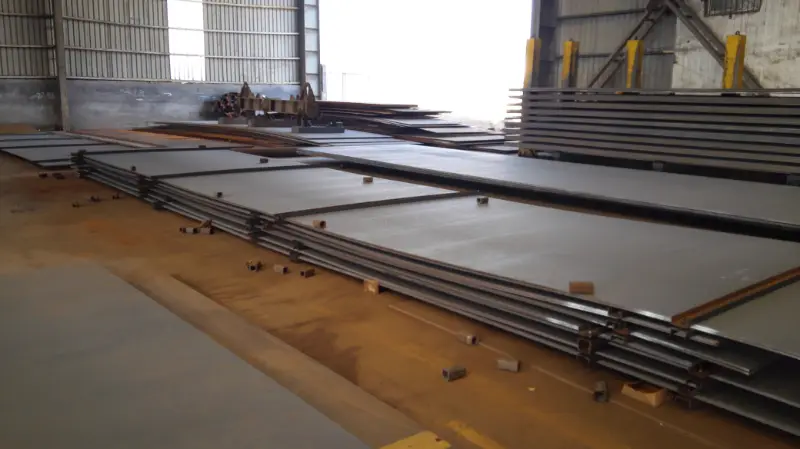
BV Grade D690 Shipbuilding Steel Plate
BV Grade D690 Shipbuilding Steel Plate: High-Strength Marine Structural Material
BV Grade D690 is a high-strength quenched and tempered shipbuilding steel plate certified by Bureau Veritas. It offers minimum yield strength of 690 MPa, excellent weldability, and toughness for critical offshore and marine structures.
Hot rolling, controlled rolling, quenching and tempering; suitable for cutting, cold forming (with limitations), and welding
- Phone : +8618037372205
- Email : [email protected]
- WhatsApp: Contact via Whtsapp
- WeChat: +8618037372205
BV Grade D690 Shipbuilding Steel Plate Introduction
BV Grade D690 is a high-strength shipbuilding steel plate governed by the rules of Bureau Veritas (BV). It belongs to the category of quenched and tempered (Q&T) steels with a specified minimum yield strength of 690 MPa. This steel is characterized by superior weldability, excellent low-temperature toughness, and high resistance to crack propagation. The typical chemical composition is carefully controlled to achieve the desired mechanical properties through a combination of microalloying elements such as Nb, V, Ti, and controlled rolling/Q&T processes. BV D690 is primarily intended for use in critical structural components of ships, offshore platforms, and other marine constructions where high strength-to-weight ratio and durability in harsh environments are essential. Its delivery condition is usually quenched and tempered, ensuring uniform mechanical properties throughout the plate thickness.
BV Grade D690 Shipbuilding Steel Plate Chemical Composition
The chemical composition of BV D690 steel is tightly controlled to guarantee hardenability, strength, and toughness after quenching and tempering. Typical values are based on the requirements of BV Rules and common industrial practice. The steel is fully killed and fine-grained.
- Carbon is kept low (≤0.20%) to ensure weldability.
- Manganese and silicon act as deoxidizers and solid-solution strengtheners.
- Phosphorus and sulfur are restricted to very low limits for cleanliness and toughness.
- Microalloying elements (Al, Nb, V, Ti) refine grain size and provide precipitation strengthening.
- Cr, Ni, Mo are optionally added to increase hardenability for heavy plates.
| Element | Typical Value (max %) | Remarks |
|---|---|---|
| Carbon (C) | 0.20 | Ladle analysis; max. 0.20% for product analysis |
| Silicon (Si) | 0.10 – 0.55 | Killed steel practice |
| Manganese (Mn) | 0.70 – 1.70 | Higher Mn promotes strength and toughness |
| Phosphorus (P) | 0.025 | Maximum; lower values improve low-temperature toughness |
| Sulfur (S) | 0.025 | Maximum; low S ensures ductility and lamellar tearing resistance |
| Aluminum (Al) (total) | 0.020 min | Usually 0.020–0.080% for fine grain practice |
| Niobium (Nb) | 0.05 max | Microalloy for grain refinement and precipitation hardening |
| Vanadium (V) | 0.10 max | Optional, similar effect as Nb |
| Titanium (Ti) | 0.05 max | Used for deoxidation and grain refinement |
| Chromium (Cr) | 0.25 max | Optional; up to 0.25% may be added |
| Nickel (Ni) | 0.80 max | Optional; improves toughness |
| Molybdenum (Mo) | 0.50 max | Optional; enhances hardenability for thick plates |
| Copper (Cu) | 0.35 max | Optional; residual element |
| Nitrogen (N) | 0.012 max | Bound by Al, Ti, etc. |
BV Grade D690 Shipbuilding Steel Plate Thermal and Electrical Physical Properties
The physical properties are typical for quenched and tempered low-alloy steel with a similar composition and strength level. These values are not specified by BV Rules but are provided as engineering reference data. Properties may vary slightly with temperature and heat treatment condition. Density is standard for steel; thermal expansion coefficient and thermal conductivity are important for design and welding.
| Property | Typical Value | Unit | Test Temperature / Condition |
|---|---|---|---|
| Density (ρ) | 7.85 | g/cm³ | 20°C |
| Elastic Modulus (E) | 210 | GPa | 20°C |
| Shear Modulus (G) | 81 | GPa | 20°C |
| Poisson's Ratio (ν) | 0.3 | — | 20°C |
| Thermal Expansion Coefficient (α) | 12.5 × 10⁻⁶ | 1/K | 20 – 100°C |
| Thermal Expansion Coefficient (α) | 13.5 × 10⁻⁶ | 1/K | 20 – 200°C |
| Thermal Expansion Coefficient (α) | 14.1 × 10⁻⁶ | 1/K | 20 – 400°C |
| Thermal Conductivity (λ) | 36 | W/(m·K) | 20°C |
| Thermal Conductivity (λ) | 35 | W/(m·K) | 100°C |
| Thermal Conductivity (λ) | 33 | W/(m·K) | 200°C |
| Thermal Conductivity (λ) | 31 | W/(m·K) | 400°C |
| Specific Heat Capacity (cₚ) | 460 | J/(kg·K) | 20°C |
| Specific Heat Capacity (cₚ) | 490 | J/(kg·K) | 100°C |
| Specific Heat Capacity (cₚ) | 530 | J/(kg·K) | 200°C |
| Specific Heat Capacity (cₚ) | 580 | J/(kg·K) | 400°C |
| Electrical Resistivity (ρₑ) | 0.25 – 0.30 | μΩ·m | 20°C (approx.) |
BV Grade D690 Shipbuilding Steel Plate Mechanical Properties
The mechanical properties are tested on quenched and tempered specimens. The specified values are minima unless a range is indicated. Impact test temperatures and minimum energy values depend on the thickness and the grade suffix (e.g., -20°C for E-grade equivalent toughness). The data below reflects BV Rules for D-grade plates; D690 typically implies transverse Charpy V-notch testing at -20°C. Yield strength and tensile strength must be within the specified limits for all thicknesses.
| Property | Required Value | Unit | Test Conditions |
|---|---|---|---|
| Yield Strength (ReH) | 690 min | MPa | Transverse; 0.5% strain under load or 0.2% offset method |
| Tensile Strength (Rm) | 770 – 940 | MPa | Transverse |
| Elongation (A) | 14 min | % | Gauge length 5.65√So; transverse specimen |
| Bend Test (180°) | D = 3a (t ≤ 5 mm); D = 4a (t > 5 mm) | — | No cracks; mandrel diameter D, specimen thickness a |
| Charpy V-notch Impact (KV₂) | ≥ 69 (longitudinal) / ≥ 46 (transverse) | J | At -20°C; average of 3 specimens, single minimum 70% of average |
| Hardness (HBW) | 270 – 360 (typical) | HBW | Supplementary requirement if not specified by customer |
| Through-thickness reduction of area (Z) | ≥ 35 (Z35 class) or as per agreement | % | If specified for joint design |
BV Grade D690 Shipbuilding Steel Plate Equivalent Material Standards and Grades
| Country/Region | Standard | Grade | Remarks |
|---|---|---|---|
| International (BV) | BV Rules | D 690 | Base certification; also designated NV D690 |
| International (DNV) | DNV Rules | L 690 | DNV equivalent; same strength level, similar chemistry |
| International (Lloyd's Register) | LR Rules | L 690 | Lloyd's Register grade with 690 MPa YS |
| International (ABS) | ABS Rules | EH 690 | ABS designation for quenched and tempered 690 MPa steel |
| International (CCS) | CCS Rules | E 690 | China Classification Society equivalent |
| International (NK) | NK Rules | E 690 | Nippon Kaiji Kyokai equivalent |
| International (KR) | KR Rules | EH 690 | Korean Register equivalent |
| International (RINA) | RINA Rules | E 690 | RINA equivalent grade |
| European (EN) | EN 10225-1 | S690QL1 | Structural steel for offshore structures; comparable mechanicals |
| USA (ASTM) | ASTM A514 / A517 | Grade Q | High-strength quenched & tempered plate; similar strength but not for marine classification without additional certification |
BV Grade D690 Shipbuilding Steel Plate Application Introduction
BV D690 steel is extensively utilized in the marine and offshore industries where high strength, excellent weldability, and reliable low-temperature toughness are mandatory. Its quenched and tempered condition provides a balanced combination of mechanical characteristics, enabling weight reduction and improved payload capacity. Suitable for critical welded structures subjected to high static and dynamic loads in harsh environments.
Product Applications: Structural plates for hulls, decks, and bulkheads, Jacket legs and bracing members for offshore platforms, Racks and chords of jack-up drilling units, Penetrations and stiffeners in marine structures, Submarine pipeline components, High-strength structural tubing
Processed into products: Hull shell plates (ice belt region), Deck longitudinal stiffeners, Transition pieces in offshore wind foundations, Lifting frames and spreader bars, Crane pedestals and slew rings, Mud mats and pile sleeves
Application industries: Shipbuilding (commercial and naval vessels, especially ice-class hulls), Offshore oil & gas (jack-up rigs, semi-submersibles, fixed platforms), Renewable energy (offshore wind turbine foundations and transition pieces), Heavy lifting and transportation (crane booms, heavy-lift vessels), Pressure vessels and storage tanks for low temperature service, Mining and dredging equipment
BV Grade D690 Shipbuilding Steel Plate Similar or Alternative Materials
| Country/Region | Standard | Grade | Remarks |
|---|---|---|---|
| International (BV) | BV Rules | E 620 (or D 620) | Lower yield strength (620 MPa); similar weldability, better toughness |
| International | EN 10025-6 | S690Q / S690QL | Structural steel not requiring marine class; similar mechanical properties but no ship classification |
| USA | ASTM A514 | Grade F | Good toughness; may be used for non-marine heavy structures |
| Japan | JIS G 3128 | SHY 685 | High yield strength steel for welded structures; comparable to BV D690 in strength |
| European | EN 10225 | S690QL1 | Specifically for offshore structures with improved weldability and Z-direction properties |
| International | API 2Y | Grade 60 | Steel for offshore structures; yield 414 MPa (60 ksi) – much lower strength, not a direct substitute |
Notes:
BV D690 plates are typically supplied in the quenched and tempered condition with a marking indicating the classification society certification. Thickness ranges usually from 6 mm to 150 mm. For plates intended for welded structures with high restraints, a Z-direction (through-thickness) tensile test may be specified according to BV additional requirements (e.g., Z25, Z35) to ensure resistance to lamellar tearing. Welding must follow approved welding procedure specifications (WPS) using low-hydrogen electrodes or processes to avoid cold cracking. Pre-heating and interpass temperature control are crucial, and post-weld heat treatment should be avoided unless mandatory, as it may reduce strength.
- Share



