
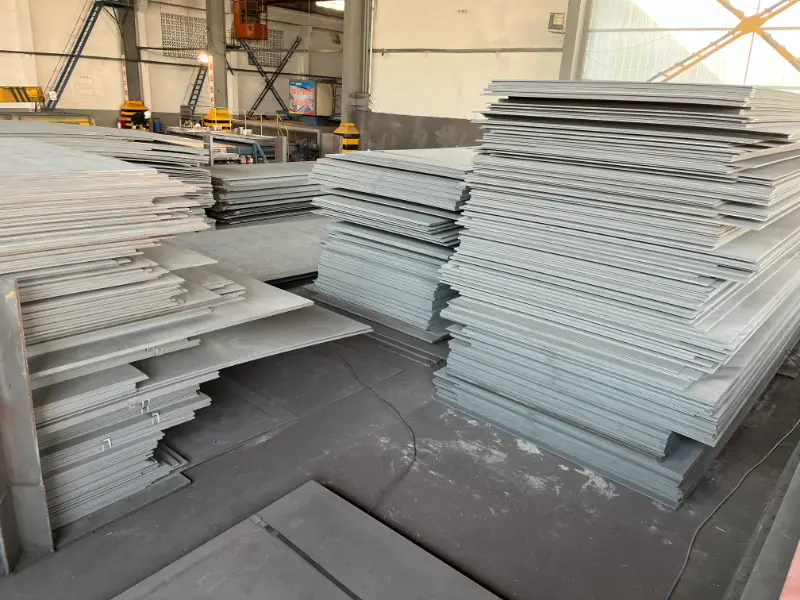
BV Grade E690 Shipbuilding Steel Plate
BV Grade E690 Shipbuilding Steel Plate - High Strength Marine & Offshore Steel
Detailed specifications of BV Grade E690 shipbuilding steel: chemical composition, mechanical properties, thermal and electrical properties, international equivalent grades, and application guidance.
Hot rolling, controlled rolling, thermo‑mechanical control process (TMCP), quenching & tempering (Q&T)
- Phone : +8618037372205
- Email : [email protected]
- WhatsApp: Contact via Whtsapp
- WeChat: +8618037372205
BV Grade E690 Shipbuilding Steel Plate Introduction
BV Grade E690 is a high-strength quenched and tempered steel plate certified by Bureau Veritas (BV) for shipbuilding and offshore structures. It offers a minimum yield strength of 690 MPa with excellent low‑temperature impact toughness (−40 °C) and good weldability. The steel is produced through a low‑alloy design with microalloying elements to achieve a fine grain structure after quenching and tempering. Typical applications include heavy‑duty structural parts in container ships, ice‑class vessels, jack‑up rig legs, and critical offshore components. The steel meets the rigorous requirements of BV Rules for Materials and Welding, ensuring reliable service under dynamic loads and harsh marine environments.
BV Grade E690 Shipbuilding Steel Plate Chemical Composition
The following table lists the typical chemical composition limits for BV Grade E690 steel as per BV Rules. Values are maximum unless otherwise specified. The steel is a low‑alloy grade with microalloying additions of niobium, vanadium and titanium to achieve the required strength and toughness after heat treatment. Carbon equivalent (CEV) is usually restricted to ensure good weldability.
| Element | Standard Value (wt%) | Remarks |
|---|---|---|
| Carbon (C) | 0.20 max | Ladle analysis |
| Silicon (Si) | 0.55 max | |
| Manganese (Mn) | 1.60 max | |
| Phosphorus (P) | 0.025 max | |
| Sulfur (S) | 0.025 max | |
| Chromium (Cr) | 0.20 max | |
| Nickel (Ni) | 0.30 max | |
| Molybdenum (Mo) | 0.08 max | |
| Aluminium (Al) | 0.020 min | Acid soluble |
| Copper (Cu) | 0.35 max | |
| Niobium (Nb) | 0.04 max | |
| Vanadium (V) | 0.08 max | |
| Titanium (Ti) | 0.02 max | |
| Nitrogen (N) | 0.012 max | If not fixed by other elements |
| CEV (Carbon Equivalent) | Typically ≤0.52 | CEV = C + Mn/6 + (Cr+Mo+V)/5 + (Ni+Cu)/15 |
BV Grade E690 Shipbuilding Steel Plate Thermal & Electrical Physical Properties
The following physical properties are typical for high‑strength low‑alloy steels similar to E690. These values are provided for general engineering calculations and are not part of the mandatory BV specification. Actual properties may vary slightly depending on exact chemical composition and heat treatment condition.
| Property | Typical Value | Unit | Test Condition / Remarks |
|---|---|---|---|
| Density (ρ) | 7850 | kg/m³ | Room temperature |
| Modulus of Elasticity (E) | 210 | GPa | Tension, room temperature |
| Shear Modulus (G) | 81 | GPa | Calculated, room temperature |
| Poisson's Ratio (ν) | 0.3 | – | Room temperature |
| Thermal Expansion Coefficient (α) | 11.5 – 12.5 | ×10⁻⁶ K⁻¹ | Temperature range 20 °C to 100 °C |
| Thermal Conductivity (λ) | ~50 | W/(m·K) | At 25 °C |
| Specific Heat Capacity (c) | ~460 | J/(kg·K) | At 25 °C |
| Electrical Resistivity (ρₑ) | ~0.25 | µΩ·m | At 20 °C |
BV Grade E690 Shipbuilding Steel Plate Mechanical Properties
The mechanical properties of BV E690 steel plates are determined at room temperature in the quenched and tempered condition. Impact toughness is verified at −40 °C using Charpy V‑notch specimens taken in the longitudinal direction. Values may vary slightly depending on product thickness and mill practice; the table reflects requirements for plates ≤50 mm thick. Bending tests are performed with a former diameter of 3 times the plate thickness for ductility assessment.
| Property | Standard Requirement | Unit | Test Condition |
|---|---|---|---|
| Yield Strength (ReH) | ≥690 | MPa | Transverse tensile test, room temperature, plate thickness ≤50 mm |
| Tensile Strength (Rm) | 770 – 940 | MPa | Transverse tensile test, room temperature, plate thickness ≤50 mm |
| Elongation (A) | ≥14 | % | Gauge length 5.65√So, transverse, room temperature, thickness ≤50 mm |
| Charpy Impact (KV) | ≥50 (average) | J | Longitudinal, −40 °C, V‑notch |
| Charpy Impact (KV) | ≥34 (single value) | J | Longitudinal, −40 °C, V‑notch |
| Bend Test | No cracks after bending | Bend former diameter = 3t (t = plate thickness), ambient temperature |
BV Grade E690 Shipbuilding Steel Plate Exact Equivalent Material Standards & Replaceable Grades
| Country/Region | Standard | Grade | Remarks |
|---|---|---|---|
| France / International | BV Rules | E690 | Original grade – Bureau Veritas |
| USA | ABS Rules | EH690 | American Bureau of Shipping equivalent |
| Norway / Germany | DNV Rules | E690 | DNV (det Norske Veritas) equivalent |
| UK | LR Rules | EH690 | Lloyd's Register equivalent |
| Japan | NK Rules | KE690 | ClassNK equivalent |
| Italy | RINA Rules | E690 | Registro Italiano Navale equivalent |
| Russia | RS Rules | E690 | Russian Maritime Register of Shipping equivalent |
| China | CCS Rules | E690 | China Classification Society equivalent |
| Korea | KR Rules | RE690 | Korean Register of Shipping equivalent |
BV Grade E690 Shipbuilding Steel Plate Application Introduction
BV Grade E690 steel is designed for the most demanding structural applications in shipbuilding and offshore engineering, where high strength and excellent low‑temperature toughness are required. It allows weight reduction and increased payload capacity while maintaining safety margins. Proper welding procedures (preheating, inter‑pass temperature control, post‑weld heat treatment) and selection of matching consumables are essential to preserve the mechanical properties of the heat‑affected zone.
Product Applications: Container ship hull girders and hatch coamings, Icebreaker hull plates and stiffeners, Jack‑up rig leg chords and racks, Offshore crane booms and pedestals, Structural nodes and complex welded assemblies
Processed into products: Longitudinal stiffeners and transverse frames, Deck plates and bottom shells, Bulkhead plates, Rudder horns and skegs, Bogie beams and load‑bearing brackets, Flame‑cut and machined parts requiring high strength
Application industries: Shipbuilding (container ships, bulk carriers, ice‑class vessels), Offshore oil & gas (jack‑up rigs, semi‑submersibles, platform structures), Marine engineering (harbour cranes, heavy‑lift equipment), Renewable energy (offshore wind turbine foundations, transition pieces)
BV Grade E690 Shipbuilding Steel Plate Similar / Substitute Materials
| Country/Region | Standard | Grade | Remarks |
|---|---|---|---|
| Europe | EN 10025‑6 | S690QL / S690QL1 | High strength structural steel, similar strength level, not specifically for ship class |
| USA | ASTM A514 | Grade B | Quenched & tempered alloy steel plate, yield strength 690 MPa, used in structural applications |
| USA | ASTM A517 | Grade B | Similar to A514 but for pressure vessels, similar composition |
| China | GB/T 16270 | Q690D | High strength structural steel plate, similar strength, may require additional qualification for marine use |
Notes:
Welding recommendations: preheat typically 100–150 °C depending on thickness; use low‑hydrogen electrodes/ welding wires matching the base material strength level (e.g., G 89 type consumables); maintain inter‑pass temperature below 250 °C; post‑weld heat treatment (stress relieving) may be required for thick sections. Always refer to the latest BV Rules and the manufacturer's technical data sheets. For structural designs, fatigue and fracture mechanics assessments should be performed when the steel is used in critical dynamically loaded components.
- Share



