
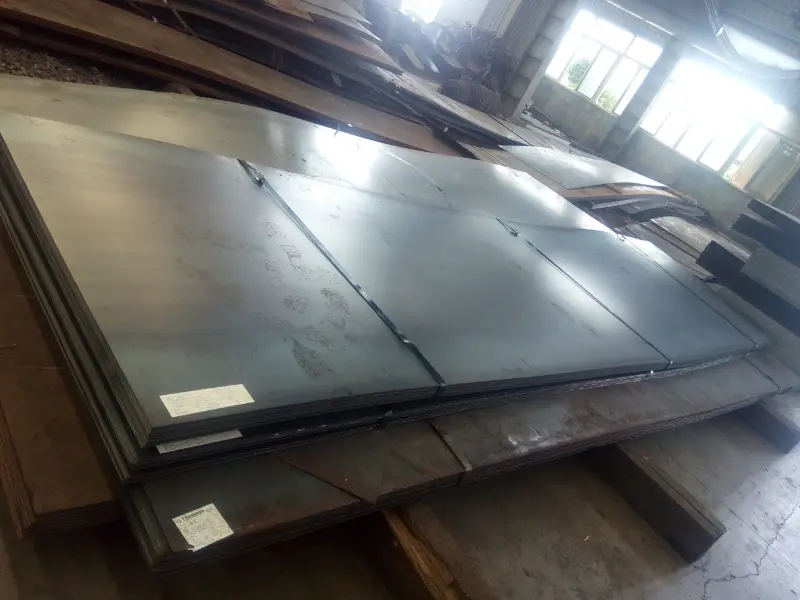
BV Grade F690 Shipbuilding Steel Plate
BV Grade F690 Shipbuilding Steel Plate – 690 MPa Quenched & Tempered Marine Steel
Explore chemical composition, mechanical properties, and applications of BV Grade F690 quenched and tempered shipbuilding steel plate. Certified by Bureau Veritas, minimum yield strength 690 MPa, excellent toughness at -60°C.
Hot rolling, Quenching and Tempering (Q&T)
- Phone : +8618037372205
- Email : [email protected]
- WhatsApp: Contact via Whtsapp
- WeChat: +8618037372205
BV Grade F690 Shipbuilding Steel Plate Introduction
BV Grade F690 is a high-strength quenched and tempered (Q&T) structural steel plate certified by Bureau Veritas (BV) for shipbuilding and offshore engineering. It belongs to the F690 series with a minimum yield strength of 690 MPa and guaranteed impact toughness at -60°C (F-grade). This steel offers an excellent combination of high strength, good weldability, and superior fracture toughness, making it ideal for critical components in harsh marine environments. Typical applications include heavy-lift ship hulls, jack-up rig legs, crane booms, and pressure vessels. The steel is produced by controlled rolling followed by quenching and tempering to achieve the desired mechanical properties. Plate thickness can reach up to 150 mm, with slight reduction in yield strength for thicker sections. BV F690 is fully compliant with BV Rules for Steel Ships, Part 2, and can be delivered with additional certifications such as NACE, CTOD, or pre-production qualification testing upon request.
BV Grade F690 Shipbuilding Steel Plate Chemical Composition
The chemical composition of BV F690 steel is strictly controlled to ensure high strength and good weldability. The maximum allowable limits for key elements are specified in BV Rules. Optionally, microalloying elements such as Nb, V, and Ti are added to refine grain size and improve toughness. Carbon equivalent (CEV) is usually limited to 0.50–0.55 for typical plate thickness to guarantee weldability.
| Element | Standard Value (wt%, max unless range) | Remarks |
|---|---|---|
| C | ≤ 0.20 | Lower carbon improves weldability |
| Si | ≤ 0.80 | Deoxidizer, contributes to strength |
| Mn | ≤ 1.70 | Grain refinement and strength |
| P | ≤ 0.025 | Maximizes toughness |
| S | ≤ 0.015 | Strictly controlled for cleanliness |
| Cr | ≤ 2.00 | Hardenability element |
| Ni | ≤ 2.00 | Improves low-temperature toughness |
| Mo | ≤ 1.00 | Enhances hardenability and creep resistance |
| Cu | ≤ 0.50 | Weathering resistance (if requested) |
| Nb | ≤ 0.06 | Microalloy grain refiner |
| V | ≤ 0.12 | Precipitation strengthening |
| Ti | ≤ 0.05 | Grain size control |
| Altot | ≥ 0.020 | Aluminum content for fine grain practice |
| N | ≤ 0.012 | Prevention of strain aging |
BV Grade F690 Shipbuilding Steel Plate Thermal and Electrical Physical Properties
Physical properties are typical for quenched and tempered low-carbon structural steels. These values may vary slightly depending on exact heat treatment and tempering temperature, but serve as reliable design data for thermal and electrical analysis.
| Property | Typical Value | Unit | Test Condition |
|---|---|---|---|
| Density (ρ) | 7850 | kg/m³ | At 20°C |
| Modulus of Elasticity (E) | 205 - 210 | GPa | At 20°C |
| Shear Modulus (G) | approx. 80 | GPa | At 20°C, calculated from E and ν |
| Poisson's Ratio (ν) | 0.3 | - | At 20°C, elastic range |
| Thermal Expansion Coefficient (α) | 11.5 × 10⁻⁶ | /K | Between 20°C and 100°C |
| Thermal Expansion Coefficient (α) | 12.3 × 10⁻⁶ | /K | Between 20°C and 300°C |
| Thermal Conductivity (λ) | 42 - 48 | W/(m·K) | At 20°C |
| Specific Heat Capacity | 460 - 480 | J/(kg·K) | At 20°C |
| Electrical Resistivity (ρe) | 0.22 - 0.28 | μΩ·m | At 20°C |
BV Grade F690 Shipbuilding Steel Plate Mechanical Properties
Mechanical values are mandatory minimum requirements as per BV Rules. The yield strength depends on plate thickness, with thicker sections showing a slight reduction. Impact testing is performed on longitudinal Charpy V-notch specimens at -60°C. The plate also exhibits good ductility in bending tests with a specified bend diameter.
| Property | Standard Requirement | Unit | Test Condition |
|---|---|---|---|
| Yield Strength (ReH) | ≥ 690 | MPa | Thickness ≤ 50 mm, transverse |
| Yield Strength (ReH) | ≥ 670 | MPa | Thickness 50-100 mm, transverse |
| Yield Strength (ReH) | ≥ 630 | MPa | Thickness 100-150 mm, transverse |
| Tensile Strength (Rm) | 770 - 940 | MPa | All thickness, transverse |
| Elongation (A) | ≥ 14 | % | Gauge length 5.65√S₀, longitudinal |
| Charpy Impact Energy (KV) | ≥ 27 | J | -60°C, longitudinal, average of 3 |
| Bend Test (d = bend diameter, a = thickness) | no cracks | - | 180° bend, d = 4a for all thickness |
BV Grade F690 Shipbuilding Steel Plate Fully Equivalent Material Standards and Substitutable Grades
| Country/Region | Standard | Grade | Remarks |
|---|---|---|---|
| France/International | BV Rules Part 2 Ch 1 | F690 | Original BV grade, -60°C impact |
| Europe | EN 10025-6 | S690Q (+ option 30 for -60°C) | With additional BV certification and F-grade impact test |
| USA | ASTM A514/A514M | Grade Q (modified) | Requires supplementary S-requirements for -60°C impact and BV stamping |
| USA (ABS) | ABS Rules | FQ70 | Equivalent high-strength quenched and tempered hull structural steel |
| Norway/Germany (DNV GL) | DNVGL-OS-B101 | NV F690 | Fully equivalent under DNV GL classification |
| UK (LR) | Lloyd's Register Rules | LF690 | High strength steel with -60°C Charpy, equivalent properties |
BV Grade F690 Shipbuilding Steel Plate Application Introduction
BV F690 steel is specifically designed for welded structures subjected to heavy loads and severe marine environments. Its high strength-to-weight ratio allows for lighter designs and increased payload. The -60°C impact toughness guarantees safety in Arctic or cold-water operations. Typical applications include:
Product Applications: Hulls of ice-breakers, LNG carriers, and heavy-lift vessels, Jack-up rig legs, spudcans, and cantilever beams, Deck structures and crane pedestals on offshore platforms, Pressure vessels and storage tanks for shipboard use, Subsea frames and ROV handling systems
Processed into products: Windlass foundation and mooring brackets, Main girder and stiffener for ship hulls, Boom and arm sections of marine cranes, Turret mooring parts for FPSOs, Transverse and longitudinal frames in large tankers
Application industries: Shipbuilding and marine engineering, Offshore oil and gas exploration and production, Heavy machinery and lifting equipment, Renewable energy (offshore wind substructures), Port and harbor infrastructure
BV Grade F690 Shipbuilding Steel Plate Similar or Approximate Substitute Materials
| Country/Region | Standard | Grade | Remarks |
|---|---|---|---|
| Europe | EN 10025-6 | S690QL / S690QL1 | Higher toughness, delivery condition Q&T. Impact test at -40°C only, need to verify if -60°C can be ordered. |
| USA | ASTM A514 | Grade B, H, F | Quenched and tempered alloy steel plates with min 690 MPa YS. Impact properties vary, usually not as stringent as -60°C without special agreement. |
| Japan | JIS G 3128 | SHY685 / SHY70 | High yield strength steel for welded structures. Equivalent strength but requires separate BV approval. |
| China | GB/T 16270 | Q690D/E/F | High strength structural steel, Q690F with -60°C impact can be a rough alternative, but must be processed under ship classification rules. |
| International | API 2Y / 2W | Grade 60 (690 MPa YS) | Offshore structural steel plates, specification similar but needs BV supplementary testing. |
Notes:
BV F690 plates are normally supplied with BV surveyor's inspection and 3.2 certification according to EN 10204. Weldability: Preheating (typically 100–150°C) and low-hydrogen welding consumables are recommended. Post-weld heat treatment (PWHT) may be required for thick sections; however, mechanical properties after PWHT must be verified. Dimensional and surface tolerances comply with BV Rules or EN 10029 Class C. Optional testing includes: ultrasonic examination per EN 10160 Class S2E3, through-thickness tensile (Z35), and corrosion testing. The carbon equivalent (CEV) is normally limited to 0.50–0.55 to ensure good field weldability.
- Share



