
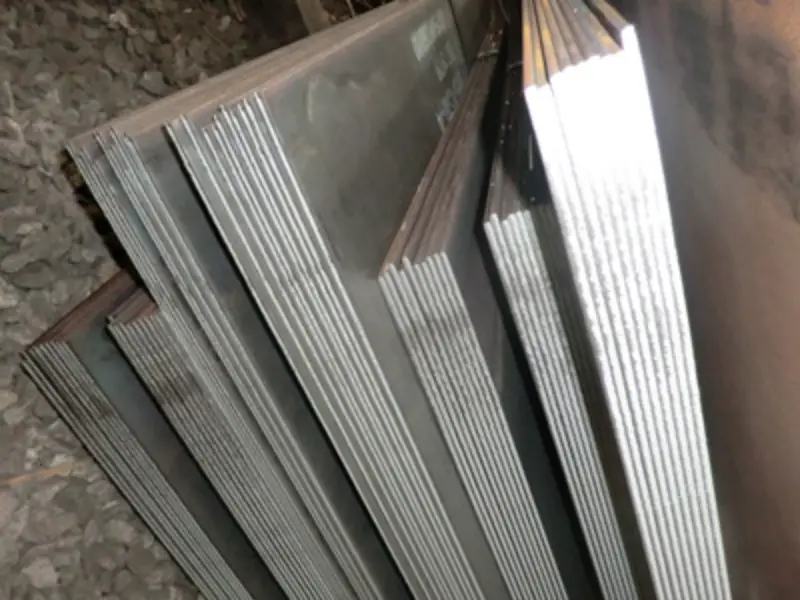
GL Grade A Shipbuilding Steel Plate
GL Grade A Shipbuilding Steel Plate: Complete Material Data & International Equivalents
Expert material data sheet for GL Grade A shipbuilding steel plate per GL rules. Includes chemical composition, mechanical properties, physical properties, international equivalents, similar materials, and application guide.
Hot rolling, normalizing, cold forming, welding, cutting, bending
- Phone : +8618037372205
- Email : [email protected]
- WhatsApp: Contact via Whtsapp
- WeChat: +8618037372205
GL Grade A Shipbuilding Steel Plate Introduction
GL Grade A is an ordinary strength hull structural steel plate defined by Germanischer Lloyd (GL) classification society. This grade is widely used in shipbuilding for general structures like decks, bulkheads, and stiffeners. It offers minimum yield strength of 235 MPa and good weldability with a controlled carbon equivalent. The steel is typically supplied in normalized or as-rolled condition, meeting strict requirements for low-temperature toughness when thickness exceeds certain limits. This data sheet provides authoritative typical values based on GL rules and IACS UR W11, ensuring reliable material selection.
GL Grade A Shipbuilding Steel Plate Chemical Composition
Requirements according to GL Rules 2019 Part 2, Chapter 1, Section 2, Table 2.1 for Grade A. Elements not listed are residual (max 0.35% each for Cu, Cr, Ni, Mo). Total residuals not to exceed 0.70%. For silicon-killed steels, acid soluble aluminum minimum 0.015% may be specified. Carbon equivalent (CEV) often limited to ≤0.40% for improved weldability.
| Element | Standard Value | Remarks |
|---|---|---|
| C | ≤ 0.21 | Ladle analysis |
| Mn | ≥ 2.5 × C, usually 0.5 – 1.4 | Min. 0.5% for thickness ≤ 50 mm; for higher thickness, Mn may be increased |
| Si | ≤ 0.50 | If required, silicon-killed |
| P | ≤ 0.035 | |
| S | ≤ 0.035 | |
| Al (acid sol.) | ≥ 0.015 | When silicon-killed and specially ordered |
| Cu | ≤ 0.35 | Residual |
| Cr | ≤ 0.35 | Residual |
| Ni | ≤ 0.35 | Residual |
| Mo | ≤ 0.35 | Residual |
| Ceq (CEV) | ≤ 0.40 (typical) | Calculated as C + Mn/6 + (Cr+Mo+V)/5 + (Ni+Cu)/15, often guaranteed for weldability |
GL Grade A Shipbuilding Steel Plate Thermal and Electrical Physical Properties
Typical physical properties for mild steel similar to Grade A. These values are not guaranteed by GL rules but are representative for design calculations. Density may vary slightly with alloy content. Thermal conductivity decreases with increasing temperature.
| Property | Standard Value | Unit | Test Condition |
|---|---|---|---|
| Density (ρ) | 7850 | kg/m³ | at 20°C |
| Elastic Modulus (E) | 200 – 210 | GPa | at 20°C, static |
| Shear Modulus (G) | 75 – 80 | GPa | at 20°C, calculated |
| Poisson's Ratio (ν) | 0.27 – 0.30 | – | elastic range |
| Thermal Expansion Coefficient (α) | 11.5 – 12.5 | ×10⁻⁶/K | 20–100°C |
| Thermal Conductivity (λ) | 50 – 55 | W/(m·K) | at 20°C |
| Specific Heat Capacity | 460 – 500 | J/(kg·K) | at 20°C |
| Electrical Resistivity (ρ_e) | 0.15 – 0.20 | Ω·mm²/m | at 20°C (0.15–0.20 ×10⁻⁶ Ω·m) |
GL Grade A Shipbuilding Steel Plate Mechanical Properties
Mechanical properties per GL Rules for thickness ranges up to 100 mm. Tensile test specimens taken transverse to rolling direction. For plate thickness >100 mm, consult GL materials rules; typically yield strength reduces to min 215 MPa. Grade A does not require impact testing for thickness ≤50 mm in general applications. For thickness >50–70 mm, impact test at 0°C min. average 27 J may be required; for >70–100 mm at 0°C min 27 J. These requirements can vary based on ship design and class notations. Elongation values based on gauge length 5.65√So (A5).
| Property | Standard Value | Unit | Test Condition |
|---|---|---|---|
| Yield Strength (ReH) | ≥ 235 | MPa | thickness ≤ 100 mm, transverse |
| Tensile Strength (Rm) | 400 – 520 | MPa | thickness ≤ 100 mm, transverse |
| Elongation (A5) | ≥ 22 | % | thickness ≤ 50 mm, gauge length 5.65√So |
| Elongation (A5) | ≥ 21 | % | thickness > 50 and ≤ 70 mm |
| Elongation (A5) | ≥ 20 | % | thickness > 70 and ≤ 100 mm |
| Impact Energy (KV) | ≥ 27 (avg.) | J | at 0°C, longitudinal, thickness > 50 mm (typical) – where required |
| Bend Test (mandrel dia.) | No cracks | – | Bend 180°, mandrel diameter 3t (t=thickness) for t ≤ 50 mm |
GL Grade A Shipbuilding Steel Plate Identical Materials: Standard Equivalents & Substitute Grades
These classification society grades are functionally identical to GL Grade A according to IACS Unified Requirement W11. They can be directly substituted in shipbuilding applications subject to the respective society's approval.
| Country / Region | Standard / Society | Grade | Remarks |
|---|---|---|---|
| USA | ABS Rules | Grade A | American Bureau of Shipping |
| UK | LR Rules | Grade A | Lloyd's Register |
| Norway | DNV Rules | Grade A | DNV (now DNV GL) |
| France | BV Rules | Grade A | Bureau Veritas |
| China | CCS Rules | Grade A | China Classification Society |
| Japan | NK Rules | Grade A | Nippon Kaiji Kyokai (ClassNK) |
| South Korea | KR Rules | Grade A | Korean Register |
| Italy | RINA Rules | Grade A | Registro Italiano Navale |
| Russia | RMRS Rules | Grade A | Russian Maritime Register of Shipping |
GL Grade A Shipbuilding Steel Plate Application Introduction
GL Grade A is primarily intended for ordinary strength hull structures in ships and offshore units. It is suitable for welding and forming operations typical in shipyards. The steel is often used where no special low-temperature toughness is required for base material below 50 mm thickness. The following lists illustrate common applications.
Product Applications: Merchant vessels (bulk carriers, tankers, container ships), Passenger ships (in secondary structures), Floating cranes and dredgers, Barges and pontoons, Offshore substructures (non-critical)
Processed into products: Hull plates and shell plating, Decks and deckhouses, Bulkheads and inner bottoms, Web frames and longitudinals, Stiffeners and brackets, Hatch coamings and covers, Engine room structural elements, Rudders and rudder horns (subject to class approval)
Application industries: Shipbuilding and ship repair, Offshore oil & gas (platform topsides, jackets if classed), Marine engineering, Barge and floating dock construction, Port and harbor machinery
GL Grade A Shipbuilding Steel Plate Similar / Approximate Substitute Materials
These grades are not identical but can be considered for non-marine structural applications where class approval is not required. Always verify chemical composition and mechanical properties against the specific project specification.
| Country / Region | Standard | Grade | Remarks |
|---|---|---|---|
| International | ISO 630-2 | S235 J0 (or J2) | Structural steel with similar min. yield 235 MPa; additional toughness requirements may differ. |
| Europe | EN 10025-2 | S235JR / S235J0 | Typical structural carbon steel; may have higher S, P limits, and no formal marine approval. |
| China | GB/T 700 | Q235B | Similar strength grade; not classed for shipbuilding unless certified. |
| USA | ASTM A131 / A131M | Grade A | Standard specification for structural steel for ships; identical in properties to GL Grade A. |
Notes:
Supply condition: Plates can be delivered as-rolled, normalized, or thermomechanically rolled as per GL rules. Surface condition: EN 10163-2 Class A, sub-class 2 typically. Internal soundness tested by ultrasonic to EN 10160 requirements when specified. Welding: All common shipyard welding processes (SAW, GMAW, SMAW) are applicable with appropriate consumables matching the strength level and carbon equivalent. Preheating is rarely needed for thickness under 30 mm if CEV ≤0.40%. Corrosion: Not inherently corrosion-resistant; coatings or cathodic protection required for seawater immersion.
- Share



