
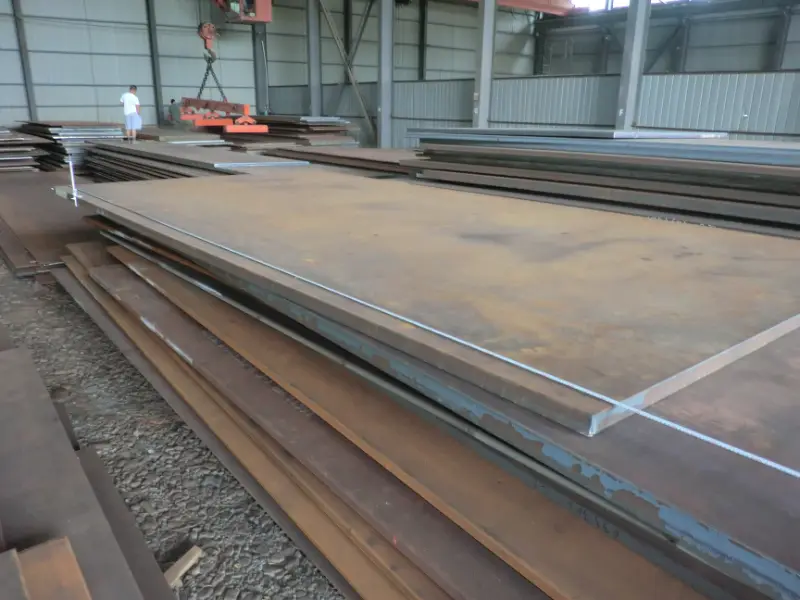
GL Grade B Shipbuilding Steel Plate
GL Grade B Shipbuilding Steel Plate: Complete Datasheet & International Equivalents
Comprehensive material data for GL Grade B shipbuilding steel plate according to Germanischer Lloyd (DNV GL) rules and IACS UR W11. Includes chemical composition, mechanical, thermal and electrical physical properties, complete international equivalents, alternative materials, and detailed application guide.
Cutting, welding, bending, forming, drilling
- Phone : +8618037372205
- Email : [email protected]
- WhatsApp: Contact via Whtsapp
- WeChat: +8618037372205
GL Grade B Shipbuilding Steel Plate Introduction
GL Grade B is a normal strength shipbuilding structural steel plate covered by the rules of Germanischer Lloyd (now part of DNV GL) and fully conforming to the IACS unified requirement UR W11. It delivers a minimum yield strength of 235 MPa over a wide range of plate thicknesses and exhibits excellent weldability, moderate toughness and good forming characteristics. The chemical composition is controlled to ensure a fine‑grained microstructure, principally through aluminium additions. Typical delivery condition is hot‑rolled, normalised or thermomechanically controlled processed (TMCP). This grade is widely applied for hull structural members, decks, bulkheads and offshore components, where reliable low‑temperature impact properties at 0 °C are mandated. The plate can be processed with standard shipyard techniques including cutting, bending, welding and flame straightening.
GL Grade B Shipbuilding Steel Plate Chemical Composition
The chemical composition of GL Grade B steel complies with IACS UR W11 for Grade B. Limits for carbon, phosphorus and sulfur are kept low to ensure good weldability and toughness. Aluminium is required for fine‑grain practice. Residual elements are controlled to avoid detrimental effects on hot ductility and mechanical properties. Actual values shall be reported by the manufacturer on the test certificate.
| Chemical Element | Standard Value (max unless indicated) | Remarks |
|---|---|---|
| C | ≤ 0.21 | All thicknesses |
| Mn | ≥ 0.80 (≥ 2.5 × C, min 0.80) | Fine‑grain strengthening |
| Si | ≤ 0.50 | Deoxidation |
| P | ≤ 0.035 | Low for toughness |
| S | ≤ 0.035 | Low for ductility |
| Al (acid soluble) | ≥ 0.015 | Grain refinement; total Al ≥ 0.020 if used |
| Cu (residual) | ≤ 0.35 | From scrap |
| Cr (residual) | ≤ 0.20 | From scrap |
| Ni (residual) | ≤ 0.40 | From scrap |
| Mo (residual) | ≤ 0.08 | From scrap |
GL Grade B Shipbuilding Steel Plate Thermal and Electrical Physical Properties
Physical properties are typical values for carbon‑manganese structural steel similar to GL Grade B and can be used for engineering calculations. Actual values may vary depending on exact composition and processing. These properties are not part of the classification standard but are based on published data for shipbuilding steels.
| Performance Item | Standard Required Value | Unit | Test Condition |
|---|---|---|---|
| Density (ρ) | 7850 | kg/m³ | At 20 °C |
| Modulus of Elasticity (E) | 205 | GPa | At 20 °C |
| Shear Modulus (G) | 80 | GPa | At 20 °C |
| Poisson's Ratio (ν) | 0.3 | – | At 20 °C |
| Thermal Expansion Coefficient (α) | 11.5 × 10⁻⁶ | 1/K | 20 – 100 °C |
| Thermal Expansion Coefficient (α) | 12.0 × 10⁻⁶ | 1/K | 20 – 200 °C |
| Thermal Conductivity (λ) | 51.9 | W/(m·K) | At 20 °C |
| Specific Heat Capacity (c) | 486 | J/(kg·K) | At 20 °C |
| Electrical Resistivity (ρ_e) | 0.15 | Ω·mm²/m | At 20 °C |
GL Grade B Shipbuilding Steel Plate Mechanical Properties
Mechanical properties are determined in accordance with IACS UR W11 for Grade B. Tensile testing is performed transverse or longitudinal as agreed. The yield strength is defined as the upper yield point (ReH) or 0.2% proof strength, and the tensile strength range applies up to 100 mm thickness. Elongation is measured on a gauge length of 5.65√So (A5). Charpy V‑notch impact testing is carried out at 0 °C; minimum average energy and single value requirements are given.
| Performance Item | Standard Required Value | Unit | Test Condition / Thickness |
|---|---|---|---|
| Yield Strength (ReH) | ≥ 235 | MPa | t ≤ 100 mm (transverse or longitudinal) |
| Tensile Strength (Rm) | 400 – 520 | MPa | t ≤ 100 mm (transverse or longitudinal) |
| Elongation (A5, gauge length 5.65√So) | ≥ 22 | % | t ≤ 50 mm |
| Elongation (A5) | ≥ 21 | % | 50 < t ≤ 70 mm |
| Elongation (A5) | ≥ 20 | % | 70 < t ≤ 100 mm |
| Bend Test (180°) | d = 3t | – | t ≤ 50 mm; no cracks |
| Bend Test (180°) | d = 4t | – | 50 < t ≤ 70 mm; no cracks |
| Bend Test (180°) | d = 5t | – | 70 < t ≤ 100 mm; no cracks |
| Charpy V‑notch Impact Energy (KV, longitudinal) | ≥ 27 (average) / ≥ 19 (single) | J | Test temperature 0 °C; t ≤ 100 mm |
| Charpy V‑notch Impact Energy (KV, transverse) | ≥ 20 (average) / ≥ 14 (single) | J | Test temperature 0 °C; t ≤ 100 mm |
GL Grade B Shipbuilding Steel Plate Fully Equivalent Material Standards & Interchangeable Grades
| Country / Region | Standard / Society | Equivalent Grade | Remarks |
|---|---|---|---|
| International | IACS | Grade B | Unified Requirement W11, basis for GL Grade B |
| USA | ABS | Grade B | American Bureau of Shipping |
| France | BV | Grade B | Bureau Veritas |
| China | CCS | Grade B | China Classification Society |
| Norway / Germany | DNV GL | Grade B | Merged classification society (former DNV and GL) |
| United Kingdom | LR | Grade B | Lloyd's Register |
| Japan | NK (ClassNK) | Grade B | Nippon Kaiji Kyokai |
| Italy | RINA | Grade B | Registro Italiano Navale |
| South Korea | KR | Grade B | Korean Register |
| Russia | RMRS | Grade B | Russian Maritime Register of Shipping |
GL Grade B Shipbuilding Steel Plate Application Introduction
GL Grade B is intended for welded ship hulls and marine structures where moderate strength and good weldability are required. It can be used for both longitudinal and transverse members, decks and shell plating exposed to ambient and moderately low temperatures. Standard shipyard fabrication processes such as hot forming, cold bending, plasma cutting and submerged arc welding are readily applicable. Prior to fabrication, the material can be normalised or delivered in TMCP condition to optimise toughness. Designers should note the thickness‑dependent elongation and bend test parameters when specifying plate.
Product Applications: Ship hull plates and sections, Offshore platform structural decks and legs, Barge bottom, side and deck plating, Floating docks and pontoons, Caissons and sheet piling for marine works
Processed into products: Hull shell plating (side, bottom, deck), Bulkheads and watertight doors, Longitudinal stiffeners and stringers, Transverse webs and frames, Brackets and tripping stiffeners, Rudder and skeg plates, Main deck and superstructure plating, Internals of ballast and fuel tanks
Application industries: Shipbuilding, Offshore Engineering, Marine Construction, Barge and Dredger Building, Port and Coastal Infrastructure
GL Grade B Shipbuilding Steel Plate Similar / Comparable Alternative Materials
| Country / Region | Standard | Grade | Remarks |
|---|---|---|---|
| Europe | EN 10025‑2:2004 | S235JR | Comparable strength (min 235 MPa), but not certified for marine use; impact only at +20 °C |
| USA | ASTM A36/A36M | A36 | Similar yield (250 MPa) and tensile range, but different impact requirements; not a shipbuilding grade |
| China | GB/T 700 | Q235B | General structural steel, comparable strength; no classification society approval for hull construction |
| Japan | JIS G3101 | SS400 | Common structural steel, tensile 400‑510 MPa, no toughness guarantee at low temperatures |
Notes:
The steel shall be delivered with inspection documents to EN 10204 type 3.1 or 3.2 as required by the classification society. Ultrasonic testing according to class rules may be additionally specified. Post‑weld heat treatment is not generally required for this grade. The DNV GL merger means current orders may reference DNV GL Grade B, which is identical to the former GL Grade B. For thicknesses above 100 mm, higher strength or special grades are normally mandated by the classification society.
- Share



