
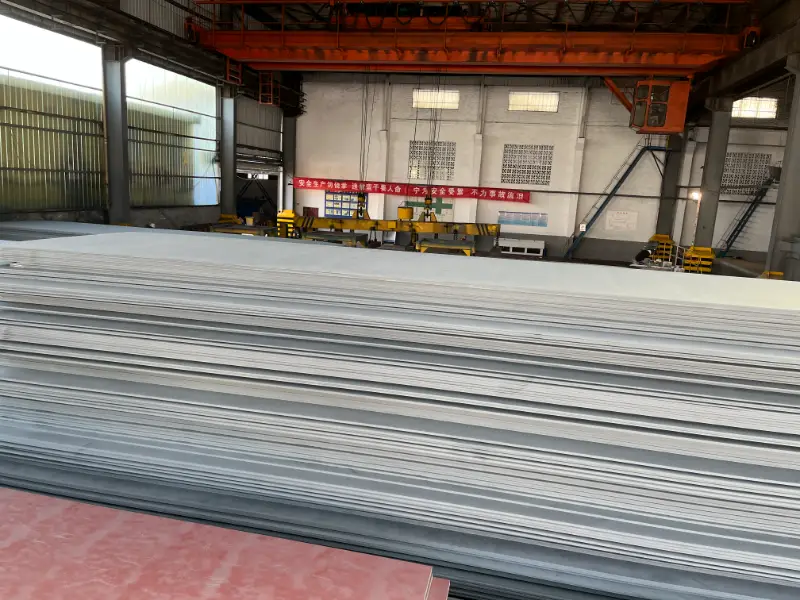
GL Grade D Shipbuilding Steel Plate
GL Grade D Shipbuilding Steel Plate - Material Data, Equivalent Grades & Applications
Detailed chemical composition, mechanical and physical properties of GL Grade D shipbuilding steel plate per GL rules. Includes international equivalents, similar materials, and application guidance.
Welding, bending, forming, machining, cutting, rolling
- Phone : +8618037372205
- Email : [email protected]
- WhatsApp: Contact via Whtsapp
- WeChat: +8618037372205
GL Grade D Shipbuilding Steel Plate Introduction
GL Grade D is a normal-strength shipbuilding steel plate governed by the classification society Germanischer Lloyd (now part of DNV GL). It is widely used in hull structures and marine constructions requiring moderate strength and good low-temperature toughness. This grade offers a minimum yield point of 235 MPa and is designed for service temperatures down to -20°C. With controlled chemical composition and fine grain practice, GL Grade D provides reliable weldability and formability. Key features:
- Good low-temperature impact toughness (27J at -20°C)
- Typical tensile strength 400–520 MPa
- Easy to weld and form
GL Grade D Shipbuilding Steel Plate Chemical Composition
The chemical composition of GL Grade D is controlled to ensure proper mechanical properties and weldability. Carbon equivalent is typically limited to avoid cold cracking. Note: The following values are typical per GL Rules. For thicknesses above 50 mm, slightly modified requirements may apply.
| Element | Standard Value | Remarks |
|---|---|---|
| Carbon (C) | ≤0.21 | Max |
| Manganese (Mn) | ≥2.5×C and ≤1.50 | If CEV required |
| Silicon (Si) | ≤0.50 | Max |
| Phosphorus (P) | ≤0.035 | Max |
| Sulfur (S) | ≤0.035 | Max |
| Aluminium (Al) (acid soluble) | ≥0.015 | If fine grain required |
| Carbon equivalent (CEV) | ≤0.40 (typical) | CEV = C + Mn/6 + (Cr+Mo+V)/5 + (Ni+Cu)/15 |
GL Grade D Shipbuilding Steel Plate Physical Properties
Physical properties are typical for carbon-manganese structural steels and can vary slightly with composition and processing.
| Property | Value | Unit | Test Condition |
|---|---|---|---|
| Density (ρ) | 7.85 | g/cm³ | 20°C |
| Modulus of elasticity (E) | 205 – 210 | GPa | 20°C |
| Shear modulus (G) | 79 – 81 | GPa | 20°C |
| Poisson's ratio (ν) | 0.29 – 0.30 | 20°C | |
| Thermal expansion (α) | 11.5 – 12.5 | 10⁻⁶/K | 20–100°C |
| Thermal conductivity (λ) | 45 – 52 | W/(m·K) | 20°C |
| Specific heat capacity | 460 – 500 | J/(kg·K) | 20°C |
| Electrical resistivity (ρₑ) | 0.15 – 0.25 | Ω·mm²/m | 20°C |
GL Grade D Shipbuilding Steel Plate Mechanical Properties
Mechanical properties are determined on transverse test pieces for plates. Impact test specimens are taken longitudinally or transversely as per specification. KV is minimum average energy absorbed on ISO V-notch specimens.
| Property | Value | Unit | Test Condition |
|---|---|---|---|
| Yield strength (ReH) | ≥235 | MPa | Ambient temperature |
| Tensile strength (Rm) | 400 – 520 | MPa | Ambient temperature |
| Elongation (A) | ≥22 | % | Gauge length 5.65√S₀ |
| Impact energy (KV) | ≥27 | J | Longitudinal, -20°C |
| Impact energy (KV) | ≥20 | J | Transverse, -20°C |
| Bend test | No cracks | 180° bend, d=3t (t=thickness) |
GL Grade D Shipbuilding Steel Plate Exact Equivalent Grades from Other Classification Societies
| Country/Region | Standard | Grade | Remarks |
|---|---|---|---|
| International | DNV GL | Grade D | Unified DNV GL rules |
| USA | ABS | Grade D | ABS Rules |
| France | BV | Grade D | BV Rules |
| China | CCS | Grade D | CCS Rules |
| UK | LR | Grade D | Lloyd's Register |
| Japan | NK (ClassNK) | Grade D | ClassNK Rules |
| South Korea | KR | Grade D | Korean Register |
| Italy | RINA | Grade D | RINA Rules |
| Norway | DNV (historical) | Grade D |
GL Grade D Shipbuilding Steel Plate Application Introduction
GL Grade D steel is primarily employed in shipbuilding and marine engineering where reliable toughness at sub-zero temperatures is required. It is suitable for hull plates, stiffeners, and structural members. Main application areas:
- Commercial ships: bulk carriers, tankers, container vessels
- Naval vessels and patrol boats
- Offshore structures: platforms, jackets, and modules
- Port equipment and ship unloaders
Product Applications: Hull plates, Deck plates, Bulkhead plates, Stiffeners, Girders, Web frames, Floors, Transverse frames, Barges, Offshore platform structures
Processed into products: Ship hull shell, Deck panels, Bulkhead sections, Reinforcing plates, Bracket plates, Foundation plates, Bilge keels
Application industries: Shipbuilding, Marine & Offshore, Structural Engineering, Port & Harbor Construction, Heavy Equipment Manufacturing
GL Grade D Shipbuilding Steel Plate Similar Structural Steels for General Engineering
| Country/Region | Standard | Grade | Remarks |
|---|---|---|---|
| European Union | EN 10025-2 | S235J0 | Equivalent mechanical properties, impact at 0°C; not marine certified |
| European Union | EN 10025-2 | S235J2 | Impact at -20°C; close toughness requirement |
| Germany | DIN 17100 | St37-3 U | Older standard, comparable |
| USA | ASTM A36 / A36M | A36 | Similar strength, no impact requirement |
| USA | ASTM A131 / A131M | Grade D | Shipbuilding steel direct equivalent |
Notes:
For thicknesses above 50 mm, the yield stress may be reduced to 215 MPa. Actual properties are subject to the specific GL Rule edition. Manufacturers can provide test certificates. CEV must not exceed 0.40% for thickness >25 mm unless special welding procedure is used.
- Share



