
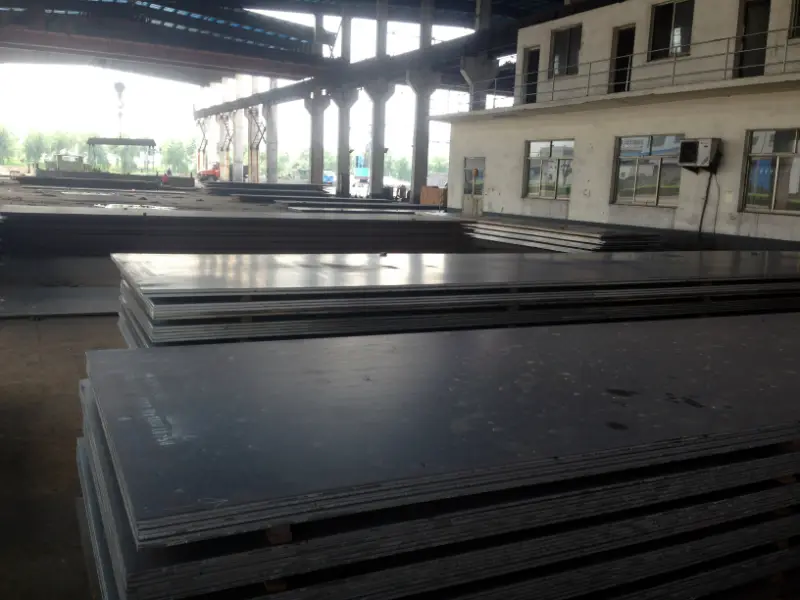
KR Grade A32 Shipbuilding Steel Plate
KR Grade A32 Shipbuilding Steel Plate - High Strength Hull Structural Steel
Explore KR Grade A32 shipbuilding steel plate properties: chemical composition, mechanical and thermal performance, international equivalents, and typical applications in hull structures and offshore engineering.
Hot rolling, controlled rolling, normalizing, thermo-mechanical control process (TMCP) as applicable; suitable for cutting, cold forming, welding
- Phone : +8618037372205
- Email : [email protected]
- WhatsApp: Contact via Whtsapp
- WeChat: +8618037372205
KR Grade A32 Shipbuilding Steel Plate Introduction
KR Grade A32 is a high-strength hull structural steel certified by the Korean Register of Shipping (KR). It is designed for shipbuilding and offshore structures, offering a minimum yield strength of 315 MPa and good notch toughness at 0°C. Main characteristics include excellent weldability, reliable low-temperature impact performance, and consistent strength-thickness profiles. The steel is microalloyed with elements such as niobium, vanadium, or titanium to achieve fine grain size and enhanced mechanical properties. It conforms to the IACS Unified Requirement W11 for normal and high strength hull structural steels. Delivery condition is usually normalized or controlled rolled, and it can be supplied as plates, sheets, and wide flats. Typical thickness range is up to 100 mm, with guaranteed Charpy V-notch impact energy of at least 31 J at 0°C in longitudinal direction.
KR Grade A32 Shipbuilding Steel Plate Chemical Composition
The chemical composition conforms to KR Rules and IACS UR W11 for Grade A32.
- Microalloying elements like Nb, V, Ti may be added singly or in combination to attain the required strength and notch toughness.
- Aluminum is used as grain refiner; acid-soluble aluminum content is typically 0.015% minimum if agreed.
- Carbon equivalent (CEV) is commonly controlled to ensure weldability, with typical maximum CEV of 0.38% depending on thickness.
| Element | Value (max / range) | Remarks |
|---|---|---|
| Carbon (C) | ≤ 0.18% | Heat analysis |
| Silicon (Si) | ≤ 0.50% | Heat analysis |
| Manganese (Mn) | 0.90 – 1.60% | Heat analysis |
| Phosphorus (P) | ≤ 0.035% | Heat analysis |
| Sulfur (S) | ≤ 0.035% | Heat analysis |
| Aluminum (Al, acid soluble) | ≥ 0.015% (if specified) | Optional grain refining element |
| Niobium (Nb) | 0.02 – 0.05% | Optional microalloy |
| Vanadium (V) | 0.05 – 0.10% | Optional microalloy |
| Titanium (Ti) | ≤ 0.02% | Optional microalloy; typical 0.008–0.02% |
| Nitrogen (N) | ≤ 0.009% (if not Al-killed) | If no Al addition or other binding elements |
| Copper (Cu) | ≤ 0.35% | Residual element |
| Chromium (Cr) | ≤ 0.20% | Residual element |
| Nickel (Ni) | ≤ 0.40% | Residual element |
| Molybdenum (Mo) | ≤ 0.08% | Residual element |
KR Grade A32 Shipbuilding Steel Plate Thermal and Electrical Physical Properties
The following physical properties are typical for normalized or TMCP A32 steel at ambient temperature. Values may vary slightly with exact chemistry and heat treatment condition. These are not mandatory requirements but are widely accepted engineering references.
| Property | Typical Value | Unit | Condition / Reference Temperature |
|---|---|---|---|
| Density (ρ) | 7.85 | g/cm³ | Room temperature (20°C) |
| Young's Modulus (E) | 205 | GPa | Room temperature |
| Shear Modulus (G) | 80 | GPa | Calculated from E and Poisson's ratio |
| Poisson's Ratio (ν) | 0.29 | — | Room temperature |
| Thermal Expansion Coefficient (α) | 12.0 × 10⁻⁶ | K⁻¹ | Mean value between 20°C and 100°C |
| Thermal Expansion Coefficient (α) | 12.5 × 10⁻⁶ | K⁻¹ | Mean value between 20°C and 200°C |
| Thermal Expansion Coefficient (α) | 13.5 × 10⁻⁶ | K⁻¹ | Mean value between 20°C and 400°C |
| Thermal Conductivity (λ) | 51 | W/(m·K) | At 20°C |
| Thermal Conductivity (λ) | 48 | W/(m·K) | At 200°C |
| Thermal Conductivity (λ) | 42 | W/(m·K) | At 400°C |
| Specific Heat Capacity (cp) | 460 – 480 | J/(kg·K) | Room temperature |
| Electrical Resistivity (ρe) | 0.20 – 0.25 | Ω·mm²/m | At 20°C |
KR Grade A32 Shipbuilding Steel Plate Mechanical Properties
Mechanical properties are stipulated for normalized, controlled rolled, or TMCP conditions in accordance with KR Rules.
- Tensile testing is performed on flat test pieces taken in the transverse direction for plates; longitudinal test values are typically slightly higher.
- Charpy V-notch impact tests are conducted at 0°C for Grade A32; the absorbed energy is guaranteed in longitudinal direction and often verified for transverse specimens.
- Bend test is carried out without cracking up to 180° around a mandrel of specified diameter.
| Property | Required Value | Unit | Test Condition / Remarks |
|---|---|---|---|
| Upper Yield Strength (ReH) | ≥ 315 | MPa | Room temperature, thickness ≤ 100 mm |
| Tensile Strength (Rm) | 440 – 590 | MPa | Room temperature, for all thicknesses |
| Elongation after fracture (A) | ≥ 22 | % | Gauge length 5.65√S0 (5d) for thickness ≤ 50 mm; ≥ 22% for t ≤ 50 mm; for thicker plates, minimum may reduce (e.g., 22% for t > 50 to 70 mm, 21% for t > 70 mm) |
| Bend Test (Bend angle 180°) | No cracks or ruptures | — | Mandrel diameter d = 3t (t = specimen thickness) for tensile strength < 520 MPa; d = 4t for Rm ≥ 520 MPa |
| Charpy V-notch Impact Energy (KV) at 0°C, longitudinal | ≥ 31 | J | Average of 3 tests; individual min. 22 J; applicable for thickness ≥ 6 mm |
| Charpy V-notch Impact Energy (KV) at 0°C, transverse | ≥ 24 | J | Average of 3 tests; individual min. 17 J (when transverse testing is required) |
KR Grade A32 Shipbuilding Steel Plate Exact Equivalent Standards and Replaceable Grades
| Country / Region | Standard / Classification Society | Grade Designation | Remarks |
|---|---|---|---|
| International | IACS UR W11 | A32 | IACS Unified Requirement; basis for all member societies |
| USA | ABS Rules | AH32 | American Bureau of Shipping – identical strength level and impact condition (0°C) |
| Norway / DNV | DNV Rules | AH32 | Identical to IACS A32 |
| UK | LR Rules | AH32 | Lloyd's Register |
| France | BV Rules | AH32 | Bureau Veritas |
| Italy | RINA Rules | AH32 | Registro Italiano Navale |
| China | CCS Rules | A32 | China Classification Society; same mechanical requirements |
| Japan | NK (ClassNK) Rules | AH32 | Nippon Kaiji Kyokai |
| South Korea | KR Rules | A32 | Korean Register – this standard grade |
| Russia | RMRS Rules | A32 | Russian Maritime Register of Shipping; equivalent grade |
| India | IRS Rules | AH32 | Indian Register of Shipping |
KR Grade A32 Shipbuilding Steel Plate Application Introduction
KR A32 steel is primarily used in the construction of sea-going ships and offshore structures. Its combination of moderate-high strength, good weldability, and guaranteed low-temperature toughness ensures reliable service in marine environments. Typical processing includes plasma cutting, submerged arc welding, and cold forming. It is frequently selected for critical structural parts where weight savings and high fatigue life are important.
Product Applications: Hull plates for bulk carriers, tankers, container ships, Decks and bottom shell plates, Longitudinal and transverse stiffeners, Watertight bulkheads and partitions, Hatch coamings and hatch covers, Offshore platform decks, legs, and bracings, Pile foundations for quay walls and jetties
Processed into products: Main deck panels, Bottom and side shell frames, Web frames and stringers, Stiffened panel sub-assemblies, Bracket plates and gussets, Boom and crane pedestal bases (if approved for dynamic loading), Transition piece flanges for wind turbine towers, Mooring system foundations
Application industries: Shipbuilding and ship repair, Offshore oil and gas platform construction, Marine engineering and harbor facilities, Heavy civil structures and bridges with marine exposure, Renewable energy offshore foundations (wind turbine jackets, transition pieces)
KR Grade A32 Shipbuilding Steel Plate Similar / Near-Equivalent Alternative Materials
| Country / Region | Standard | Grade | Remarks |
|---|---|---|---|
| International | IACS UR W11 | AH36 | Higher strength (yield ≥ 355 MPa), same impact test temperature 0°C; may substitute A32 with reduced thickness |
| International | IACS UR W11 | DH32 | Same strength as A32 but impact test at -20°C; suitable for colder service conditions |
| EU | EN 10025-3 | S355N/NL | Rolled structural steel with min. 355 MPa yield; similar toughness options, but not specifically marine certified |
| EU | EN 10025-4 | S355M/ML | TMCP structural steel; similar strength, may be used for marine applications with additional certification |
| USA | ASTM A131 / ABS | AH36 | Same toughness class (0°C), higher yield; interchangeable with thickness consideration |
| China | GB/T 712 | A32 | Chinese standard equivalent; identical IACS grade |
Notes:
Welding consumables: Low-hydrogen welding procedures are recommended; preheating is typically not required for moderate thicknesses, but may be considered for thick sections and high restraint. Certification: Plates are stamped with KR logo and grade symbol. Test frequency: Per KR Rules, tensile and impact tests are carried out per heat treatment lot and per 50 tons or fraction thereof. Surface quality: Complies with class standards; plates are normally descaled and primed if specified.
- Share



