
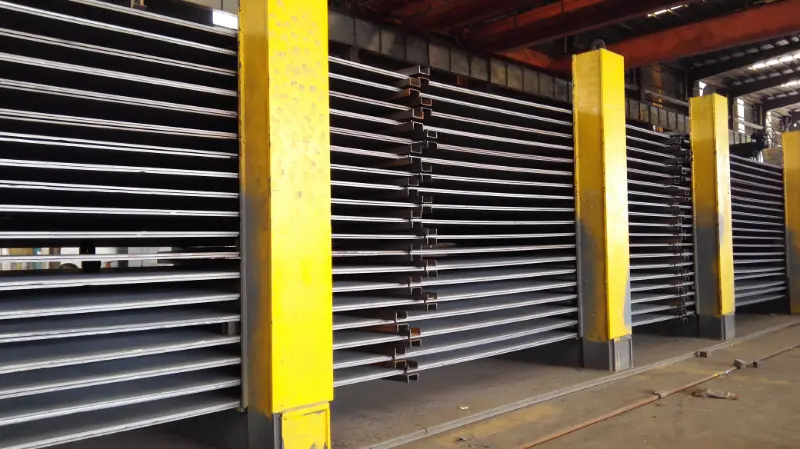
KR Grade D32 Shipbuilding Steel Plate
KR Grade D32 Shipbuilding Steel Plate: High-Strength Structural Steel for Marine Engineering
KR Grade D32 is a high-strength shipbuilding steel plate certified by the Korean Register of Shipping (KR), widely used in the construction of hulls and offshore structures with excellent low-temperature toughness.
Cutting, welding, bending, forming, and normalizing. Suitable for TMCP as an alternative to conventional normalizing treatment.
- Phone : +8618037372205
- Email : [email protected]
- WhatsApp: Contact via Whtsapp
- WeChat: +8618037372205
KR Grade D32 Shipbuilding Steel Plate Introduction
KR Grade D32 is a normalized or thermo-mechanical controlled processed (TMCP) shipbuilding steel plate classified under the high-strength structural steel category according to the Korean Register of Shipping rules. As a grade in the D series, it is designed to provide a minimum yield strength of 315 MPa and tensile strength ranging from 440 to 570 MPa. The 'D' designation indicates the capability to perform at temperatures as low as -20°C with guaranteed Charpy V-notch impact toughness. This steel offers an excellent balance of strength, weldability, and resistance to brittle fracture, making it suitable for critical structural applications in ship hulls, decks, and hull stiffeners. Its chemical composition is strictly controlled, with appropriate amounts of carbon, manganese, silicon, and microalloying elements such as niobium and vanadium to achieve the required mechanical properties. KR D32 is typically supplied in normalized or TMCP condition, ensuring uniform microstructure and consistent mechanical behavior.
KR Grade D32 Shipbuilding Steel Plate Chemical Composition
The chemical composition of KR Grade D32 steel plate is controlled according to the Korean Register of Shipping rules for high-strength hull structural steels. Elements such as carbon, manganese, silicon, and residuals are strictly limited to ensure good weldability and low-temperature toughness. Microalloying elements like niobium (Nb), vanadium (V), and titanium (Ti) may be added individually or in combination to achieve the required strength without compromising weldability. The following table presents the ladle analysis limits as per KR standard requirements.
| Chemical Element | Standard Value (max %) | Remarks |
|---|---|---|
| Carbon (C) | 0.18 | Ladle analysis upper limit |
| Manganese (Mn) | 0.90 – 1.60 | Range; may be adjusted for thickness |
| Silicon (Si) | 0.10 – 0.50 | Typical range; max 0.50 |
| Phosphorus (P) | 0.035 | Maximum |
| Sulfur (S) | 0.035 | Maximum |
| Chromium (Cr) | 0.20 | Residual; maximum |
| Nickel (Ni) | 0.40 | Residual; maximum |
| Molybdenum (Mo) | 0.08 | Residual; maximum |
| Copper (Cu) | 0.35 | Residual; maximum |
| Aluminum (Al) – acid soluble | ≥0.015 | If used as grain refiner; minimum |
| Niobium (Nb) | 0.02 – 0.05 | Optional grain refiner/strengthener; typical |
| Vanadium (V) | 0.05 – 0.10 | Optional; may be used |
| Titanium (Ti) | ≤0.02 | Optional; if added, typically < 0.02 for deoxidation |
| Nitrogen (N) | ≤0.009 | If elements like Ti or Al are present; typical limit |
| Carbon Equivalent (CE) | ≤0.38 | CE = C + Mn/6 + (Cr+Mo+V)/5 + (Ni+Cu)/15 |
KR Grade D32 Shipbuilding Steel Plate Thermal and Electrical Physical Properties
The physical properties listed below are typical for normalized high-strength low-alloy shipbuilding steel comparable to KR D32. Data are provided for general engineering design and are not mandatory specification requirements. Actual values may vary slightly depending on exact chemical composition and processing route (normalized vs. TMCP). Density and elastic moduli are essential for structural analysis, while thermal expansion, thermal conductivity, and specific heat capacity are critical for welding and heat transfer calculations.
| Property | Standard Required Value (Typical) | Unit | Test Condition / Remarks |
|---|---|---|---|
| Density (ρ) | 7.85 | g/cm³ | At room temperature (20°C) |
| Young's Modulus (E) | 205 | GPa | At room temperature; typical for low-alloy carbon steel |
| Shear Modulus (G) | 79 | GPa | Calculated from E and Poisson's ratio; approximate |
| Poisson's Ratio (ν) | 0.28 – 0.30 | - | Ambient temperature; elastic range |
| Thermal Expansion Coefficient (α) | 11.7 (20–100°C); 12.5 (20–200°C); 13.5 (20–400°C) | 10⁻⁶/K | Mean linear coefficient; temperature ranges given |
| Thermal Conductivity (λ) | 51 (at 20°C); 47 (at 200°C); 39 (at 400°C) | W/(m·K) | Typical for low-alloy structural steel; decrease with temperature |
| Specific Heat Capacity (cp) | 460 – 480 | J/(kg·K) | Near room temperature; increases slightly with temperature |
| Electrical Resistivity (ρ_e) | 0.18 – 0.25 | µΩ·m | At ambient temperature; typical range for carbon-manganese steel |
KR Grade D32 Shipbuilding Steel Plate Mechanical Properties
The mechanical properties of KR Grade D32 steel are verified by tensile and impact tests at the specified position and orientation relative to the rolling direction. Minimum yield strength and tensile strength apply to thicknesses up to 100 mm; for thicker products, slightly lower strength values may be permissible according to the classification society. The Charpy V-notch impact test is performed at -20°C, and the required absorbed energy value depends on the material tensile strength grade and specimen orientation (longitudinal or transverse). The bend test ensures adequate formability without cracking.
| Property | Standard Required Value | Unit | Test Condition |
|---|---|---|---|
| Yield Strength (ReH) | 315 (minimum) | MPa | Transverse test piece, room temperature; for t ≤ 100 mm |
| Tensile Strength (Rm) | 440 – 570 | MPa | Room temperature; transverse test piece |
| Elongation (A5) | 22 (minimum) | % | Gauge length 5.65√So; transverse |
| Elongation (A200) | 18 (minimum) | % | Alternatively used for plates > 40 mm; gauge length 200 mm; transverse |
| Charpy Impact Energy (KV2) | 31 (minimum, longitudinal); 22 (minimum, transverse) | J | At -20°C; average of 3 specimens; single min 70% of average |
| Bend Test (D = bending mandrel diameter) | D = 3a (for t ≤ 25 mm); D = 4a (for t > 25 mm) | - | 180° bend; no cracks or defects; a = sample thickness |
KR Grade D32 Shipbuilding Steel Plate Fully Equivalent Standards and Replaceable Grades
| Country / Region | Standard | Grade | Remarks |
|---|---|---|---|
| International | IACS UR W11 | D32 | Base requirement adopted by all IACS members |
| USA | ABS Rules | Grade D32 | American Bureau of Shipping equivalent |
| Norway/Germany | DNV Rules | DNV D32 | Det Norske Veritas equivalent |
| France | BV Rules | BV D32 | Bureau Veritas equivalent |
| UK | LR Rules | LR D32 | Lloyd's Register equivalent |
| China | CCS Rules | CCS D32 | China Classification Society equivalent |
| Japan | NK Rules | NK D32 | Nippon Kaiji Kyokai equivalent |
| Italy | RINA Rules | RINA D32 | Registro Italiano Navale equivalent |
KR Grade D32 Shipbuilding Steel Plate Application Introduction
KR D32 steel plate is engineered for primary structural members of ships and offshore units operating in cold waters. The guaranteed -20°C Charpy notch toughness makes it suitable for hull envelopes, decks, and stiffeners in vessels navigating in temperate to moderately cold environments. With proper welding and fabrication, it delivers reliable service in dynamically loaded marine structures.
Product Applications: Hull plates and shell plating, Deck plates, Transverse and longitudinal stiffeners, Bottom plating, Bulkhead panels, Web frames and bracket plates
Processed into products: Ship hull shell plates, Keel plates, Bilge strakes, Deck stringer plates, Longitudinal girder webs, Transverse bulkhead lower strake, Hatch coaming stays
Application industries: Shipbuilding (commercial ships: bulk carriers, tankers, container vessels), Offshore oil and gas (platforms, FPSO modules), Naval and defense (structural plates for naval vessels), Marine engineering (lock gates, floating docks, bridges)
KR Grade D32 Shipbuilding Steel Plate Similar / Closely Related Substitute Materials
| Country / Region | Standard | Grade | Remarks / Analysis |
|---|---|---|---|
| International | IACS UR W11 | AH32 / EH32 / FH32 | Higher toughness levels (EH32 for -40°C, FH32 for -60°C). AH32 has 0°C impact test. Useful when lower or higher temperature toughness is acceptable. |
| European | EN 10025-4 | S355M / S355ML | Thermo-mechanical rolled structural steel comparable in strength but not specifically certified for ship classification. S355M is TMCP with 345 MPa min yield; similar to AH/DH/EH 32. |
| Japan | JIS G 3106 | SM490A / SM490YA | Welded structural steel with yield 325–365 MPa range. SM490YA is for higher toughness applications. Not a direct ship classification grade but sometimes used in marine structures with additional requirements. |
| International | API Spec 2H / 2W | Grade 50 (345 MPa min yield) | Offshore structural steel plate with yield strength similar to D32. Requires additional qualification for shipbuilding use. |
Notes:
- Welding: KR D32 steel offers good weldability with conventional shipbuilding welding processes (SAW, FCAW, SMAW). Low carbon equivalent (≤0.38) minimizes risk of cold cracking; preheating may be required for thick sections (>50 mm) or low ambient temperatures. Post-weld heat treatment is generally not required.
- Thickness tolerance and surface quality comply with KR Rules Part 1.
- Ultrasonic testing may be specified according to classification society rules or additional customer requirements for through-thickness properties (Z-grade).
- Impact specimens are taken from a location 2 mm below the rolled surface and perpendicular to the plate surface, with notch orientation as specified.
- For service temperatures below -20°C, consider KR Grade E32 (impact at -40°C) or FH32 (impact at -60°C).
- Share



