
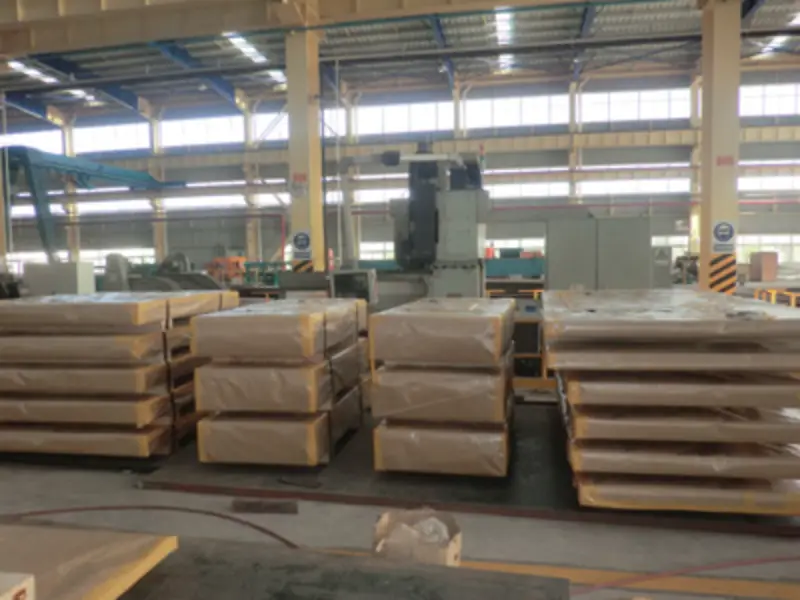
GL Grade F40 Shipbuilding Steel Plate
GL Grade F40 Shipbuilding Steel Plate - Properties, Equivalents & Applications
Detailed material data for GL Grade F40 high-strength shipbuilding steel plate, including chemical composition, mechanical and physical properties, international equivalents, and application guidelines.
Hot rolling plus normalizing (N) or thermomechanical controlled rolling (TMCP / M)
- Phone : +8618037372205
- Email : [email protected]
- WhatsApp: Contact via Whtsapp
- WeChat: +8618037372205
GL Grade F40 Shipbuilding Steel Plate Introduction
GL Grade F40 is a high-strength hull structural steel plate specified by Germanischer Lloyd (now DNV GL) for ship and offshore constructions. It features a minimum yield strength of 390 MPa, excellent weldability and outstanding notch toughness at extremely low temperatures (down to -60 °C). Controlled rolling (TMCP) or normalizing ensures fine-grained microstructure and consistent mechanical properties. This steel is widely utilized for critical structural parts in severe cold-climate maritime environments, providing high safety margins against brittle fracture.
GL Grade F40 Shipbuilding Steel Plate Chemical Composition
The following table represents the typical ladle analysis limits for GL F40 steel plates as per GL rules and IACS UR W11. Micro-alloying elements such as Nb, V, Ti may be added singly or in combination to achieve the required strength and toughness.
- Carbon equivalent (CEV) is usually limited to ensure good weldability.
- Full killed and fine grain treated with adequate aluminium content.
| Element | Standard Value (max, %) | Remarks |
|---|---|---|
| C (Carbon) | ≤ 0.18 | Ladle analysis |
| Mn (Manganese) | 0.90 – 1.60 | Depending on thickness and CEV limits |
| Si (Silicon) | ≤ 0.50 | |
| P (Phosphorus) | ≤ 0.025 | |
| S (Sulfur) | ≤ 0.025 | |
| Al (Aluminium, total) | ≥ 0.015 | Acid soluble Al; value may be higher for fine grain practice |
| Nb (Niobium) | ≤ 0.05 | Optional micro-alloying element |
| V (Vanadium) | ≤ 0.10 | Optional micro-alloying element |
| Ti (Titanium) | ≤ 0.02 | Optional micro-alloying element |
| Ni (Nickel) | ≤ 0.80 | Residual (may be higher for thick plates) |
| Cr (Chromium) | ≤ 0.25 | Residual |
| Mo (Molybdenum) | ≤ 0.08 | Residual |
| Cu (Copper) | ≤ 0.35 | Residual |
| CEV (Carbon Equivalent) | Typically ≤ 0.40–0.43 | CEV = C+Mn/6+(Cr+Mo+V)/5+(Ni+Cu)/15; exact limits per thickness and GL rules |
GL Grade F40 Shipbuilding Steel Plate Thermal and Electrical Physical Properties
These physical properties are not part of the classification rule requirements but represent typical values for low-alloyed structural steel of this grade at room temperature. They are intended for design calculations where applicable. Variations may occur depending on exact composition and heat treatment.
| Property | Typical Value | Unit | Test Condition / Remarks |
|---|---|---|---|
| Density (ρ) | 7.85 | g/cm³ | At 20 °C |
| Elastic modulus (E) | 205 | GPa | At 20 °C |
| Shear modulus (G) | 80 | GPa | At 20 °C, calculated from E and Poisson's ratio |
| Poisson's ratio (ν) | 0.3 | – | At 20 °C, for elastic range |
| Thermal expansion coefficient (α) | 11.5 × 10⁻⁶ | K⁻¹ | For temperature range 20 – 100 °C |
| Thermal expansion coefficient (α) | 12.0 × 10⁻⁶ | K⁻¹ | For temperature range 20 – 200 °C |
| Thermal expansion coefficient (α) | 13.0 × 10⁻⁶ | K⁻¹ | For temperature range 20 – 400 °C |
| Thermal conductivity (λ) | 50 | W/(m·K) | At 20 °C; typical for low-alloy steel |
| Thermal conductivity (λ) | 45 | W/(m·K) | At 100 °C |
| Specific heat capacity (Cp) | 460 | J/(kg·K) | At 20 °C; approximate value |
| Electrical resistivity (ρ_e) | 0.20 – 0.25 × 10⁻⁶ | Ω·m | At 20 °C |
GL Grade F40 Shipbuilding Steel Plate Mechanical Properties
Mechanical properties are specified for plates in as-delivered condition (+N or +M). Yield strength and tensile strength depend on plate thickness. Impact test requirements are for longitudinal specimens at the specified temperature; transverse values may be agreed separately. Bend test is carried out over an appropriate former diameter to ensure ductility.
| Property | Standard Requirement | Unit | Test Condition / Remarks |
|---|---|---|---|
| Yield strength (ReH) | ≥ 390 | MPa | Thickness ≤ 50 mm |
| Yield strength (ReH) | ≥ 370 | MPa | Thickness > 50 mm ≤ 70 mm |
| Yield strength (ReH) | ≥ 350 | MPa | Thickness > 70 mm ≤ 100 mm |
| Tensile strength (Rm) | 510 – 660 | MPa | Valid for all thicknesses |
| Elongation (A5) | ≥ 20 | % | Gauge length 5.65√So; min. value for thickness ≤ 50 mm |
| Elongation (A5) | ≥ 19 | % | Thickness > 50 mm ≤ 70 mm |
| Elongation (A5) | ≥ 18 | % | Thickness > 70 mm ≤ 100 mm |
| Charpy V-notch impact (KV) | ≥ 34 (longitudinal) | J | Test temperature -60 °C; average of 3 specimens, single min. 24 J |
| Charpy V-notch impact (KV) | ≥ 24 (longitudinal) | J | Individual minimum value at -60 °C |
| Bend test (180°) | No cracks or defects | – | Bend former diameter: 3t (t = plate thickness) for Rm ≤ 600 MPa; thicker formers may apply |
GL Grade F40 Shipbuilding Steel Plate Completely Equivalent Material Standards and Substitutable Grades
| Country / Region | Standard | Grade / Designation | Remarks |
|---|---|---|---|
| Germany / International (GL merged with DNV) | DNV GL Rules for Ships / IACS UR W11 | VL F40 (formerly GL F40) | Direct successor; identical requirements |
| USA | ABS Rules for Building and Classing Steel Vessels | ABS FH40 | Same strength and -60 °C impact |
| France | BV Rules for the Classification of Steel Ships | BV FH40 | Identical to IACS FH40 |
| China | CCS Rules for Materials and Welding | CCS FH40 | Equivalent in strength and toughness |
| Norway | DNV Rules for Ships | DNV FH40 | Same as GL F40 after merger |
| South Korea | KR Rules for the Classification of Steel Ships | KR FH40 | FH40 grade |
| United Kingdom | LR Rules for the Manufacture, Testing and Certification of Materials | LR FH40 | Lloyd's Register FH40 |
| Japan | NK Rules for the Survey and Construction of Steel Ships | NK FH40 | Nippon Kaiji Kyokai FH40 |
| Italy | RINA Rules for the Classification of Ships | RINA FH40 | Registro Italiano Navale FH40 |
GL Grade F40 Shipbuilding Steel Plate Application Introduction
GL F40 steel plate is specifically designed for welded marine structures operating at sub-zero conditions. Its high strength and superior notch toughness at -60 °C make it suitable for critical parts in ice-going vessels and arctic offshore installations. Key application areas include:
- Hull envelopes and stiffening members of LNG carriers and icebreakers.
- Deck structures and crane pedestals on heavy-lift vessels.
- Highly stressed nodes and braces in offshore platforms.
- Structural modules exposed to polar environments.
Product Applications: Ocean-going ships (ice breakers, tankers, bulk carriers, container ships), Floating production storage and offloading (FPSO) units, Offshore platforms (jackets, topsides), Crane barges and heavy-lift vessels, Submarine pressure hulls (special approvals), Arctic bridges and port structures
Processed into products: Main deck plating and sheer strakes, Bottom and side shell plates in ice-strengthened zones, Bilge keels and skegs, Hatch coamings and corner reinforcements, Bracket plates and web frames, Pedestal stools for heavy equipment, Longitudinal stiffeners and girders, Breast hooks and stem plates
Application industries: Shipbuilding (naval and commercial, especially ice-class vessels), Offshore oil and gas (jack-ups, semi-submersibles, FPSO modules), Arctic engineering (ports, bridges, ice-resistant structures), Heavy civil construction (locks, dams, bridge girders in cold climates), Wind energy (transition pieces and substructures for offshore wind turbines in cold seas)
GL Grade F40 Shipbuilding Steel Plate Similar or Closely Related Substitute Materials
| Country / Region | Standard | Grade | Remarks |
|---|---|---|---|
| IACS | UR W11 | AH40, DH40, EH40 | Same strength level (min 390 MPa yield) but less stringent impact temperatures: AH40 (0 °C), DH40 (-20 °C), EH40 (-40 °C). Suitable when lower low-temperature toughness is acceptable. |
| EN (Europe) | EN 10025-4 | S420M/ML (thermomechanical) | Higher yield strength (420 MPa), comparable toughness; may replace GL F40 after engineering assessment for thicker sections. |
| ASTM (USA) | ASTM A131/A131M | FH40 | ASTM shipbuilding standard, identical to IACS FH40, equivalent to GL F40. |
| Various | GL / IACS | VL A40, VL D40, VL E40 | Former GL grades with lower toughness guarantees; strength identical, temperature performance lower. |
Notes:
Certification: All plates must be supplied with a GL (or DNV GL) certificate after survey and testing. Welding: Welding consumables should be selected to match the strength and toughness requirements; preheating may be required for thick sections. Further processing: Hot and cold forming can be performed, but caution should be exercised with cold forming strains (>3% strain may require re‑normalizing). Thickness range: Generally available from 6 mm to 100 mm. Impact test temperature: Although F40 specifies -60 °C, lower temperature testing can be agreed upon for special applications. CEV restrictions: CEV limits depend on thickness and welding procedures; typically ≤ 0.40 for thickness ≤ 50 mm, ≤ 0.43 for thicker plates.
- Share



